
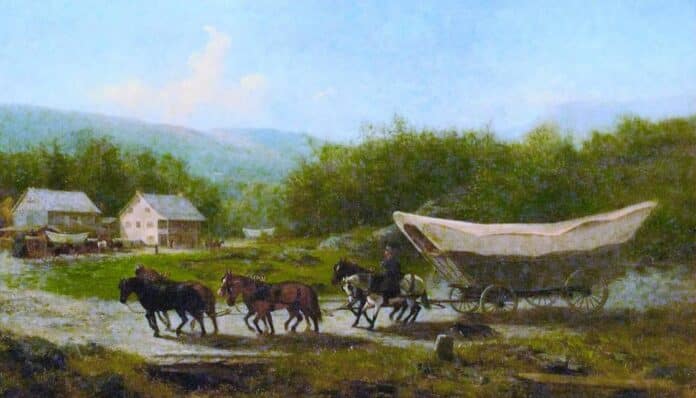
Americans keep to the right side of the road because of a freight wagon first built in Pennsylvania around 1750. The Conestoga wagon had no front seat, and the way its drivers sat pushed traffic to the right long before any law required it.
Americans and Brits have always agreed on one thing about driving, which is that the other side has it backward. So how did a former British colony end up on the opposite side of the road from Britain?
Left or right around the world
Only about a third of the world’s countries drive on the left today. Britain is one of them, along with many of its former colonies, including Australia, India, Pakistan, Jamaica and South Africa.
The United States broke from that colonial pattern. The reasons go back well before the automobile, to horse drawn buggies, a toppled French king and one very particular 18th century wagon.
Why Britain stays left
The British habit of keeping left is older than cars, and historians do not agree on exactly where it came from. The explanation heard most often involves swords.
Highway robbery was a real danger in medieval times. Most riders were right handed, so passing an oncoming stranger on the left kept the sword arm free in case the stranger turned out to be hostile.
For most of the Middle Ages, though, people simply rode down the middle of the road or along whichever side was in better shape, since traffic was light. Rules only became necessary once cities grew crowded.
Britain’s first attempt came in 1756, when traffic crossing London Bridge was officially told to keep left. Other towns, some in Scotland among them, passed similar rules, and the Highway Act of 1835 finally made driving on the left the law on every road in Britain.
How France switched to the right
Across the Channel, things went the other way. Before the French Revolution of 1789, custom gave the left side of the road to aristocrats in their carriages and pushed everyone else to the right, a visible mark of class.
That order collapsed after revolutionaries executed King Louis XVI in 1793. Nobles began walking and riding on the right like everyone else. That may have been a gesture of solidarity, but it was more likely a simple way to avoid catching the eye of the newly powerful common people.
France then made the right side standard. Napoleon Bonaparte carried the rule into many of the lands his armies conquered, which largely explains why the Netherlands, Russia, Poland and Germany drive on the right. Napoleon never conquered Britain, so the British kept to the left and spread that habit across their empire and into the age of the car.
Also read: The First Coast-to-Coast Drive in 1903 Began With a $50 Bet and Took 63 Days
Test yourself
How much have you picked up so far?
3 quick questions on what you have read so far. The story continues below.
The wagon that settled it in America
Colonial Americans were already doing things their own way. Historian Albert C. Rose concluded that "all available evidence seems to indicate that the right-hand travel predominated in colonial America from the time of the earliest settlements."
The preference had little to do with European custom. It came from how Americans moved overland, and above all from the wagons used to push west.
Historians usually single out the Conestoga wagon. Built in Pennsylvania from around 1750, it was a big, heavy freight wagon pulled by four to eight horses, sturdier than most covered wagons of the day, and it soon became the main way to haul both goods and people over land.
Why the driver sat on the left
The Conestoga had no driver's seat at the front. The driver either rode the nearest horse on the left side, a style called postillion, or perched on a plank on the wagon's left side known as a "lazy board."
Either way, the driver stayed on the left. That let him hold the reins in his left hand and the whip in his right, and reach the brake lever fixed to the wagon's left side.
Sitting on the left, it made more sense to keep the wagon itself on the right side of the road. The driver could see the road ahead more clearly and judge the room he needed to pass oncoming wagons.
From habit to law
By the late 1700s Conestoga wagons were so common that keeping right had become the unwritten rule across much of colonial America, with no law behind it at all. Carriages, carts and lone riders fell into the same habit, especially when passing traffic coming the other way.
As roads around big towns filled up, states began writing down what wagon drivers were already doing:
- Pennsylvania led in 1792 with a keep right rule on its turnpike
- New York followed in 1804, the first state to require right hand travel on every public highway
- New Jersey adopted a rule in 1813 and Massachusetts in 1821
By the Civil War, every state followed right hand travel, whether by law or by long settled habit.
Colonial Americans could easily have kept the British custom, or chosen the right as a salute to their revolutionary allies in France. In the end it was the Conestoga wagon that steered the country to the right side of the road, or the wrong side, if you ask the British.
Also read: Florida's Overseas Highway Crosses 42 Bridges, and 11 More Roads Worth the Drive
Based on reporting by History Facts
By Trivia News Staff | Geography