
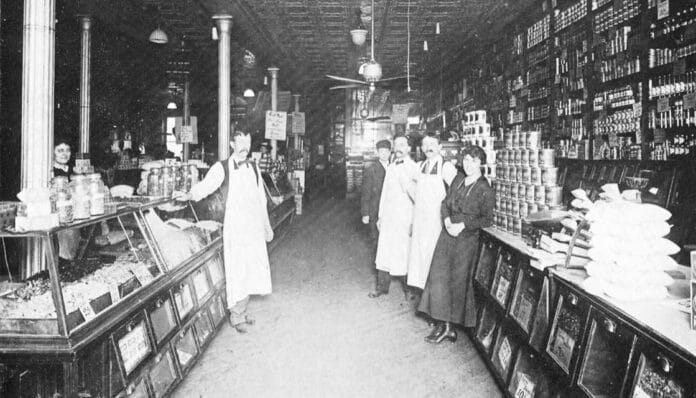
A dozen eggs in Chicago cost 87 cents in December 1920. Adjusted for inflation, that is about $15.11 in 2026 dollars, the most Americans have ever paid for eggs.
Grocery bills have climbed sharply since the COVID-19 pandemic began in 2020, yet shoppers today still hand over a far smaller share of their pay for food than earlier generations did. In 1901 the typical American family put more than 40% of its budget toward food, while in 2021 Americans spent 10% of their disposable income on it, helped by higher wages and cheaper processed food.
The worst moments came in 1920 and the 1970s, when war, shortages and runaway inflation sent everyday staples soaring. Here are five foods that once cost a small fortune.
Eggs: about $15 a dozen in 1920
A century ago, eggs were not the cheap protein they are now. Unless you kept your own hens, they were something of a luxury. They only became affordable in the middle of the 20th century, once farmers moved laying hens indoors and used artificial light to stretch the laying season.
“Not only were eggs more expensive in real dollars in the past, but people would have spent a larger share of their income on food, because they earned less,” says Carola Binder, an economic historian at the University of Texas at Austin.
The peak arrived in 1920, which was also the worst year for inflation in American history. Consumer prices jumped 23.7% between June 1919 and June 1920, the biggest 12 month rise the Consumer Price Index has ever recorded. The cause was World War I, which had pulled resources away from civilian life and left shortages behind.
Before poultry farms had electric lighting, egg prices also swung with the seasons. Hens laid the most in spring, so eggs were cheapest then and dearest in winter, which is why the Bureau of Labor Statistics recorded that December 1920 price in Chicago.
For comparison, the priciest eggs of modern times cost $6.32 a dozen in March 2025, during an outbreak of highly pathogenic avian influenza. By September 2026 the average had fallen to $2.27, more than six times less than in 1920.
Milk: $12.57 a gallon in 1920
Milk followed the same path after World War I. In 1916, before America joined the war, a gallon averaged 36 cents, which was already expensive. By 1920 inflation had doubled that to 72 cents, worth $12.57 in 2026 dollars.
Milk spiked again in the early 1970s. Because it has to be trucked from farm to store, it was hit hard by the energy costs of the 1973 and 1974 oil embargoes, and a surprise milk shortage arrived at the same moment.
In 1973 a quart of milk in New York City averaged 35 cents. That works out to $1.40 a gallon, or $10.44 in 2026 dollars. In October 2026, the U.S. Department of Agriculture put the average price of a gallon of conventional whole milk at $3.88.
Test yourself
How much have you picked up so far?
3 quick questions on what you have read so far. The story continues below.
Bread: $2.91 a loaf in 1975
The 1970s were rough on the grocery budget for more than one reason. Oil shocks and the energy crisis were joined by bad weather and world politics, and one deal with the Soviet Union pushed white bread up by about 50%.
It began when Soviet wheat farms in Russia and Ukraine were ruined by a hard winter frost and then a scorching, dry summer. In 1972 Soviet buyers negotiated with American exporters and agreed to buy 10 million tons of U.S. grain, at a generous price that the American government subsidized.
Also read: A Movie Ticket Cost 46 Cents and Mortgages Ran 2.5% in 1950s America
Only afterward did officials in Washington grasp that the wheat shortage was worldwide, not just Soviet. With so much of the American harvest already promised abroad, food prices jumped, and the sale earned the nickname "The Great Grain Robbery."
Shoppers felt it at the bread shelf:
- In 1970, a pound of white bread averaged 24 cents.
- By 1975, the same pound cost 36 cents, a 50% increase.
- A standard 1.25 pound loaf therefore cost 45 cents in 1975, or $2.91 in 2026 dollars.
- In September 2026, a 1 pound loaf averaged $1.83, up from $1.26 in March 2019.
Ground beef: $8.75 a pound in 1951
Ground beef averaged $6.79 a pound in 2026, close to double its 2020 price, largely because long droughts shrank American cattle herds. Even so, Americans have paid more.
After World War II, wartime price controls ended and millions of returning GIs set out to start families and buy homes and goods. Prices rose 20.1% between March 1946 and March 1947 alone. That inflation was only beginning to ease when the Korean War started in June 1950.
Food prices climbed again in 1951, and the government brought back price controls as it had in World War II. They were far less popular this time. "During the Korean War, the price controls were a lot less popular, because people didn't all universally support the war effort," Binder says. "When beef prices rose, consumers got really upset, and it made the whole price control system lose a lot of public support."
In March 1951 ground beef averaged 67 cents a pound, which is $8.75 in 2026 dollars. Round steak, a lean and tough cut that sold for $9.84 a pound in September 2026, topped out at the equivalent of $14.24 a pound in January 1952.
Chicken: $8.60 a pound in 1950
Americans now eat more than 100 pounds of chicken per person every year, partly because it is usually the cheapest meat in the store. A whole broiler averaged $2.06 a pound in 2026, a third of the price of ground beef.
That was not always so. Before factory farming and modern breeding, chicken was a fairly costly meat. Young birds sold for 50 cents a pound in the early 1900s, roughly $20 to $30 a pound in 2026 money.
Back then farmers kept hens mainly for eggs and only killed them for meat once they stopped laying, and older birds tend to be tough and gamey. Raising young, tender "broilers" purely for meat only began in the 1920s, and the market took off in the 1950s, when Americans ate about 20 pounds of chicken a head each year.
The most expensive year of the broiler era was 1950, with postwar food prices still high. A whole fresh chicken cost 60 cents a pound, equal to $8.60 in 2026 dollars and more than four times what the same bird cost in 2026.
Also read: Sears Ran More Than 700 Stores by the 1950s, Then the Department Store Lost Its Crown
Based on reporting by History.com
By Trivia News Staff | History