
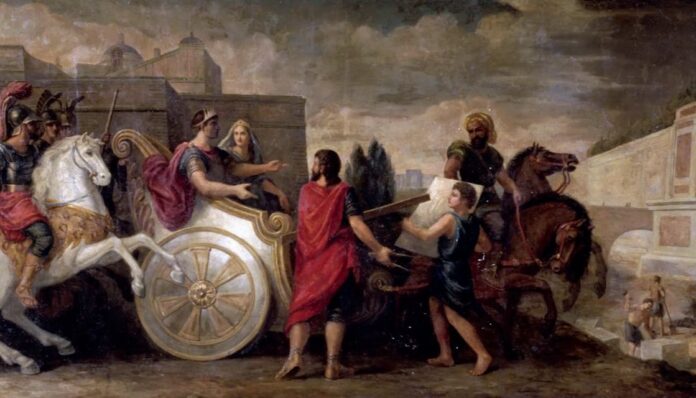
Of the Seven Wonders of the Ancient World, only the Pyramids of Giza still stand. The rest crumbled long ago, yet visitors can still walk among the ruins of most of them.
The Hanging Gardens of Babylon are the exception. After more than a century of digging, archaeologists have not found a single trace of them, and some scholars now think the gardens were real but stood in a different city altogether.
A gift for a homesick queen
The best known version of the story credits King Nebuchadnezzar II, who ruled the Neo-Babylonian Empire from 603 to 562 B.C.E. He is the same king who sacked Jerusalem and carried the Israelites into captivity.
His wife, Princess Amytis, came from Media, an ancient Persian kingdom of forests and mountains. The flat, sunbaked plains of Mesopotamia depressed her, so the king is said to have built her an artificial mountain of brick and stone planted with hundreds of trees, an oasis in the desert.
A rival legend gives the credit to Queen Semiramis, a half legendary ruler said to have led the Assyrian Empire in the late 9th century B.C.E. That is why some sources call them the Hanging Gardens of Semiramis.
Seven writers, all centuries late
Everything we know about the gardens comes from seven ancient historians, and every one of them wrote centuries after the gardens were supposedly built. The oldest and most trusted was Berossus of Kos, a priest of the Babylonian god Marduk, who wrote a guide to Mesopotamia called Babyloniaca in 280 B.C.E.
His original text is lost. It survives only in quotations by later authors such as Josephus, the Roman Jewish historian of the 1st century C.E., who described stone terraces shaped like mountains and planted with every kind of tree because the king’s wife missed the scenery of her homeland.
Two words from those accounts have interesting histories:
- Paradise is thought to come from the walled gardens of the region, through the old Persian pairi-daeza, meaning to build a walled enclosure.
- Hanging translates the Greek kremastos, once read as gardens literally suspended on ropes. Scholars now take it to mean overhanging, describing terraces that stepped up one above another.
What the gardens supposedly looked like
The Greek historian Diodorus Siculus, writing in the 1st century, said the gardens rose in tiers like a theater, supported on galleries, with the highest level reaching 50 cubits and sitting level with the city walls. He put the walls at 22 feet thick.
Converting his units gives a sense of scale. The Mesopotamian cubit of the time was about 533 millimeters, and by his figures the gardens ran about 120 meters on each side, roughly 3.5 acres.
Diodorus also described how the terraces were sealed. Layers of reeds set in bitumen, two courses of baked brick and a sheet of lead kept water from soaking through, with soil piled on top deep enough for large trees.
That waterproofing mattered. Stone was scarce in Mesopotamia, so most buildings used sun dried mud brick, which could survive the region’s rare rain but would have dissolved under the steady watering a huge garden needed. The gardens were probably among the few structures in Babylon built with big stone slabs, a useful clue for anyone searching for them.
Also read: Venus de Milo’s Missing Arms and 8 Other Mysteries Behind Famous Statues
Test yourself
How much have you picked up so far?
3 quick questions on what you have read so far. The story continues below.
The mystery machines
Diodorus mentioned hidden "machines" that lifted water from the river. Archaeologists have long suspected an Archimedean screw, a spiral inside a tube that raises water as it turns.
Screws like that were thought to date from the 3rd century B.C.E. But a cuneiform tablet from the reign of the Assyrian king Sennacherib, who ruled from 704 to 681 B.C.E., seems to describe casting them in bronze, which would push the invention back 500 years. Another candidate is the noria, a bucket wheel turned by oxen or donkeys, though its earliest recorded use is from the 1st century B.C.E.
The Roman writer Strabo backed up those dimensions and described screws carrying water up from the Euphrates. Philo of Byzantium, a Greek scientist writing in 250 B.C.E., added palm trunk beams and streams forced upward through spirals.
Babylon's own records are silent
For all those lavish Greek and Roman descriptions, no surviving Babylonian record mentions the gardens. That is odd, because Mesopotamian kings loved listing their achievements.
A set of clay tablets known as the Topography of Babylon describes Nebuchadnezzar's capital in great detail, down to the names of individual streets, and nothing like a giant garden appears in it. Grand gardens were not unusual in the region either: Tiglath Pileser built one at Nineveh in the 12th century B.C.E., and others followed at Nimrud and Babylon.
The dig that came up empty
Babylon's ruins, about 80 kilometers south of modern Baghdad, lay unexplored until 1899, when the German archaeologist Robert Koldewey began excavating. Over 14 years he uncovered the city walls, the Ishtar Gate and the ziggurat of Marduk, a temple some link to the Tower of Babel.
In the southern citadel he found a basement of 14 stone vaulted rooms with strange holes in the floor and decided he had found the gardens. Later archaeologists disagreed. The site was too far from the Euphrates to water easily, and tablets found there pointed to a storehouse and administrative building.
Several explanations remain. The gardens may have been invented by Greek and Roman writers, destroyed by an earthquake in the 2nd century B.C.E., or simply not found yet, since only a small part of the 8.5 square kilometre site has been fully excavated. The Euphrates has also shifted west since Nebuchadnezzar's day, so any ruins could lie under the river. They may also have been lost in 1987, when Saddam Hussein bulldozed large parts of ancient Babylon to build a reconstruction on the site.
The Nineveh theory
In 2013 the Oxford University scholar Stephanie Dalley argued that key ancient texts had been mistranslated. In her reading, the famous accounts describe earlier gardens at Nineveh, 480 kilometers from Babylon, built by Sennacherib between 704 and 681 B.C.E.
Those gardens are well documented in carvings on the walls of his palace. The remains of the Jerwan aqueduct, which carried water 50 kilometers from the mountains to Nineveh, still bear an inscription in which Sennacherib boasts of bringing water across steep valleys on white limestone blocks.
The theory explains several puzzles. Only Josephus, drawing on Berossus, names Nebuchadnezzar as the builder; the other writers mention an unnamed "Syrian King." Alexander the Great's army camped for four days near the Jerwan aqueduct before the Battle of Gaugamela in 331 B.C.E., giving his scholars time to see the site, and their notes may later have been credited to Babylon.
Language may have helped the mix up. The name Babylon is said to mean "Gate of the Gods" and was applied to several Mesopotamian cities, so Nineveh may have been a Babylon without being the one the Greeks knew. The theory also fits the silence of Herodotus, the 5th century B.C.E. Greek historian who may have visited Babylon and never mentions the gardens, though his account of Giza leaves out the Great Sphinx too.
A mystery that may never be solved
The Nineveh idea is one explanation among several, and settling it would take hard archaeological evidence that is increasingly difficult to gather in Iraq. In 2016 the militant group ISIL destroyed Nineveh's Maskhi Gate and hundreds of artifacts in the nearby Mosul Museum.
That a structure this grand could vanish so completely is a reminder of how fragile the ancient past is, and of how much of it may already be gone for good.
Also read: Salmonella Is a New Suspect in the 430 BC Plague That Killed Up to a Third of Athens
Based on reporting by Today I Found Out
By Trivia News Staff | Landmarks