
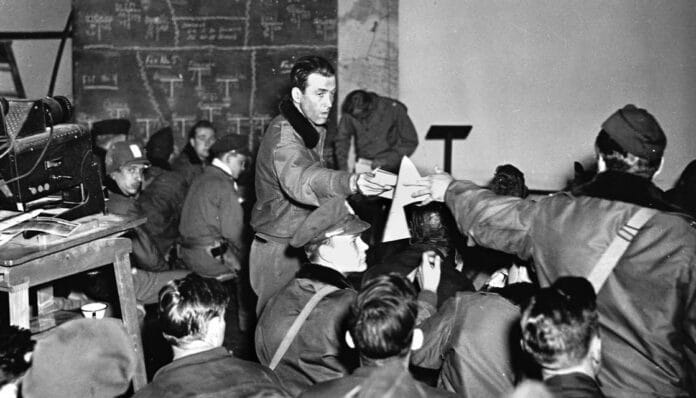
Jimmy Stewart had just won an Oscar when he walked away from Hollywood to join the U.S. Army Air Forces. Over the next two years he flew 20 combat missions over France and Germany as a bomber pilot.
He never really left the military after that. Stewart served 27 years in uniform and retired in 1968 as a brigadier general, which makes him the highest ranking actor in American military history.
A small town boy who loved airplanes
James Maitland Stewart grew up in Indiana, Pennsylvania, and aviation hooked him early. He spent his boyhood building model airplanes, and Charles Lindbergh’s solo flight across the Atlantic in 1927 thrilled him.
He went to Princeton University in 1928 and earned a degree in architecture. Acting turned out to be the thing he loved most, though, and in 1932, the year he graduated, he made his Broadway debut in a play called Carry Nation.
A talent scout who caught him on stage got him a contract with MGM in 1935. His first supporting role came that year in The Murder Man, and You Can’t Take It with You gave him his breakthrough in 1938.
From Oscar night to the draft board
The role that made Stewart a star was Jefferson Smith in Mr. Smith Goes to Washington in 1939. Two years later he won the Academy Award for Best Actor for The Philadelphia Story, accepting it on February 27, 1941.
Less than a month later, on March 22, he enlisted. Getting in had not been simple. When he first faced the draft board in February 1941, he weighed five pounds less than the minimum, so he put the weight on and reported for duty in March.
He already held a commercial pilot’s license, which led him to apply for a commission in the Air Corps. He became a second lieutenant on January 1, 1942.
Kept out of combat, then sent to Europe
For more than a year, Stewart was stuck training pilots at a base in Albuquerque. The government reportedly feared that losing a movie star in battle would hurt the morale of both the troops and the public, so it kept him away from the fighting.
Stewart did not think his fame should shape his service, and he took the matter to his commander. In November 1943 he finally shipped out to Europe with the 703rd Bombardment Squadron.
His record over the next two years included:
- 20 combat missions flown over France and Germany
- the Distinguished Flying Cross
- the French Croix de Guerre avec Palme
- a climb from private to colonel by 1945, an unusually fast rise
He was the first major movie star to enter the armed forces during the war, and at 32 he was older than most of the men around him.
Test yourself
How much have you picked up so far?
3 quick questions on what you have read so far. The story continues below.
A shell in the wheel well
Stewart seldom talked about what he went through, but a few stories have survived. According to the George C. Marshall Foundation, an anti-aircraft shell exploded in the wheel well of his plane in 1944 and tore a large hole in the floor.
The bomber broke in two when it landed. Stewart is said to have climbed out and told a sergeant, "Sergeant, somebody sure could get hurt in one of these damned things."
His diaries show the other side of it. The National Guard Association of the United States quotes an entry written after a successful mission, in which he said it felt awful for everyone to be laughing and singing a day after so many men had been lost, adding, "I guess that's the way things are in this dirty, stinking war."
He made no feature films during the war. His only screen work in those years was a short propaganda film, Winning Your Wings, which urged young men to sign up for the Army Air Forces.
Twenty more years in the reserve
The war ended on September 2, 1945, but Stewart's service did not. He came home that fall, moved into the Air Force Reserve, and went back on active duty several more times over the following decades.
He was promoted to brigadier general in 1959. He flew his last mission during the Vietnam War and retired from the Air Force in 1968, 27 years after he first enlisted.
Also read: Arlington's Tomb of the Unknown Soldier Has Been Guarded Around the Clock Since 1937
It's a Wonderful Life, and the films that followed
When he first got back from Europe, Stewart was not sure he wanted to act again. He thought about going home to Pennsylvania to run his family's hardware store.
Then Frank Capra asked him to star in It's a Wonderful Life. The film did not do especially well on its release in 1946, yet it is now one of the best loved holiday movies ever made.
In the 1950s his career went higher still. He made four films with Alfred Hitchcock, Vertigo and Rear Window among them, and earned another Oscar nomination for Anatomy of a Murder. He kept working through the 1960s and 1970s, then made only four films after 1980.
A national treasure
After his wife Gloria died in 1994, Stewart withdrew from public life. He died of a heart attack on July 2, 1997, at the age of 89.
His acting career ran 56 years, broken only by the four years of the war, and his service is still counted among his greatest achievements. A 2026 film called Jimmy tells the story of his time as a combat pilot and how it shaped the rest of his life.
When he died, President Bill Clinton called him "a national treasure" and wrote that Stewart was "a great actor, a gentleman, and a patriot."
Also read: Veterans Day Began as Armistice Day in 1919, and How It Differs From Memorial Day
Based on reporting by All That's Interesting
By Trivia News Staff | History