
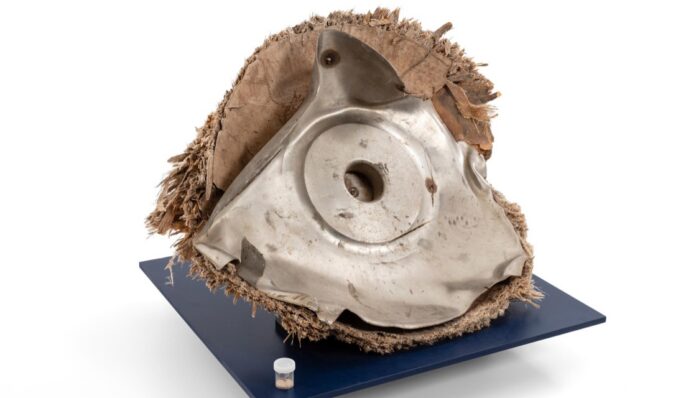
When America’s first space station came down in 1979, pieces landed across Western Australia, and the local shire sent NASA a $400 fine for littering. It went unpaid for 30 years.
Thousands of dead satellites, spent rocket stages and broken spacecraft fragments are circling Earth right now. Most of what falls burns up as a brief fireball, but bigger objects sometimes survive the trip, and a few have landed in places nobody expected. These are 10 of the most dramatic returns.
10. Kosmos 1402, 1983
The Soviet radar satellite Kosmos 1402 ended its mission in late 1982. Its nuclear reactor was meant to detach and climb into a high, long lasting disposal orbit, but the separation failed and the satellite split into three objects.
The main body fell on January 23, 1983, and the reactor section followed on February 7 over the South Atlantic. Soviet officials said there was no danger, yet researchers later found radioactive strontium in rainwater collected in Arkansas between February and June 1983 and concluded the fresh debris most likely came from that reactor.
9. Salyut 7, 1991
The Soviet station Salyut 7 had been empty since its last crew left in 1986. A docked module’s engines raised its orbit by about 84 miles while a possible space shuttle retrieval was considered.
Strong solar activity then heated and expanded the upper atmosphere, increasing drag. On February 7, 1991, the combined station, about 88,000 pounds, fell uncontrolled, overshot its South Pacific target and crossed Argentina as a bright fireball. Pieces were found near Capitán Bermúdez, and no one was hurt.
8. A Delta II stage over Texas and Oklahoma, 1997
Early on January 22, 1997, the second stage of a Delta II rocket that had launched an Air Force satellite from California in April 1996 came back down. It broke apart about 48 miles above Kansas and spread debris over Oklahoma and Texas.
A stainless steel fuel tank of about 551 pounds landed just 165 feet from a farmhouse near Georgetown, Texas. In a Tulsa park at about 3:30 a.m., Lottie Williams saw a fireball cross the sky and minutes later felt something tap her shoulder, a blackened scrap of woven fiberglass about six inches long. It matched insulation from that kind of stage, though it was never tied to the exact rocket, and she is widely described as the only person known to have been hit by space debris. She was not hurt.
Test yourself
How much have you picked up so far?
3 quick questions on what you have read so far. The story continues below.
7. Long March 5B over Côte d'Ivoire, 2020
China launched its powerful Long March 5B on May 5, 2020, and left the huge core stage in orbit with no plan to steer it down. At nearly 44,000 pounds, it was among the largest objects to fall uncontrolled in decades.
It broke up over the Atlantic and Africa on May 11. Debris, including a large pipe shaped piece, turned up near the village of Mahounou, and local reports described damaged homes and a cheesemaker's building, but no casualties. NASA administrator Jim Bridenstine called the reentry dangerous and noted it could have come down over New York had it fallen a little earlier.
6. Long March 5B over Borneo, 2022
Two years later another core stage did the same thing. It carried the Wentian lab module to China's Tiangong station on July 24, 2022, then stayed in orbit with no way to guide itself home.
The roughly 48,500 pound stage fell on July 30 UTC and broke apart over the Indian Ocean. Witnesses in Kuching, on Borneo, filmed the fragments and at first thought they were seeing a meteor shower, and Philippine authorities reported pieces landing in the Sulu Sea near Palawan.
5. Tiangong-1, 2018
China's first space station launched in 2011 for a planned two years and kept working until controllers lost contact in March 2016. With no way to bring it down deliberately, the 18,700 pound station began a slow fall that turned into a worldwide guessing game.
It reentered on April 2, 2018, Beijing time, over the central South Pacific. Most of it burned up, and no fragments were ever recovered.
4. A SpaceX trunk in a sheep paddock, 2022
On July 9, 2022, a loud sonic boom shook Australia's Snowy Mountains. The likely cause was the discarded trunk of SpaceX's Crew-1 Dragon, dropped before the capsule came home in May 2021.
Large pieces landed on farmland around Dalgety, New South Wales. Sheep farmer Mick Miners found a charred object almost 10 feet tall in his paddock on July 25, after neighbor Jock Wallace had found another. Astrophysicist Brad Tucker linked the debris to SpaceX, and the Australian Space Agency confirmed it.
3. A battery pallet that hit a Florida home, 2024
In March 2021 the International Space Station released a pallet holding about 5,800 pounds of old nickel hydride batteries, the heaviest piece of trash it had ever thrown overboard. Engineers expected it to burn up completely when it fell on March 8, 2024.
It did not. A 1.6 pound stanchion made of heat resistant Inconel survived and struck a house in Naples, Florida. NASA confirmed in April 2024 that the piece came from the pallet and said it would study why its models had missed it.
2. Skylab, 1979
Skylab was brought down early by the sun. Unexpectedly strong solar activity swelled the atmosphere and dragged the 170,000 pound station down years ahead of schedule.
NASA could adjust its attitude as it fell and aimed the debris toward the Indian Ocean, but on July 11, 1979, a small error in the breakup calculation pushed the wreckage hundreds of miles east. Here is what followed:
- The Shire of Esperance fined NASA $400 for littering.
- California radio host Scott Barley raised the money from listeners and paid it in 2009.
- Stan Thornton, 17, found pieces on his property and flew to San Francisco to collect a $10,000 newspaper prize.
- A large chunk appeared onstage at the Miss Universe pageant in Perth.
1. Cosmos 954, 1978
The most alarming case began on September 18, 1977, when the Soviet Union launched Cosmos 954, a radar satellite powered by a small nuclear reactor. The reactor was supposed to be ejected into a high orbit at the end of the mission, but the mechanism failed.
On January 24, 1978, the satellite broke up over northern Canada and spread radioactive debris across 47,900 square miles of the Northwest Territories, Alberta and Saskatchewan. Canada and the United States ran a months long search called Operation Morning Light into October, yet Canadian officials estimated only about 0.1% of the power source was ever recovered, and the United Nations later set up a working group to study nuclear powered satellites.
Based on reporting by Listverse
By Trivia News Staff | History