
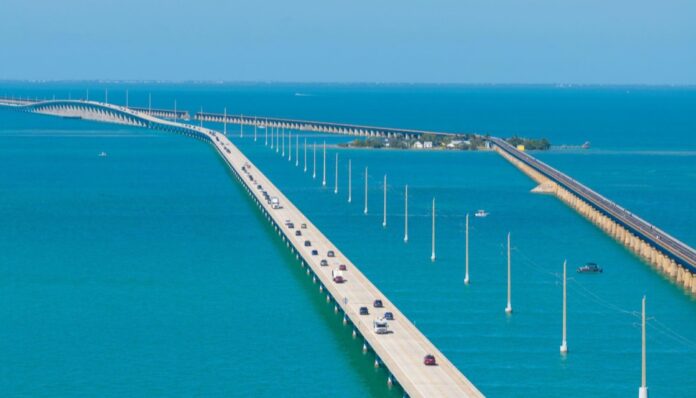
The Overseas Highway runs 113 miles from Key Largo to Key West and crosses 42 bridges over open water, so for long stretches it feels like driving across the sea. It is one of a handful of roads around the world where the journey matters more than the destination.
Some climb through mountains or hug dramatic coastlines, others cross deserts or join regions that once felt worlds apart. Here are 12 of the best known, from America’s Route 66 to the ancient Silk Road.
Route 66, United States
No road is more tied to the American road trip. Route 66 opened in 1926 and ran about 2,400 miles from Chicago to Santa Monica, California, through eight states, passing farmland, small towns, the Great Plains and Southwestern desert, with stops such as the Painted Desert and the Petrified Forest.
Its diners, gas stations, motels and roadside oddities came to stand for freedom and the open road. The highway was officially decommissioned in 1985, but many original stretches and old businesses survive, keeping the Mother Road alive.
Also read: Why Neon Took Over Route 66, and What the Surviving Signs Mean Now
Pacific Coast Highway, California
California’s Highway 1 follows the Pacific from Dana Point in Orange County up to Leggett in Mendocino County. It passes Big Sur, sheer cliffs, beaches and stretches of forest.
The draw is driving with the ocean almost always in sight. Near Big Sur the cliffs drop straight into the water, while Monterey and Carmel-by-the-Sea offer history, food and places to stop.
Amalfi Coast Road, Italy
On Italy’s southern coast, the SS 163 twists along steep slopes for about 25 miles between Vietri sul Mare and Positano. It runs through or near Cetara, Maiori, Amalfi and Praiano, with the Mediterranean far below and pastel houses around every hairpin.
It is not a relaxing drive. The road is narrow, the curves are sharp, and buses and scooters share every inch of it.
Test yourself
How much have you picked up so far?
3 quick questions on what you have read so far. The story continues below.
Great Ocean Road, Australia
This road covers about 151 miles of the Victoria coast, from the surf town of Torquay to Allansford near Warrnambool. Its best known sight is the Twelve Apostles, limestone stacks rising out of the Southern Ocean.
The road also has a story many visitors miss. More than 3,000 returned servicemen built it between 1919 and 1932 as a memorial to those who served in World War I, which makes it Australia's largest war memorial.
Ring Road, Iceland
Route 1, known as the Ring Road, loops about 827 miles around most of Iceland and links Reykjavík, Akureyri and Höfn. Because it is a circle, it has no real start or finish, and drivers can join it in several places.
Depending on the section, travelers pass waterfalls, black sand beaches, glaciers, volcanic ground, fjords and geothermal areas. It is the simplest way to see how much the country's scenery changes without doubling back.
Garden Route, South Africa
The Garden Route covers roughly 185 miles of the southern coast, from Mossel Bay in the Western Cape to Storms River in the Eastern Cape. The Indian Ocean lies on one side and the Outeniqua and Tsitsikamma mountains on the other, with Knysna and Plettenberg Bay along the way.
The area is famous for fynbos, a type of vegetation with thousands of plant species, many found nowhere else. Birds, monkeys and marine life are common, and parts of the region sit inside the Garden Route Biosphere Reserve.
Stelvio Pass, Italy
High in the Alps, the Stelvio Pass reaches 9,055 feet, the highest paved mountain pass in Italy. It links the Valtellina valley with Val Venosta through a famous run of 88 hairpin bends.
Cyclists made it legendary, thanks to its punishing climbs and its place in major races. Drivers and riders still come for one of Europe's most memorable mountain roads.
Overseas Highway, Florida Keys
South of mainland Florida, U.S. Highway 1 becomes the Overseas Highway. Its 113 miles pass Key Largo, Islamorada, Marathon and the Lower Keys before ending in Key West.
The best known stretch is the Seven Mile Bridge, which joins Knight's Key near Marathon to Little Duck Key. With tropical water and open sky on both sides, the drive between islands is the attraction itself.
Also read: The First Coast-to-Coast Drive in 1903 Began With a $50 Bet and Took 63 Days
Karakoram Highway, Pakistan and China
This road runs about 810 miles through some of the highest terrain on Earth and crosses into China's Xinjiang region at the Khunjerab Pass. At 15,466 feet, that pass makes it the highest paved international road in the world.
Building it took about 20 years of cutting through the Karakoram, the Himalayas and the Hindu Kush, partly along the old Silk Road. It is often called the Eighth Wonder of the World.
Transfăgărășan, Romania
The Transfăgărășan crosses Romania's Făgăraș Mountains for more than 93 miles, from near Pitești to the Transylvanian side near Cârțișoara. Tunnels, switchbacks and steep climbs carry it through the Carpathians.
Near its highest point sits Bâlea Lake, a glacial lake at about 2,034 meters, surrounded by alpine meadows, waterfalls and jagged peaks. The road became world famous after the hosts of the BBC show Top Gear raved about its curves.
Atlantic Road, Norway
The Atlantic Road is short, about 22 miles from Kårvåg near Kristiansund to the fishing village of Bud. It hops across small islands and rocky skerries on the northwest coast.
Its signature is a set of seven bridges leaping from island to island with the ocean right beside them. Storms make it especially dramatic, and it appeared in the 2021 James Bond film No Time to Die.
Silk Road, Asia
The Silk Road was never one road but a vast network of trade routes covering more than 21,000 miles, linking China with Central Asia, the Middle East and Europe. Today it survives only in sections, archaeological sites and old cities along the way.
For centuries merchants carried silk, spices and other valuable goods along it. They also carried ideas, and religions, languages, technology and art spread along the same paths. That exchange helped shape the history of Asia, the Middle East and Europe, which is why the network still matters long after the caravans stopped.
Based on reporting by WanderTrivia
By Trivia News Staff | Geography