
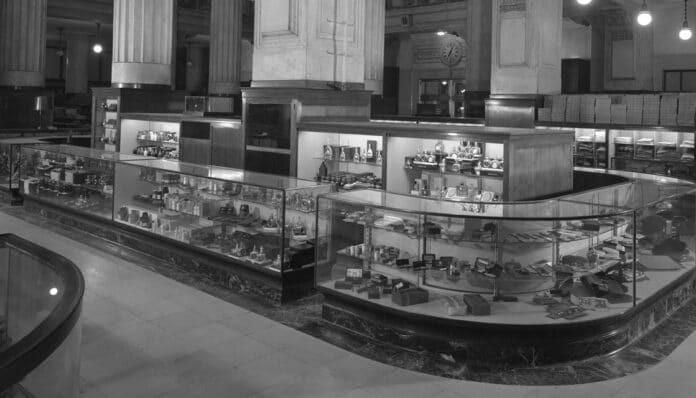
By the mid-1950s Sears had more than 700 stores across the United States, and JCPenney passed 1,700 by 1959. For a generation of shoppers the department store was the center of American retail, and Sears was the biggest name in it until 1991.
Plenty of readers remember dressing up for a trip downtown to Gimbels or Marshall Field’s, where shopping doubled as a chance to meet friends. A few decades later those same stores were the giant anchors at either end of the local mall. Today Macy’s, JCPenney, Kohl’s and a handful of others survive, while many once familiar names are gone.
Built to feel like palaces
The first big American department stores wanted shopping to feel like an outing, not a chore. Wanamaker’s in Philadelphia and Marshall Field’s in Chicago turned buying clothes and household goods into something close to entertainment.
They did it with lavish window displays, holiday decorations, restaurants, music and grand architecture that gave people a reason to stay. Historians have called these early stores “palaces of consumption” for exactly that reason.
The range of goods was a marvel in itself. Instead of walking from a shoe shop to a clothier to a hardware store, customers found shoes, clothing, housewares and toys under one roof.
Escalators carried shoppers easily between floors, where many saw products they would never have met in a small local shop. The largest stores became part of their city’s identity, and their Christmas windows turned into traditions of their own.
Also read: FDR Moved Thanksgiving Up a Week in 1939, and 23 States Refused to Follow
Test yourself
How much have you picked up so far?
3 quick questions on what you have read so far. The story continues below.
Following shoppers to the suburbs
The golden age began to shift after World War II. Millions of families moved to the suburbs, and the car changed where Americans lived, worked and spent their money.
Downtown stores had relied on people arriving on foot or by streetcar and bus. Now shoppers wanted easy parking and a store close to home, and suburban shopping centers, followed later by enclosed malls, gave them both.
The department stores went where the customers were. Sears opened its first department store in Chicago in 1925 and had more than 300 by 1929, then more than 700 by the mid-1950s. JCPenney grew just as fast, with many of its 1,700 plus stores in the new suburban centers.
Anchors of the mall
When malls took off in the 1960s and 1970s, department stores became their anchor tenants. They filled huge spaces at opposite ends of the building, so shoppers walked past all the smaller stores in between.
A Saturday trip downtown gave way to an afternoon at the mall. Families could buy clothes, appliances, toys, shoes and household goods in one place and grab a quick bite at the food court. For teenagers and preteens the mall became a place to spend time with friends, somewhere parents felt safe letting them wander.
1962 and the discount challenge
Discount retail added real pressure. Kmart, Walmart and Target all launched in the same year, 1962.
As they spread through the 1960s and 1970s, they sold everyday goods for less in plainer, leaner stores. Retailers carrying a much wider range, with higher costs to match, found it hard to keep up. Sears, once the country's top retailer, lost that title to Walmart in 1991.
Department stores were squeezed from two directions:
- Discount chains beat them on price for everyday basics.
- Specialty stores such as the Gap, Ann Taylor and Express focused on narrower categories and particular customers, with deeper selections and fast changing fashion.
The old promise of "everything under one roof" carried less weight when a shopper could pay less at a discounter or walk a few doors down the mall for a more focused selection.
A rival that never closed
Then the internet arrived, a competitor with no aisles, no parking lot and no closing time. Amazon started as an online bookstore in 1995, and eBay opened as an online marketplace the same year.
Shoppers could suddenly compare prices in seconds, find exactly what they wanted without crossing a vast store or even leaving the couch, and have it delivered. Online shopping has grown enormously since and taken many physical stores down with it.
E-commerce was not the only cause of the decline. It was one more layer of competition for an industry already struggling to adapt.
Also read: Tupperware Parties Hit $25 Million in Sales by 1954, Then the Party Slowly Ended
Macy's, Nordstrom, Dillard's and other long running brands are still looking for ways to draw people in, growing their online business and leaning on the categories where they can still compete. The sprawling one stop store that defined American shopping for generations, though, is now something many people remember fondly and rarely visit.
Based on reporting by History Facts
By Trivia News Staff | History