
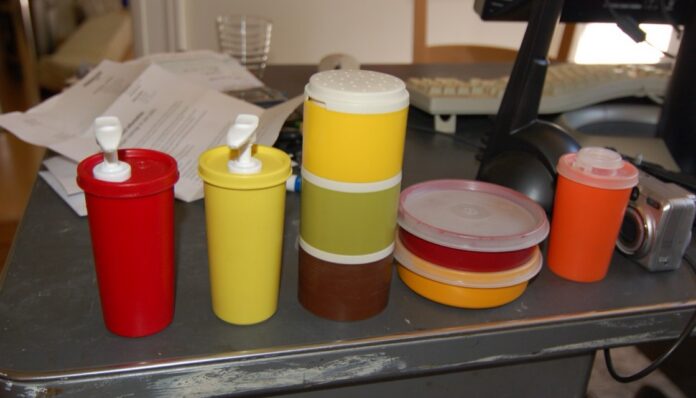
Tupperware did not sell well in stores at first, because shoppers could not work out how to close the lids. Home parties fixed that, and by 1954 roughly 20,000 people were selling the containers and sales had reached $25 million, about $310 million in today’s money.
Plenty of readers can picture a mother or grandmother hosting one, with neighbors drinking coffee in the living room while a dealer showed off an airtight seal. Here is how those gatherings took over postwar America and why they faded.
An invention nobody understood
The story starts in the 1940s with inventor Earl Tupper. He made light, tough plastic containers from polyethylene left over from wartime manufacturing.
Most families at the time kept leftovers in glass dishes or under wax paper or aluminum foil. Tupper’s containers could be reused, were hard to break and had flexible airtight lids that kept food fresh longer.
The catch was the famous “burping” seal, which needed a particular technique to close properly. On department store shelves, shoppers walked right past the containers, and some who bought them brought them back because they believed the lids did not fit.
Brownie Wise and the first parties
Everything changed when a saleswoman named Brownie Wise got involved. She and her mother already ran a direct-selling business called Patio Parties, and Wise saw that a home demonstration was the best way to sell Tupperware.
In someone’s living room, guests could watch the containers being used, ask questions and handle them for themselves. That made the product easy to understand in a way packaging never could.
Earl Tupper was impressed enough to make Wise vice president of Tupperware Home Parties. She turned the hostess party into a sales network that spread across the country, and the results were remarkable.
Where shopping met socializing
For many suburban homemakers in the 1950s and 1960s, a Tupperware party was as much a social event as a sales pitch. A host invited friends, neighbors and relatives over for refreshments, and a representative showed off the newest containers, kitchen tools and serving pieces with games and giveaways to keep things lively.
Many women spent their days running the household, and these evenings gave them a regular way to see people outside church or school activities. It was shopping and socializing rolled together, long before social media.
Money was part of the appeal, too:
- Hosts earned free products based on how much their guests bought, which encouraged them to invite more people.
- Independent consultants earned income by running parties and recruiting other sellers.
- For some women, it was one of the few flexible ways to make money while raising a family.
Wise herself became one of the first businesswomen in postwar America to earn national recognition.
Peak Tupperware
By the 1960s and 1970s, the parties were a fixture of suburban life. Kitchens moved from pastel pink, mint green and baby blue to the bold 1970s earth tones of avocado green, harvest gold and burnt orange.
Tupperware was spun off as an independent public company in 1996 after decades under its parent company, Premark, and pushed hard into other countries. By then its direct sales system, run entirely through independent consultants instead of stores, reached almost 100 countries.
The company’s sales peaked at $2.67 billion in 2013. By then, the party plan it made famous had inspired home selling of everything from clothing to cookware.
Why the party ended
Several changes wore the model down over time. As more women took full-time jobs, it became harder to host or attend an evening sales party, and workplaces and other activities filled the social role those parties once played.
Shopping habits changed, too. Big-box stores, malls and later online retailers made it simple to buy similar products quickly, without giving up an evening to a demonstration.
Competition grew after Tupperware’s patents expired in the 1980s. Airtight plastic storage stopped being a novelty and became an ordinary household item sold by many manufacturers.
The company adapted with catalogs and direct mail from the 1990s, then digital catalogs and early online ordering, and by the 2010s social media and virtual parties. Even so, after years of falling sales and growing debt, Tupperware Brands filed for Chapter 11 bankruptcy protection in the United States in 2024 as part of a restructuring.
The name has outlasted the parties. Many Americans still call any plastic food container “Tupperware,” no matter who made it.
Based on reporting by History Facts
By Linda Carver | Culture