
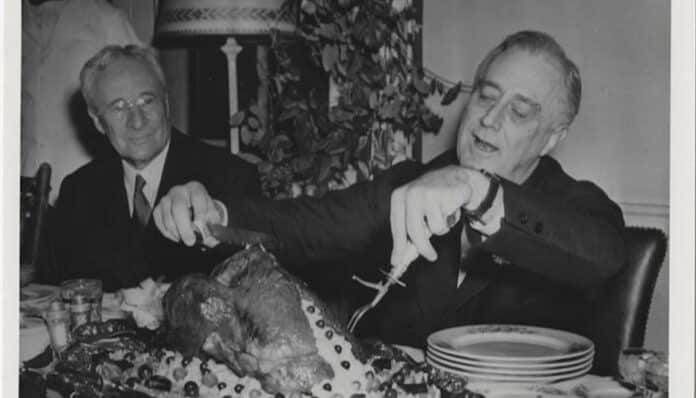
In 1939, President Franklin D. Roosevelt moved Thanksgiving one week earlier to give stores more shopping days before Christmas. The country split almost down the middle, with 22 states following him, 23 sticking with the old date and three celebrating twice.
Critics nicknamed the new holiday “Franksgiving.” The experiment lasted three years before Roosevelt admitted it had not worked and Congress fixed the date for good.
A holiday without a fixed date
Thanksgiving began as a fall harvest festival in the colonial Northeast and spread to many new states during the 19th century. Each governor picked the date, so celebrations landed in any autumn month and sometimes as late as March.
Writer and magazine editor Sarah Josepha Hale campaigned for a single national holiday. In October 1863, President Abraham Lincoln issued a proclamation asking Americans to observe the last Thursday of November as a day of thanksgiving.
Andrew Johnson issued his own proclamation in 1865 and chose the first Thursday in December instead. Later presidents mostly returned to Lincoln’s choice, and the last Thursday of November became the custom.
Why Roosevelt wanted a change
Retail groups first pressed Roosevelt in 1933, his first year in office. November had five Thursdays that year, so a holiday on the last one left a short window before Christmas, and an earlier date would have added a week of shopping.
The calendar repeated the problem in 1939. Business leaders pleaded again, and Lowell Mellett, executive director of the National Emergency Council, sent a memo warning that retailers expected one of their worst shopping seasons in years after the downturn of 1937 and 1938.
On August 14, 1939, at the end of a press conference, Roosevelt announced that Thanksgiving would come a week early that November. He said there was nothing sacred about the traditional date.
The backlash came from everywhere
Big retailers were pleased, but plenty of other Americans were not. Complaints poured in from people who had planned around the old date:
- A small business owner in Brooklyn wrote that crowded department stores in a short season sent overflow shoppers to local shops, so the old rhythm helped him.
- A calendar maker said the change made that year’s calendars obsolete and spoiled millions of 1940 calendars already printed.
- College football coaches had to reshuffle big games scheduled for what everyone assumed would be the holiday on the final Thursday.
Governors had the final say in their own states, and many ignored the president. In 1939, 22 states celebrated Franksgiving on November 23, while 23 held Thanksgiving on November 30. Texas, Colorado and Mississippi declared both days holidays.
A second try in 1940
Roosevelt did not back down. He again proclaimed the second to last Thursday of November as Thanksgiving in 1940.
More governors came around that year, but 16 states still held out for the final Thursday. Families in neighboring states could find themselves celebrating a week apart.
Did it help the stores?
The early results pointed both ways. A study by the National Retail Dry Goods Association found that businesses had gained from the earlier date in 1939. A civic and business federation near New York City disagreed and said the switch had only created a great deal of needless confusion.
By 1941 the evidence had turned against the idea. In early May that year, New York City Mayor Fiorello La Guardia sent Roosevelt the results of a citywide investigation, and store owners reported no rise in sales from the early holiday.
Most owners told the survey they wanted the final Thursday back. La Guardia wrote that he would support the president’s date, but felt bound to report strong opposition, much of it sentimental.
Also read: What the Pilgrims Actually Ate at the First Thanksgiving in 1621
How the fourth Thursday became law
On May 20, 1941, Roosevelt said the expected economic boost had not arrived. He announced that Thanksgiving would move back to the last Thursday of November in 1942.
Congress decided the date needed to be fixed rather than left to each president, and after some debate it chose the fourth Thursday of November. In most years that is the last Thursday, but in a five Thursday November it falls a week earlier, just as Roosevelt had wanted.
Roosevelt signed the joint resolution on December 26, 1941, and the short Franksgiving era was over. This year the rule puts Thanksgiving on Thursday, November 26, 2026.
Also read: Colonial Williamsburg Breakfast Was Cornmeal Hoecakes, Not Today’s Pancake Stacks
Based on reporting by HISTORY
By Karen Mitchell | Culture