
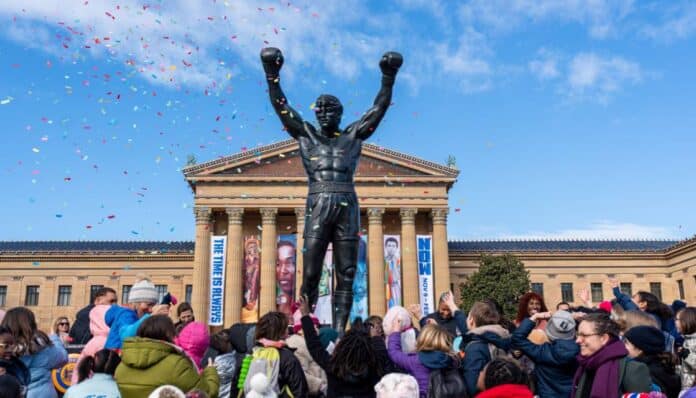
Rocky came out in 1976, which makes this year its 50th, and the story of a Philadelphia boxer nobody believed in still lands with audiences. Mike Sielski, whose 2026 book Going the Distance: Stallone, Philly, and the Story of Rocky traces how the film was made, calls watching it “a rite of passage.”
What many fans never learn is that the movie was an underdog story off screen too. Sylvester Stallone wrote the screenplay in just three days, and a 1976 New York Times article described a writer with $106 in the bank, a pregnant wife, a starving bullmastiff and rent he could not pay on a run-down Hollywood apartment.
Selling the script, and himself
Getting United Artists interested in the script was only half the fight. Stallone, a complete unknown, then had to persuade the studio to let him play the lead himself.
The gamble paid off on a scale nobody predicted. Rocky grossed more than $225 million at the box office, more than any other film released in 1976, and earned nine Academy Award nominations. It won three of them, including Best Picture.
Sielski says people can watch it as a sports movie, or the way Stallone meant it, as a love story. Most viewers, he believes, simply see it as a piece of inspirational pop culture.
A new camera made the famous scenes
Some of the most famous shots in the film depended on a gadget that barely existed at the time. The Steadicam, a wearable rig that separates the camera from the operator’s body so the picture glides instead of bouncing, is ordinary now. In 1976 it had been used on only a handful of productions, among them the Woody Guthrie biopic Bound for Glory.
Its inventor, camera operator Garrett Brown, spent two years building it to avoid hauling a bulky camera dolly around. According to Sielski, Brown shut himself in a Holiday Inn in West Chester, Pennsylvania, sketching diagrams and pulling vacuum cleaners apart for parts.
The crew had only five days to film in Philadelphia and got little help from the mayor. Sielski credits Brown’s invention with making the run up the steps, the jog along the river and the fights with Apollo Creed, played by Carl Weathers, feel fresh and physical.
Test yourself
How much have you picked up so far?
3 quick questions on what you have read so far. The story continues below.
It rewrote the sports movie
Rocky took the usual sports hero and turned him upside down. Sielski admits the film is schmaltzy at some level, but argues that it arrived at the right moment, when the country was weary and cynical after the civil rights era, Vietnam and Watergate, and reminded people that the human spirit can refuse to quit.
It also made the training montage a staple. Rocky running through the streets, punching sides of beef and charging up the steps of the Philadelphia Museum of Art became the template for films from The Karate Kid in 1984 to Cool Runnings in 1993. And in a twist on the happy ending, Rocky does not actually win the final fight against Apollo Creed.
Also read: Jimmy Stewart Flew 20 Combat Missions in WWII and Retired as a Brigadier General
The music came cheap and went to No. 1
The producers first hoped that David Shire, then married to Talia Shire, who played Adrian, would write the score. He was busy, so the job went to Bill Conti. Director John G. Avildsen said in a 2014 interview that Conti was picked partly because the budget was so tight.
Conti had spent the early 1970s arranging Italian pop songs and ghostwriting music for spaghetti Westerns. His Rocky theme, "Gonna Fly Now," reached the top of the Billboard singles chart in 1977 and earned him an Oscar nomination for best original song.
The sequels kept the streak going. When Queen refused to let Rocky III use "Another One Bites the Dust" in 1982, the Chicago band Survivor wrote "Eye of the Tiger," shaping its famous guitar riff to match Rocky's punches. The song held No. 1 on the Billboard Hot 100 for six weeks, stayed in the top 10 for 15 straight weeks and became the second best-selling single of 1982.
A tourist trail in Philadelphia
Stallone had been away from his hometown for several years when he wrote the film, so the Philadelphia on screen looks more like the city of the early 1970s. Real locations such as the Italian Market, Independence Hall and the art museum put the city in front of audiences everywhere.
Fans now book dedicated tours of Rocky and Creed sites, race up the museum steps and pose beside a bronze statue of Balboa that was made for Rocky III. Around 4 million people are said to visit the statue each year, and an editor at The Philadelphia Inquirer told Sielski it draws more visitors than the Liberty Bell.
Still going after nine films
The franchise later handed the spotlight to Adonis Creed, son of Apollo, played by Michael B. Jordan, in the spinoff Creed. Stallone earned a Best Supporting Actor nomination for it, and the spinoff produced two sequels of its own. Across all nine films, the series has grossed almost $2 billion.
The story behind the story has reached the screen as well. In November 2026, the biopic I Play Rocky follows a young Stallone fighting to get the original film made.
Also read: A Movie Ticket Cost 46 Cents and Mortgages Ran 2.5% in 1950s America
Based on reporting by HISTORY
By Trivia News Staff | Culture