
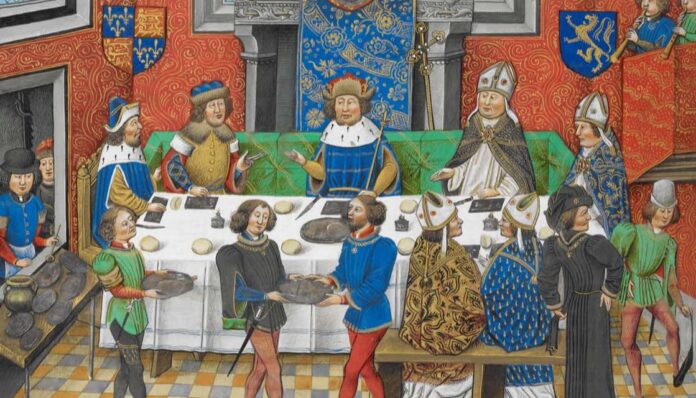
Dinner has not always been a peaceful affair. For centuries, the table was a genuinely risky place, especially when rivals and fighting men crowded together, drank heavily and carried their own sharp knives.
That is a big part of why table manners exist. Many dining rules did not start as a show of refinement. They were a form of crowd control, a quiet way to calm a room, and sometimes disarm it, before a meal turned into a brawl. Here are five customs that began as peacekeeping tools long before they became ordinary good manners.
Keep your elbows off the table
Most of us heard this rule as children without ever learning why. It goes back to medieval feasts, which were usually packed affairs with guests squeezed side by side at long trestle tables, eating, drinking and carousing.
Leaning hard or clumsily on the table could knock over a neighbor’s cup, spill food or even tip an unsteady table over. In a tense room, that was the sort of bump that could start a fight. Etiquette historians add that elbows planted on the table could look aggressive and greedy, the posture of someone ready to lunge for the food or grab the wine.
Do not reach across
Nobody can say exactly when reaching across the table became rude, but the logic matches the elbow rule. At a crowded, rowdy medieval meal, stretching across the table meant dragging a sleeve through someone’s plate, crowding a neighbor in mid-bite or simply looking greedy.
Any one of those could earn an angry rebuke, and at a table full of armed diners, an angry rebuke could turn into a knife fight.
Also read: Celery Was a Status Symbol in the Gilded Age, and 4 More Foods the Rich Craved
Test yourself
How much have you picked up so far?
3 quick questions on what you have read so far. The story continues below.
Why your dinner knife has a rounded tip
In medieval Europe, hosts usually did not hand out cutlery. Guests brought their own knife, almost always a sharp, pointed blade that served both to spear food, since forks were still rare, and as a weapon.
That did not help keep a lively dinner civilized, and Cardinal Richelieu, chief minister to King Louis XIII of France, grew tired of it. He was fed up with guests using their knife points to pick their teeth and to settle arguments. So in 1637 he had the tips of all his knives ground down and rounded, then gave those to his guests. In doing so, the cardinal invented the table knife, or at least made it popular.
King Louis XIV went further. In 1669, he banned pointed knives both on the street and at the table, specifically to cut down on violence. The rounded dinner knives in kitchen drawers today descend from that decree.
Point the blade inward
The rules around knives kept going after the points were gone. Traditional table setting says a knife should rest on the table or the plate with its blade facing inward, never toward the person beside you, and it should never be picked up to wave around while talking.
Some etiquette historians suggest this started as a way to make a quick slash at a neighbor's throat harder. It is impossible to prove. It may just be a practical way to lay a knife down so it does not have to be turned around when picked up again. Either way, a blade pointed at someone, even by accident, can feel like a threat, and turning it away is a small sign of goodwill.
Wait until everyone is served
Waiting for every plate to arrive before eating was not really about stopping fistfights, but it does head off a different kind of friction. Victorian etiquette guides, such as Isabella Beeton's 1861 Book of Household Management, laid out elaborate courses served in careful order.
Starting early threw off the rhythm of the whole meal and left other diners behind. Worse, it could mean someone sat in front of an empty plate while everyone else ate. Being left out was, and still is, exactly the kind of slight that sours a shared meal, and in a room that was already tense, it could boil over into an embarrassing scene.
These habits feel like simple politeness now. Their roots suggest that the person who first insisted on them was often just trying to get through dinner without bloodshed.
Based on reporting by History Facts
By Trivia News Staff | Culture