
In 1950 a seat at the movies cost 46 cents, less than the 60 cents a dozen eggs went for, and a home loan carried an interest rate of roughly 2.5%. Those two figures say a lot about a decade many readers still remember firsthand.
Elvis played on the radio, Ed Sullivan filled the television screen, and families were packing up for the suburbs. The country had 151 million people, and 31% of them were under 18. Here is how that young, fast changing nation looked when you count it out.
A country full of babies
Birth rates climbed sharply after World War II and stayed high from 1946 through 1964, the stretch now known as the baby boom. The 1950s sat right in the middle of it.
About 4 million babies arrived in America every year during the decade. Between 1910 and 1945 the yearly average had been closer to 2.7 million. By the time the boom ended, about 77 million babies had been born.
Low unemployment, a growing economy, cheap borrowing and a stronger middle class all helped push the numbers up. Marriage was the norm as well, with 68% of men and 66% of women married.
Fewer women at work, but the number was rising
Most households followed the same pattern, a married couple with one earner, usually the husband. In 1950 only 29% of working-age women in the U.S. had a job.
The figure looked very different by marital status. Nearly half of single women of working age, 46.4%, were employed, while fewer than a quarter of married women, 21.6%, held jobs.
Change came quickly. By 1960 the number of working women had grown from 16.5 million to almost 22.5 million, a 35% jump, even though the population of working-age women grew only 14%. The five most common jobs for women were:
- secretary, stenographer or typist
- retail salesperson
- schoolteacher
- bookkeeper
- apparel factory worker
Test yourself
How much have you picked up so far?
3 quick questions on what you have read so far. The story continues below.
Cheap mortgages and a house every 16 minutes
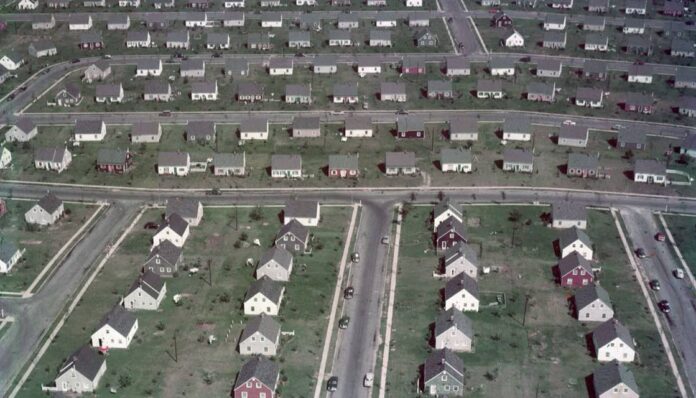
Housing boomed as Americans swapped crowded cities for the suburbs. Mortgage rates ran from 2.1% in 1950 to 2.6% in 1959.
The 16 million World War II veterans alive in 1950 could get even lower rates through the G.I. Bill, which made the decade an ideal time to buy.
The best known suburbs of the era are the Levittowns, named for developer William Levitt, who built thousands of homes in planned communities across the mid-Atlantic in the late 1940s and early 1950s. At the height of construction in the most famous of them, on Long Island, New York, a new house went up every 16 minutes.
Also read: Tupperware Parties Hit $25 Million in Sales by 1954, Then the Party Slowly Ended
Television went from rare to nearly universal
About 4.4 million homes had a TV set in 1950. That sounds like plenty until you realize it was only 9% of households.
By the end of the decade, 90% of households owned one. The sitcom became part of family life, and shows such as Leave It to Beaver, with the Cleavers, and Father Knows Best, with the Warrens, put the idealized American family on screen every week.
A night at the movies for the price of milk
Hollywood's golden age was winding down, yet theaters stayed packed, partly because going was cheap. At 46 cents a ticket, a family of four could see a film for about the cost of two gallons of milk, which sold for 83 cents a gallon.
Disney's Cinderella, released on February 15, 1950, was the year's biggest film. It took in more than $52 million and sold close to 99 million tickets. King Solomon's Mines, Father of the Bride and All About Eve were also among the top earners that year.
Big families under one roof
Census records show that about 52% of households had children under 18 living at home in 1950. In 2019 the share was down to 41%.
Families were large. About 58% of households had three to five members, 21% had six or more, 18% had two, and only 3% were a single person. Family size peaked in the late 1950s and early 1960s and has fallen ever since, reaching an average of 3.13 people in 2022.
One car in the driveway
Suburban life meant depending on a car. In 1954, 64% of U.S. households owned one car, and the number of one-car households grew from 30.1 million that year to 32.4 million in 1960.
A second car was unusual. Just over 8% of households had two in 1954, and only 0.9% had three or more, though two-car homes became a little more common by the end of the decade.
A popular family car was not cheap. The Cadillac DeVille cost about $3,523 and the Oldsmobile 88 Fiesta about $3,541, roughly $37,000 in today's money.
Also read: The ZIP Code Only Arrived on July 1, 1963, and Americans Did Not Want It at First
Based on reporting by History Facts
By Trivia News Staff | Culture