
Benjamin Franklin is remembered as a printer, a scientist and a statesman, which makes it easy to forget how much he invented along the way. He tinkered with everything from fireplaces to musical instruments, and he refused to patent a single one of his creations.
His reason was simple. Franklin believed ideas like these should be shared freely for the good of everyone. “During Benjamin Franklin’s lifetime, he was curious about so many aspects of the world that he asked questions, posited theories, designed inventions and modified already existing theories and items for practicality,” says Susannah Carroll, director of collections at The Franklin Institute.
Some of his inventions changed daily life. Others mostly scratched an itch. Here are nine of them.
Swim fins, at age 11
Franklin’s inventing started early. At 11 years old, centuries after Leonardo da Vinci had suggested something similar, he made the first working swim fins: two oval paddles about 10 inches long and 6 inches wide, with a hole for the thumb so he could grip them against his palms.
They made him faster, though he complained they tired his wrists, and a version for his feet did not work well. He had more luck with a kite. Franklin found he could be towed across a pond by a kite on a string, an early cousin of today’s kitesurfing, and called it the “greatest pleasure imaginable.” His fins and his lifelong love of swimming earned him a place in the International Swimming Hall of Fame in 1968.
The lightning rod
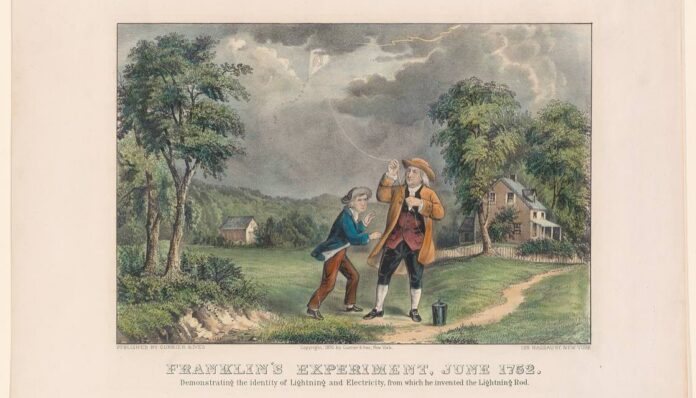
His most famous invention grew out of his electricity experiments in the late 1740s. Franklin described an idea for protecting buildings and ships from “electrical fire” in a 1750 letter to Peter Collinson of the Royal Society in London.
The first lightning rods went up in Philadelphia only after the 1752 demonstrations that lightning was electrical, first in France and then with Franklin’s famous kite. In the 1753 edition of Poor Richard’s Almanack he laid out the design: one iron rod on the roof, another driven into the ground, and a brass wire carrying the charge down between them. Friends and correspondents in other states reported back, and he improved the rods, making them bigger so they could survive repeated strikes.
Test yourself
How much have you picked up so far?
3 quick questions on what you have read so far. The story continues below.
A stove that saved wood
Starting in the late 1730s, Franklin worked on an iron fireplace meant to burn less wood and heat a room better. His "Pennsylvania Fire-Place" used an air box behind the fire that drew in clean air from below, warmed it and pushed it out through vents, while a U-shaped passage routed the smoke up the chimney.
Pennsylvania Deputy Governor George Thomas liked it, but it never cleared smoke as well as Franklin hoped, and he kept tinkering for most of his life. Carroll notes that it still used less wood and was safer than an open fire, and that most people call it the Franklin stove even though others kept improving it.
Also read: No Record Shows Washington Ordered Paine's American Crisis Read to His Troops
A clock, a lamp and a catheter
Some of Franklin's ideas were practical fixes for everyday problems:
- The three-wheeled clock. Sometime before 1758 he designed a simpler 12-hour clock with just three wheels and two pinions. A small dial counted seconds, while the main face grouped the hours into four stacks pointing to the compass directions. The only description comes from a 1773 book by James Ferguson, who said it kept time "exceedingly well."
- The flexible catheter. In 1752, hoping to help his brother John, who suffered from kidney stones, Franklin designed a hinged silver tube that bent more easily than the rigid metal ones of the day. Flexible catheters already existed in Europe, but his is considered the first used in America.
- The street lamp. Around 1757 he pushed for street lighting in Philadelphia and improved on the globe lamps imported from London, which clouded with smoke. His version had a funnel on top and vents below, plus four flat panes, so a broken pane could be swapped out instead of the whole globe.
An alphabet nobody used
In 1768 Franklin tried to give the alphabet "a more natural order," arguing that every letter should stand for one sound only. He dropped six letters he considered unnecessary, C, J, Q, W, X and Y, and added six new ones, including letters for "sh," "ng" and "um."
He soon lost interest. The system never caught on, even after the dictionary maker Noah Webster endorsed it some 20 years later.
The glass armonica
After hearing someone play a glass harp, rubbing wet fingers around the rims of upright glasses, Franklin had a London glassblower build an instrument on the same principle. It used 37 glass bowls of precise sizes, nested on an iron spindle that turned with a foot pedal.
The armonica, named after the Italian word for harmony, debuted in 1762 and won famous admirers, with Mozart and Beethoven both writing music for its eerie tone. It never became a household instrument, though. Carroll says it was hard to play and cost about as much as a piano, and some critics even claimed its sound drove listeners mad, a charge Franklin brushed off.
Bifocals
Franklin is usually pictured in glasses, and those spectacles were another of his ideas. In a May 1785 letter to London merchant George Whatley, he described having an optician make "double spectacles" for both near and far sight, so that he only had "to move my eyes up or down" to see clearly.
Some historians question exactly when he first wore them and whether he deserves all the credit. Still, he is generally believed to have come up with bifocals in 1784.
Also read: Sylvan Goldman's 1937 Shopping Cart Was Mocked Until He Hired Actors to Push It
Based on reporting by HISTORY
By Trivia News Staff | History