
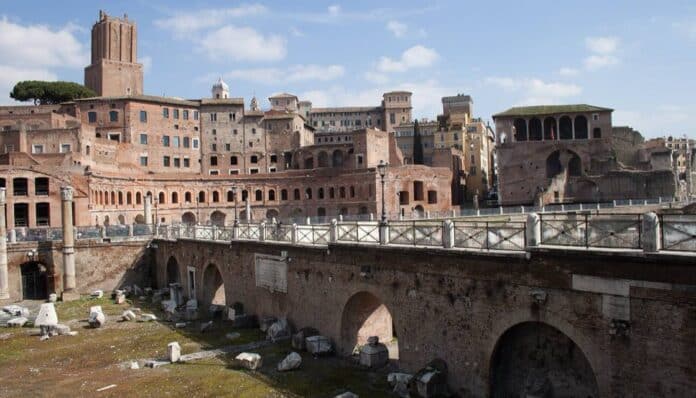
The Romans gave the world plenty of things still in use, from surgical scissors to underfloor heating to the bound book. Some people go further and credit them with the indoor shopping mall, pointing to Trajan’s Market as their proof.
The trouble is that nobody can agree what the six-level, brick-faced concrete complex was actually for, says archaeologist Darius Arya, founder and director of the educational website Ancient Rome Live. A century after excavation began, scholars are still arguing over whether its roughly 150 rooms held shops or government offices.
Who built it, and when
Some archaeologists think construction began under Emperor Domitian, who ruled from A.D. 81 to 96, citing bricks stamped with seals from his reign. Those bricks could simply have been stockpiled, though, and other scholars date the work to between A.D. 100 and 112, during the reign of its namesake, Emperor Trajan. Either way, there is agreement it was finished under Trajan.
Trajan ruled from A.D. 98 to 117, when the empire reached its greatest size, about 2 million square miles from North Africa to England and Portugal and east to Armenia. Rome, as the center of the empire’s trade, needed new buildings to match. Arya says there was a need for either a new administrative center or new shops.
Built into a hill
The job went to Apollodorus of Damascus, Trajan’s favorite architect. He set the complex beside Trajan’s Forum, another of his projects, and had workers dig away part of the Quirinal Hill so the building could climb the slope in terraces. He also ran a road straight through the middle of it.
Arya notes the market is made of brick rather than the marble of the forum. That, he says, points to a more practical, utilitarian purpose than showing off Roman wealth and power.
Test yourself
How much have you picked up so far?
3 quick questions on what you have read so far. The story continues below.
Shops, offices or both?
Interpretations still clash, Arya says. Some read the 150 rooms as shops and storerooms, others as administrative, government and archive offices with perhaps a courtroom, and a third camp thinks it was a mix.
Many ground floor rooms could have been tabernae, the Latin word for small shops. Ancient History Magazine noted that they have small windows over their doorways to let in light and air and let out smoke. Owners, renters or enslaved workers may have lived in the same rooms to guard their stock, and the most likely goods were:
- grain and oils
- fruits and vegetables
- spices and pepper
Clues in a street name
The road through the middle, which divides the upper and lower sections, is called Via Biberatica. In Latin, "biberatica" comes from "bibere," to drink, which suggests the street was lined with taverns. It may instead be a garbled form of "piper," Latin for pepper, perhaps pointing to a spice market.
Arya says the complex resembles covered halls and colonnades near ancient marketplaces, especially the Greek stoas, where open-air shops sat under long covered walkways. Yet parts of it are unlike a normal Roman market. Ancient History Magazine points out the awkward links between levels, with few, narrow entrances and staircases that would have slowed the movement of goods and people.
Also read: Sylvan Goldman's 1937 Shopping Cart Was Mocked Until He Hired Actors to Push It
The case for offices
Being right next to the forum supports the office theory, since documents could easily be carried from the forum to rooms used for file storage. The Great Hall, with six concrete cross vaults and fine views over Trajan's Forum, is thought to have been the main office of Roman administration.
However tempting the "first mall" label is, Arya admits no one really knows what the building was used for. What can be said, he adds, is that it is the largest and best preserved multilevel complex of its kind from the Roman world, comparable to a modern shopping mall.
Castle, convent, museum
After the Western Roman Empire fell in A.D. 476, the market slowly stopped serving its original purpose. In the Middle Ages, noble families took it over and reinforced it, and around 1200 it became a castle, with a defensive tower, the Torre delle Milizie, built beside it.
Pope Boniface VIII fortified it again around 1300, and Emperor Henry VII did the same 12 years later. In 1574 it became a convent that ran for more than three centuries, then a barracks that was eventually torn down.
Excavations in the 1920s and 1930s uncovered the site, and that is when it got the name Trajan's Market. Today it houses the Museum of the Imperial Fora. First mall or not, Arya says, its scale and its vaulted, terraced hillside engineering made it a pioneering piece of Roman architecture.
Also read: Black Friday Began as a Philadelphia Police Gripe in the 1950s, Not a Retail Win
Based on reporting by HISTORY
By Trivia News Staff | Landmarks