
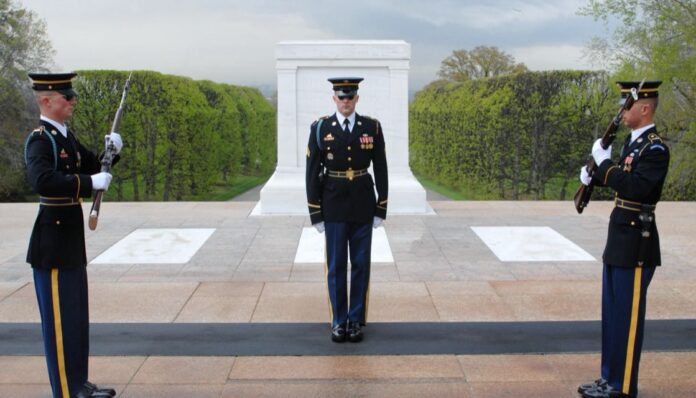
On November 11, 1921, the United States dedicated the Tomb of the Unknown Soldier at Arlington National Cemetery to honor an unidentified American killed in World War I. Since 1937 it has been guarded 24 hours a day, 365 days a year, an honor the country does not even give its presidents.
The tomb grew out of a new way of remembering the dead after a war that killed an estimated 8.5 million to 10 million soldiers. Britain and France had already buried their own unknown warriors a year earlier, and the American version followed their lead.
Why World War I changed how soldiers were remembered
Before World War I, fallen soldiers were usually buried in mass graves, and little effort went into identifying them or bringing them home. Monuments were mostly built for great victories and senior commanders.
The scale of the new war changed that. Peter Francis, chief of staff at the Commonwealth War Graves Commission, notes that the armies were no longer on the edges of society, because their ranks had been filled with masses of ordinary volunteers.
The staggering death toll led to calls for every soldier to be remembered in a deep and lasting way. In Britain, France and the United States, that meant one unknown soldier standing for all the fallen whose names were never known.
Britain buries a warrior among kings
The British government banned bringing soldiers’ bodies home during the war, partly because only the very wealthy could have paid for it. Most families could never visit a grave overseas.
The idea for a tomb came from a military chaplain, Reverend David Railton, who won the Military Cross for rescuing three soldiers under fire at the Battle of the Somme in 1916. That same year he noticed the grave of an unknown British soldier and began thinking about a national memorial.
After the war, King George V approved the plan in October 1920. Brigadier L. J. Wyatt chose one body from four brought back from the Western Front, and the Unknown Warrior was buried at Westminster Abbey in a coffin made of wood from Hampton Court Palace, with a 16th century sword from the Tower of London laid on top.
On November 11, 1920, every station platform between Dover and London was crowded with people hoping to see the train carrying the casket. More than 1 million people filed past the coffin over the following days, and Francis says many came from as far as Scotland because they believed it might be their own son, husband or father.
Test yourself
How much have you picked up so far?
3 quick questions on what you have read so far. The story continues below.
France chooses the Arc de Triomphe
France made the same decision at the same time. The Chamber of Deputies voted to bury an unknown soldier at the Arc de Triomphe in Paris.
The remains of eight unidentified French soldiers were brought to the citadel of Verdun, where a corporal named Auguste Thin made the choice. Britain and France both held their ceremonies on November 11, 1920.
The French tomb was not ready right away, so the remains were stored for a few months. The soldier was laid to rest under the arch on January 28, 1921, and an eternal flame was added on November 11, 1923.
America's turn in 1921
The United States held its ceremony one year after Britain and France. Scholar Steven Trout says only about 4,500 American soldiers were unaccounted for at the end of the war.
New York congressman Hamilton Fish proposed the idea to Congress. On October 24, 1921, Army Sergeant Edward Younger chose America's Unknown Soldier from four unidentified men who had died at Aisne-Marne, the Somme, Meuse-Argonne and Saint-Mihiel.
According to Trout, Younger was blindfolded, walked around the caskets and placed a bouquet on one of them. A fleet of vessels escorted the USS Olympia as it carried the casket across the Atlantic, and crowds lined every train platform on the way to the Capitol.
From the Capitol to Arlington
Fish had first pictured the soldier lying inside the Capitol rotunda, but the tomb was placed at Arlington National Cemetery in Virginia instead. Thousands of people followed the procession from the Capitol, and America's most decorated World War I soldiers served as pallbearers.
Trout says the tomb became the country's unofficial national World War I memorial. Over the following decades it took on more of the nation's unknown dead:
- On May 30, 1958, unknown soldiers from World War II and the Korean War were buried there.
- In 1984, an unknown service member from the Vietnam War was added.
- In 1998, DNA testing identified the Vietnam soldier as Air Force 1st Lieutenant Michael Blassie, and at his family's request he was reburied at Jefferson Barracks National Cemetery in St. Louis.
The Vietnam crypt was later rededicated to honor all U.S. service members still missing from that war.
Also read: Veterans Day Began as Armistice Day in 1919, and How It Differs From Memorial Day
Why the guard never leaves
The tomb's round-the-clock guard sets it apart from its British and French counterparts. It began in 1937 after visitors had started picnicking on the tomb, sitting on it and posing for photos with it.
Trout calls the constant watch remarkable, pointing out that the United States does not honor its own presidents that way.
Based on reporting by HISTORY
By Trivia News Staff | Landmarks