
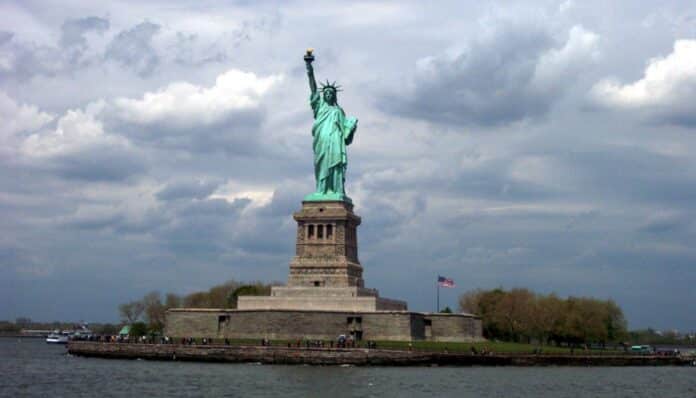
The Statue of Liberty weighs about 450,000 pounds, roughly 30 times as much as a T. rex, yet her copper skin is barely 1/16 of an inch thick. She was almost built for Egypt, nearly lost at sea on the way over, and once had a phonograph planned for her insides.
Lady Liberty was dedicated on October 28, 1886, in front of thousands of people in New York Harbor. Most Americans think they know her story. Plenty of it turns out to be wrong, or at least missing a few chapters.
A gift with a more complicated story
The common belief is that France gave the statue to celebrate the alliance of the American Revolution. It is closer to the truth to say she was made possible by one French sculptor, Frédéric Auguste Bartholdi, acting for his people for more complicated reasons.
Bartholdi was inspired by the anti-slavery activist Édouard René de Laboulaye. He pitched the statue largely as a celebration of the Union victory in the Civil War and the end of slavery, hoping French leaders would embrace liberty and democracy over monarchy and empire.
That is why broken chains lie at her feet and her right foot is raised, a step away from oppression. The United States abolished slavery just 21 years before the statue was dedicated.
She almost stood somewhere else
The design began life on another continent. Bartholdi first proposed a giant statue called “Egypt Carrying the Light to Asia” for the opening of the Suez Canal. It was never built, and he reworked the idea into the Statue of Liberty.
Even in America, New York was not the only bidder. New York struggled to raise the money, and both Boston and Philadelphia offered to pay the full price to have the statue in their own city. New York finally found the funds, and she has stayed in the harbor ever since.
The trip over was nearly a disaster too. The statue crossed the Atlantic aboard the French ship Isère, which ran into storms near Portugal and was blown off course.
Test yourself
How much have you picked up so far?
3 quick questions on what you have read so far. The story continues below.
Her real name and her original look
The statue's official name is "Liberty Enlightening the World." That mouthful was shortened in everyday speech long ago.
She did not always wear a crown either. Bartholdi first planned a pileus, the cap given to freed slaves in ancient Rome, before settling on a diadem. The 7 points of that crown stand for the 7 seas and the 7 continents, as well as the rays of the sun.
Her famous green came later. The copper started out reddish brown, and oxidation slowly gave it the green patina everyone knows today.
Also read: Mount Rushmore Was Supposed to Have Torsos, and 11 Other Landmark Secrets
Built by famous hands
Bartholdi was the main designer, but he had help from a name everyone knows. Gustave Eiffel, the engineer behind the Eiffel Tower, worked on the statue's internal structure.
Shaping the copper skin took about 300 different types of hammers. The pedestal was meant to be taller, at 114 feet, but it was cut back to 89 feet to save money.
Bartholdi was also a Freemason, which explains a plaque the Freemasons placed on the cornerstone. When the plaque was placed, the Grand Master of New York, William A. Brodie, claimed no organization had done more to promote liberty than Freemasonry, a choice that still draws critics.
Facts by the numbers
The statue is full of figures that surprise people:
- She stands 305 feet tall, about two and a half times the height of Brazil's Christ the Redeemer at 124.5 feet
- Her face alone is more than 8 feet tall, and her nose accounts for 4 feet 6 inches of that
- Her head sits about 2 feet out of alignment, a flaw found during restoration before her 100th birthday in 1986
- In winds of 50 mph she can sway up to 3 inches, and the torch up to 6 inches
- Only 240 people a day may visit the crown, a limit set after September 11, 2001, when evacuation became a priority
Strange moments in her history
Women were kept out of the original dedication ceremony. Angry suffragists held their own ceremony nearby in the harbor, pointing out that a giant woman now stood for liberty while American women still could not vote.
Thomas Edison had his own plans for her. In 1878 he announced a giant phonograph to be placed inside, so the statue could give speeches heard across New York. It never happened.
During World War I, German saboteurs blew up a munitions depot on nearby Black Tom Island in 1916. Michael Kristoff and two other German agents are believed to be responsible, and flying shrapnel caused about $100,000 in damage to the statue.
A giant battery and a famous mix-up
In the 1980s, restorers found the statue had turned into a giant battery. Moisture trapped between the copper skin and the iron framework caused galvanic corrosion, which happens when two different metals touch in the presence of water.
Her height and conductive metal also make her a favorite target for lightning. She still came through Hurricane Sandy in 2012 without damage, though Liberty and Ellis islands were closed for a time afterward.
The strangest mistake belongs to the Postal Service. A Statue of Liberty stamp turned out to show the replica in Las Vegas, because the image came from a stock photo agency and nobody noticed it was the copy.
Through all of it, her message has not changed. The Emma Lazarus poem "The New Colossus" on her pedestal still welcomes the tired, the poor and the huddled masses, and she still lives up to that original name, Liberty Enlightening the World.
Also read: Venus de Milo's Missing Arms and 8 Other Mysteries Behind Famous Statues
Based on reporting by All That's Interesting
By Trivia News Staff | Landmarks