
Everybody has seen the postcards. Plenty of people have stood in front of the real thing. Knowing what a landmark looks like, though, is not the same as knowing what happened to it.
The Statue of Liberty was not always green. Mount Rushmore was not supposed to stop at the neck. America’s most photographed places are full of accidents, budget problems and stunts that the guidebooks tend to skip.
Mount Rushmore was meant to go down to the waist
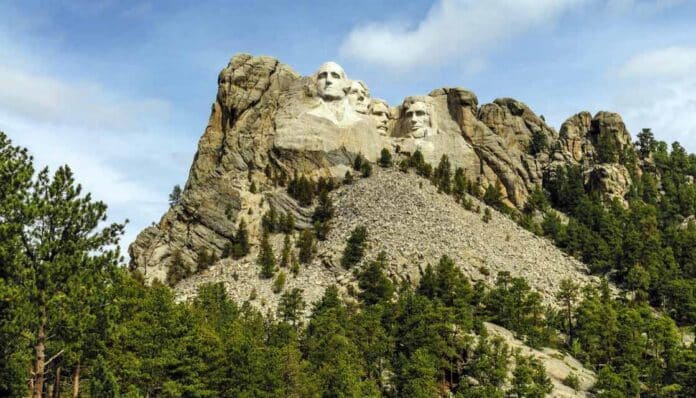
Sculptor Gutzon Borglum did not plan on four floating heads. His design carved the presidents from the waist up, torsos and all.
Money ran out, and then the Second World War pulled resources elsewhere. What survives is the top third of the idea. Stand at the base and look up, and you can fill in four enormous stone suits that were never cut.
The lady in the harbor started out brown
When the Statue of Liberty arrived from France in 1886, she was the shiny copper brown of a new penny. Twenty years of air and rain did the rest.
The chemical reaction is called oxidation, and it turned her into the green icon everyone pictures. The color nobody associates with her is the one she was actually delivered in.
Two landmarks named for colors they do not have
The Golden Gate Bridge has never been gold. Its reddish orange is an official shade called International Orange, chosen because it reads clearly against San Francisco fog and blue water, and because passing ships can spot it.
The Washington Monument has a color problem of a different kind. About 150 feet up, the stone changes shade, because construction stalled for more than 20 years over funding and the Civil War. When work restarted, the new marble came from a different quarry and never quite matched, leaving a 555 foot reminder that renovation delays are not a modern invention.
Also read: 10 Washington, D.C. Travel Secrets Most Tourists Learn Too Late
The Liberty Bell broke almost immediately
The crack in every photograph is not the result of centuries of ringing. The bell cracked the first time it was rung after arriving from England in 1752.
It was recast, then cracked again in 1835 and 1846, and it has never rung properly since. America’s bell of freedom has spent most of its existence broken.
Numbers that are hard to picture
Some of these places are best understood as quantities rather than sights.
- The Hoover Dam holds roughly 3.25 million cubic yards of concrete, enough that poured into a standard two lane road it would reach coast to coast, and the interior is still curing decades later
- The Gateway Arch in St. Louis is exactly as wide as it is tall, 630 feet each way, a symmetry Eero Saarinen designed on purpose
- Old Faithful is faithful but not punctual, with gaps between eruptions running anywhere from about 60 to 110 minutes
- The Space Needle went from idea to finished 605 foot tower in under a year, built against the clock for the 1962 World’s Fair
A spelling mistake carved in stone
The Lincoln Memorial has a typo. On the north wall, in the engraved Second Inaugural Address, carver Ernest C. Bairstow reached for the wrong stencil in 1922 and cut the word FUTURE as EUTURE.
The fix was not a recarve. Part of the E was filled in with stone and reshaped into an F, which is why the letter still looks slightly off to anyone who knows to look.
A real estate ad and 21 elephants
The Hollywood Sign was never a tribute to the movie business. It went up in 1923 to advertise a housing development called Hollywoodland, and it was meant to last about 18 months.
A century later it is still there, four letters shorter and considerably more famous than the subdivision. Over in New York, the Brooklyn Bridge got its own publicity moment in 1884, a year after opening, when the public still suspected it might collapse. P. T. Barnum walked a herd of 21 elephants across it, which settled the argument and sold a few tickets at the same time.
Also read: A Darth Vader Grotesque Hides on Washington National Cathedral
Based on reporting by Wander Trivia
By Marcus Thorne | Landmarks