
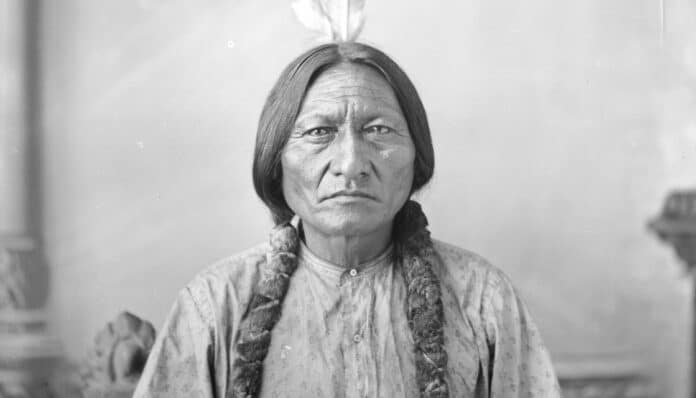
Sitting Bull, Sequoyah and Chief Joseph are three of 11 Native American leaders whose choices shaped the course of the United States. Some led through diplomacy, some through armed resistance, and one gave his people a written language of their own.
What they shared was a fight to protect their communities, keep their traditions alive and defend their sovereignty. Here is how each of them did it, from the first English settlement in Virginia to the Plains wars of the 1870s.
Chief Powhatan and the Jamestown settlers
Chief Powhatan, whose name was Wahunsenacawh, is believed to have been born in the 1540s or 1550s. He led a confederacy of more than 30 Algonquian-speaking communities around the Chesapeake Bay in what is now Virginia.
His alliance took in thousands of people and much of the land around Jamestown, where English settlers founded their first permanent settlement in North America in 1607. Powhatan was also the father of Pocahontas, whose dealings with the settlers became a key part of early colonial history. He stayed an influential leader until his death in 1618.
Chief Tamanend, the peacemaker
Tamanend, a leader of the Lenni-Lenape people, lived from about 1628 to 1700. He is remembered for working toward peace between Native Americans and European settlers in colonial Pennsylvania.
He is believed to have met William Penn, the founder of Pennsylvania, in 1682 or 1683 to agree on friendship and peaceful coexistence. Tradition links the meeting to a treaty signed under an elm tree at Shackamaxon, near today’s Philadelphia. The details are uncertain, but his reputation lasted so long that early Americans sometimes called him the “Patron Saint of America.”
Joseph Brant and Tecumseh, allies of the British
Thayendanegea, also known as Joseph Brant, lived from 1743 to 1807 and was a Mohawk military and political leader in the Haudenosaunee, or Iroquois, Confederacy. During the Revolutionary War he sided with the British, believing the Crown offered the best chance to protect Indigenous land, and led raids along the New York and Pennsylvania frontiers. After the British lost, he helped secure land along the Grand River in present-day Ontario, where many Haudenosaunee people resettled.
Tecumseh, a Shawnee leader who lived from 1768 to 1813, tried to unite Native nations into one confederacy to resist U.S. expansion westward. With his brother Tenskwatawa, a religious leader known as the Prophet, he built a movement across the Great Lakes and Ohio Valley.
In the War of 1812, Tecumseh allied with the British. His forces played a key role in the capture of Detroit in 1812, but he was killed at the Battle of the Thames on October 5, 1813, a heavy blow to the confederacy he had built.
Test yourself
How much have you picked up so far?
3 quick questions on what you have read so far. The story continues below.
Sequoyah and Sacagawea
Sequoyah, who lived from about 1778 to 1843, was a Cherokee silversmith and inventor. He spent more than a decade building a writing system for the Cherokee language and finished it around 1821.
It was a syllabary rather than an alphabet, meaning each symbol stood for a syllable, not a single sound. That let Cherokee speakers learn to read and write in their own language, and it led to the Cherokee Phoenix in 1828, the first Native American newspaper in the United States.
Sacagawea, born around 1788, joined the Lewis and Clark Expedition in 1805 with her French Canadian husband, Toussaint Charbonneau, and their infant son, Jean Baptiste. Accounts of her death differ, giving either 1812 or 1884. The expedition, sent by Thomas Jefferson in 1804 to explore the Louisiana Purchase, covered nearly 8,000 miles over three years and reached the Pacific.
She served as an interpreter, and her knowledge proved vital in Shoshone territory, where she helped the explorers get the horses they needed to cross the Rocky Mountains.
Red Cloud and Geronimo
Red Cloud, an Oglala Lakota leader who lived from 1822 to 1909, led a coalition of Lakota, Northern Cheyenne and Northern Arapaho warriors from 1866 to 1868 in what became known as Red Cloud's War. It ended with the 1868 Treaty of Fort Laramie, in which the U.S. agreed to abandon its forts on the Bozeman Trail and recognize a vast territory, the Black Hills included, as part of the Great Sioux Reservation.
It was a major victory, though the United States later broke the treaty's terms. Red Cloud turned to diplomacy afterward and traveled to Washington, D.C., to argue for his people's rights.
Geronimo, a Bedonkohe Apache warrior and spiritual leader who lived from 1829 to 1909, was born in what is now New Mexico. He spent decades fighting Mexican and U.S. forces, leading a small band in repeated escapes from reservations. He surrendered in 1886, and he and hundreds of other Apache people were held as prisoners of war and moved far from their homelands.
Sitting Bull and Crazy Horse at Little Bighorn
Sitting Bull, a Hunkpapa Lakota leader who lived from about 1831 to 1890, helped unite Lakota, Northern Cheyenne and Arapaho communities to defend their land and way of life. In June 1876 his leadership drew thousands of Native Americans together along the Little Bighorn River in present-day Montana.
There, Lakota and Cheyenne warriors defeated Lieutenant Colonel George Armstrong Custer and his troops. Sitting Bull did not command the fighting himself, but his spiritual and political influence held the resistance together. He fled to Canada, returned and surrendered in 1881, and was killed during an attempted arrest on the Standing Rock Reservation in 1890.
Crazy Horse, an Oglala Lakota military leader who lived from about 1840 to 1877, helped lead the warriors on the battlefield that day. It became one of the most significant Native American victories over the U.S. Army. He surrendered at the Red Cloud Agency in Nebraska in May 1877 and was fatally wounded four months later while being held by soldiers at nearby Fort Robinson.
Chief Joseph's 1,000 mile retreat
Chief Joseph, whose name was Hinmatóowyalahtq̓it, led a band of the Nez Perce, or Nimiipuu, and lived from 1840 to 1904. When the government ordered his people onto a reservation in 1877, they set out on a retreat of more than 1,000 miles across Idaho, Montana and Wyoming, hoping to reach Canada.
In October 1877, exhausted and just 40 miles from the border, Joseph surrendered in Montana's Bear Paw Mountains. He is linked to the famous words "I will fight no more forever," although historians question how accurately the speech was recorded and translated. He spent his last years pressing for the right to return to the Wallowa Valley.
Based on reporting by HISTORY
By Trivia News Staff | History