
Playground slides once stood as tall as 30 feet, and on a sunny day their steel could reach about 150 degrees Fahrenheit. They were only one of five pieces of old school playground equipment that look shockingly dangerous today.
A playground is meant to be a place where children burn off energy, not get burned. For much of the 20th century, though, the swings and slides came with real risks, and they often dropped kids onto ground with about as much give as a parking lot.
When the government stepped in
The turning point came in 1975. That year the U.S. Consumer Product Safety Commission, or CPSC, began drawing up safety standards for playground equipment.
It pointed to an estimated 55,000 emergency room visits tied to playground injuries in 1973. Slides, seesaws, merry-go-rounds and gliders all came under scrutiny. Some of them survive in newer designs, but many of the riskiest pieces quietly disappeared from parks and schoolyards.
1. The playground merry-go-round
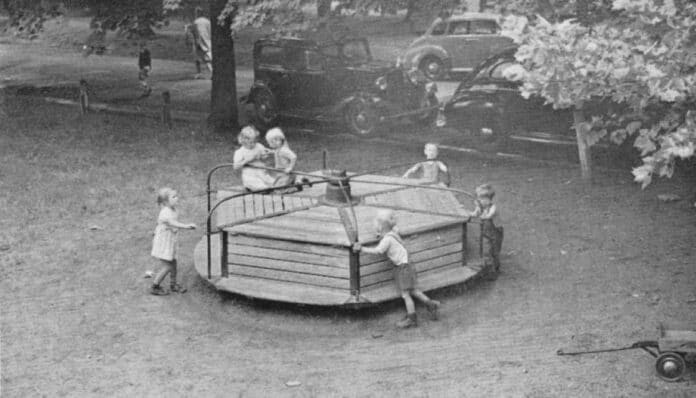
Carousels trace their roots to medieval knights’ tournaments, so perhaps their rough reputation on the playground fits. In the middle of the 20th century the playground versions could be huge, and catalogs offered models up to 16 feet across.
Anyone who rode one remembers the routine. Kids stood on the platform, gripped the bars and spun it as fast as they could push.
They could also be flung off, slip underneath, or get struck by the heavy frame once they lost their grip. Portable models had open gaps and moving parts that trapped small fingers. A CPSC review of playground injuries from 1979 to 1988 found five merry-go-round accidents that ended in partial or full finger amputations.
Test yourself
How much have you picked up so far?
3 quick questions on what you have read so far. The story continues below.
2. The giant stride
The giant stride was more or less a maypole that could launch children into the air. Ropes or chains with handles hung from a turning wheel at the top of a tall pole.
Kids grabbed a handle and ran in a circle until they were going fast enough for their feet to leave the ground. It sounds like fun, until somebody lets go and sails off, or takes a swinging handle to the head while another child is still running.
There was a second problem. A playground guide from 1908 warned that soft ground under a giant stride would soon wear into holes from all the running, so it had to sit on hard ground. Children who flew off landed on concrete or asphalt.
Opinion turned against it over the first half of the century. The National Recreation Association first recommended taking giant strides down in 1921, and by the 1970s they had vanished from North American playgrounds.
3. Jungle gyms built like obstacle courses
Climbing frames are still found on almost every playground. Some of the older jungle gyms, though, were little more than towering mazes of metal bars, closer to an Army obstacle course than a play area.
By the 1970s the designs grew more ambitious. Iowa's Miracle Recreation Equipment Company sold the Mark IV, a sprawling structure introduced in 1972, and one version stood 18 feet tall with no net beneath it.
It crammed in towers, platforms, ladders, tunnels and slides. The company's own advertising said it could "handle a whole neighborhood of children," which says a great deal.
Later research shows why that height mattered. A 2001 CPSC study found:
- About 86% of all injuries on climbing equipment came from falls
- 67% of those falls were from higher than 4 feet
- That 4 foot mark is only a small part of the height of the old jungle gyms
Also read: A NASA Engineer Invented the Super Soaker, and Over 250 Million Have Sold Since 1990
4. The Teeter Ladder
A seesaw seems innocent until you notice it is basically a catapult powered by children. Now imagine lifting it into the air.
That was the idea behind the Teeter Ladder, a long ladder balanced on a pivot. Children hung from the rungs underneath and moved their hands along the bars, shifting the weight and tipping the balance as they went.
A playground catalog from 1929 promised that "all sorts of stunts" could be done on it and said its "factor of safety" had been carefully considered. As proof, it noted that even adults could use it without it breaking. It said nothing about falling to the ground or being hit in the head by the metal ladder.
5. The towering metal slide
Slides remain a playground favorite, which makes it easy to forget how extreme the older ones were. Giant steel slides could rise 30 feet, reached by a long, rickety staircase full of gaps.
Unlike today's slides, they often sat over gravel or concrete, with almost nothing to soften a fall. And height was only half the trouble, since exposed metal on a sunny day can hit around 150 degrees Fahrenheit, hot enough to burn a child before they ever reached the bottom.
Modern slides are more often made of plastic and other materials that stay cooler, and impact absorbing surfaces have largely replaced the hard ground under playgrounds of the past.
Also read: A Movie Ticket Cost 46 Cents and Mortgages Ran 2.5% in 1950s America
Based on reporting by History Facts
By Trivia News Staff | General