
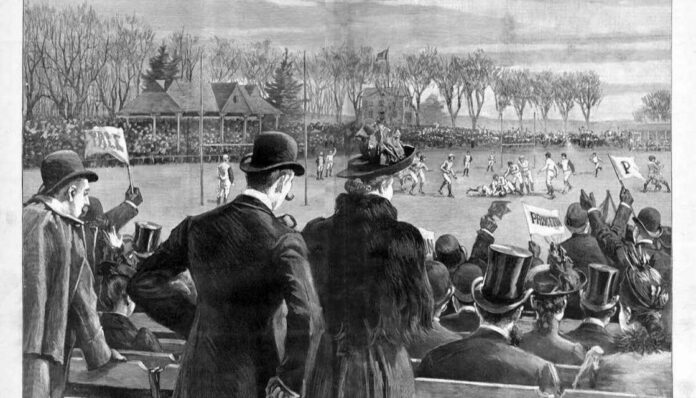
Thanksgiving football began on November 30, 1876, when Princeton met Yale in Hoboken, New Jersey, in the first college game ever played on the holiday. Fewer than 1,000 people watched, mostly students and alumni, as Yale won 2 to 0 in a contest that looked more like rugby.
Within a few years the matchup had become one of the biggest social events in New York. By 1893 it was drawing more than 50,000 fans and pulling families away from their own dinner tables.
A league built around one holiday game
The 1876 meeting came seven years after Princeton played Rutgers in what is considered the first college football game. The sport was still being worked out on campuses across the Northeast.
In 1873 students from Princeton, Yale, Harvard and Columbia formed the Intercollegiate Football Association. It standardized the rules and set the schedules, including a yearly Thanksgiving game in New York between the two teams with the best records from the season before.
Apart from Harvard in 1883 and 1887, those two teams were always Princeton and Yale. Through the 1880s and 1890s their holiday clash was the biggest date on the college football calendar.
From hundreds of fans to thousands
The real growth started in 1880, when the game moved across the Hudson River to the Polo Grounds in Manhattan. Crowds jumped from hundreds into the thousands, and 10,000 fans saw the 1881 game.
By the middle of the decade it was a fixture of New York society. A yearly game between Wesleyan and Pennsylvania was added as a side dish to the main course.
Test yourself
How much have you picked up so far?
3 quick questions on what you have read so far. The story continues below.
Champagne on the sideline
On the field, 1880s football was brutal, a game of mass tackles and flying wedges played by men with nothing thicker than skull caps on their heads. In the stands, the experience was surprisingly modern:
- Vendors outside sold pennants and flags
- Scalpers resold $1 tickets for $5
- Bookmakers took cash bets from fans on the outcome
The crowd blazed with color. Princeton supporters wore orange and black, Yale backers wore blue, and fans tied handkerchiefs in team colors to umbrellas and walking sticks. Yale's female fans wore violets, while Princeton's wore yellow chrysanthemums and orange and black rosettes.
Some ticketholders parked their stagecoaches and carriages right beside the field for the ultimate tailgate. At the 1889 game at the Berkeley Oval in the Bronx, millionaire William K. Vanderbilt watched from his coach while drinking champagne from a goblet.
Princeton won that day 10 to 0 to finish an unbeaten season. Its quarterback, an All-America player, was named Edgar Allan Poe, and his father was a cousin of the famous writer.
Yale's 37 game streak
By 1890 teams had sprung up at colleges from coast to coast, and veterans of the Princeton and Yale rivalry, including Walter Camp and Amos Alonzo Stagg, did much to spread the game. That year 45 former Yale players and 35 former Princeton players were coaching around the country.
Yale opened the decade with a 37 game winning streak that included 36 shutouts. It began with a 32 to 0 rout of Princeton at Eastern Park in Brooklyn in 1890.
The next year Yale blanked Princeton 19 to 0 in pouring rain to cap a perfect season in which it outscored opponents 488 to 0. That game, at the newly opened Polo Grounds, drew 40,000 people, thousands of them watching from the rocky cliffs of Washington Heights.
College football becomes big business
The schools may have been amateurs, but the money was real. Each pocketed $340.42 from the 1880 game, and by 1891 that figure had passed $14,000.
Fans from across the country filled the best hotels on Fifth Avenue, and shops put team photographs and colors in their windows in the weeks before the game.
Long before Macy's sent balloons down the streets on Thanksgiving morning, Princeton and Yale fans held their own parade on the way uptown. Crowds stood three and four deep as carriages and omnibuses decorated in school colors carried fans blowing tin horns and bugles.
Also read: Macy's Thanksgiving Parade Drew 10,000 in 1924, and a Century of Balloons Followed
Churches moved their services for kickoff
The game changed the holiday itself. Churches across New York moved their Thanksgiving services earlier to avoid clashing with kickoff, and chairs sat empty at family dinners.
In 1891 Harper's Weekly declared that a powerful rival had taken the place of the Thanksgiving dinner, and that rival was the Thanksgiving game.
The last holiday showdown
After another Yale win in 1892, Princeton finally broke the streak in 1893, winning 6 to 0 in front of more than 50,000 fans. It turned out to be the rivals' last Thanksgiving meeting, although they played in the city for three more seasons, and in 1897 the game moved to their campuses.
The tradition they started outlived the rivalry's New York years. By the middle of the 1890s, colleges, high schools and club teams were playing about 5,000 games every Thanksgiving.
The New York Herald noticed the shift in 1893, observing that the day was no longer a solemn religious festival but a holiday granted to see a football game.
Also read: FDR Moved Thanksgiving Up a Week in 1939, and 23 States Refused to Follow
Based on reporting by History.com
By Trivia News Staff | Culture