
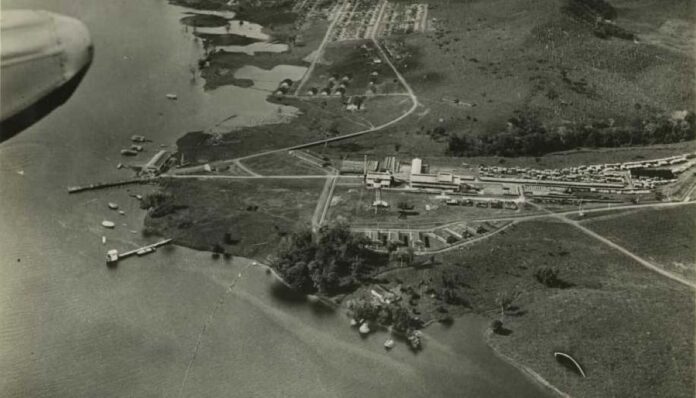
Henry Ford poured about $20 million into Fordlandia, a Midwestern style company town he built in the Brazilian Amazon in 1928, and it was largely abandoned by 1934. In those six years, not one drop of latex was harvested from its rubber trees.
Ford wanted his own supply of rubber and believed his way of running a workforce would succeed anywhere on Earth. What he got instead was blighted trees, a string of unqualified managers and a full scale worker revolt.
Why Ford needed rubber
Cars depended on rubber long before Ford went looking for it. In 1908 his Model T became the first affordable automobile, and by 1925 the base model cost just $260, around $5,000 today.
More than 15 million were sold in 20 years. Every one of them needed rubber for tires, tubes and other parts.
The Amazon had enjoyed a rubber boom from about 1879 to 1912. That ended after British explorer Henry Wickham smuggled rubber seeds out of Brazil, and Britain’s colonies in Asia began growing the trees far more efficiently, free of the native fungi and pests that plagued them at home.
Asian plantations could pack their trees much closer together than was possible in the Amazon, and they soon broke Brazil’s grip on the market. By 1922 British colonies produced 75% of the world’s rubber.
That same year Britain adopted the Stevenson Plan, which limited exports and pushed prices up. Thomas Edison and other American industrialists tried to make cheap rubber in the United States, and none of them managed it.
A city of the future on the Tapajós
Ford hoped a plantation of his own would cut his costs and prove his industrial ideals could improve workers’ lives anywhere. Brazilian officials had courted him for years, and he believed rubber belonged in its native land.
In 1928 he told The Magazine of Business that the company was going to South America not to make money but to help develop a fertile country.
His confidence had some basis. Workers at his Dearborn plant earned an unusually high minimum wage of $6 a day, about $117 today, along with good benefits, though Ford fiercely opposed unions.
According to the Henry Ford Museum, Ford secured 2.5 million acres along the Tapajós River in 1927. In return he promised Brazil 7% of the plantation’s yearly profits and local towns 2%, once it had run for 12 years.
Test yourself
How much have you picked up so far?
3 quick questions on what you have read so far. The story continues below.
Shipping in a whole town
Ford spent roughly $2 million on initial supplies. In the summer of 1928 his ships carried everything needed to build a town from nothing:
- Generators, picks and shovels
- Prefabricated buildings, boats and medicine
- Clothing and books
- A huge stock of frozen beef, so American managers would not have to eat tropical food
The plan was a typical Midwestern town dropped into the jungle, with white picket fences, paved roads, clocks set to Detroit time and Prohibition strictly enforced. Fordlandia eventually had a hospital, a school, a swimming pool, a movie theater, tennis courts and an 18 hole golf course.
Managers who knew nothing about rubber
The first man in charge, Willis Blakeley, scandalized the people of Belém with his behavior and knew nothing about running a jungle outpost or growing rubber. By the end of 1928 Ford replaced him with a Norwegian sea captain, Einar Oxholm, who was not much better suited to the job.
When the trees were finally planted, they were set too close together. Blight, parasites and pests spread easily from tree to tree and destroyed many of them, and that turned out to be the smaller problem.
35 cents a day and canned peaches
Thousands of local people came looking for work, expecting the $5 a day American workers earned. They were paid 35 cents a day instead and had to live on company property under Ford's rules.
Alcohol, tobacco and prostitution were banned. Historian Greg Grandin writes that enterprising locals simply opened bars and brothels nearby on what became known as the "Island of Innocence."
Inside the town, workers had to wear American style clothes and eat unfamiliar food such as oatmeal and canned peaches. Ford promoted square dancing, gardening and poetry readings, while men used to the slower rhythm of rural Brazil chafed at shift whistles, timesheets and orders about how to move their own bodies.
The cafeteria revolt
The breaking point came in December 1930. John Rogge, the fourth manager, fired the waiters who served meals, brought in a cafeteria line and docked workers' pay to cover their food.
The workforce erupted. Men cut the telephone lines, set fires, wrecked supplies and machinery and chased off the American managers, and they only dispersed when the army stepped in.
Abandoned in the jungle
In 1933 the company moved most of its rubber work 70 miles downriver to Belterra, and the next year Fordlandia was mostly abandoned. Belterra did little better, producing 750 tons of latex in 1942 against the 25,000 tons Ford needed every year.
After Ford retired in September 1945, his grandson Henry Ford II took over and sold both plantations back to Brazil for $244,200. The company had sunk some $20 million into them, about $370 million today.
Ford dreamed of a town for 10,000 workers, and about 3,000 people live there now. Aldous Huxley was reportedly inspired by the experiment when writing Brave New World, in which characters revere Ford almost as a god and count their calendar from the Model T's debut.
As one resident told The New York Times in 2017, Detroit is not the only place where Ford left ruins.
Based on reporting by All That's Interesting
By Trivia News Staff | Geography