
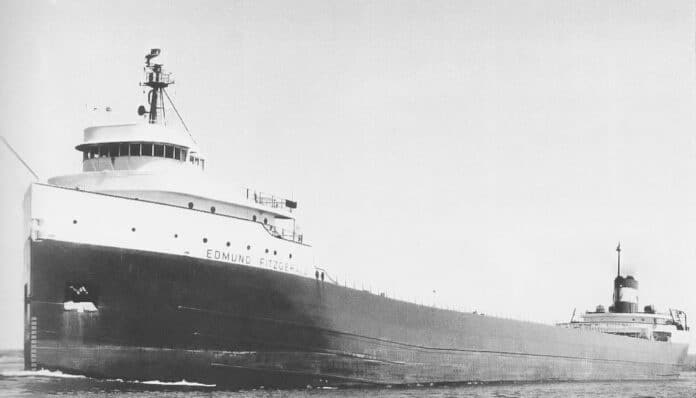
On the evening of November 10, 1975, the freighter Edmund Fitzgerald vanished from radar in a Lake Superior storm, and all 29 men aboard were lost. When the wreck was found, it lay just 17 statute miles from the calm of Whitefish Bay.
More than 50 years later, it is still the most famous shipwreck on the Great Lakes. Part of the reason is a mystery that was never fully solved, and part is a folk song that millions of Americans can still hum.
The biggest ship on the lakes
The story starts in 1957, when the Northwestern Mutual Life Insurance Company ordered a freighter meant to be the largest vessel on the Great Lakes. It came in at 729 feet (222 meters) long and weighed more than 13,600 tons.
The ship was christened on June 8, 1958, and named for Edmund Fitzgerald, the insurance company’s president. It made its maiden voyage on September 24 of that year.
Boat watchers took to it quickly. Around the lakes it picked up nicknames such as “the Big Fitz” and “the Mighty Fitz,” and for most of its working life it hauled pellets of taconite, a type of iron ore.
A November gale on Lake Superior
On November 9, 1975, the Fitzgerald left Superior, Wisconsin, bound for a steel mill near Detroit. Captain Ernest M. McSorley was in command, with 28 other men aboard.
Before long it was in radio contact with another freighter, the Arthur M. Anderson, which was running roughly 15 statute miles (24 km) behind. Later that day, gale warnings went out for southern Lake Superior, a lake with a long record of violent November storms.
Early the next morning the warning was upgraded. The two captains agreed to swing north onto a route ships commonly used in heavy weather, but the wind then shifted, and the new course carried both vessels toward the worst of the storm.
Conditions kept deteriorating through the day. At the peak, winds hit 70 to 75 knots and waves rose to 25 feet (8 meters), and McSorley described them as among the “worst seas” he had ever seen.
Test yourself
How much have you picked up so far?
3 quick questions on what you have read so far. The story continues below.
The last hours
The final afternoon unfolded in a handful of radio calls:
- Around 3:15 p.m., the Anderson's captain saw the Fitzgerald pass dangerously close to a shoal off Caribou Island
- About 15 minutes later, the Fitzgerald reported minor damage and a list, said its pumps were running, and asked the Anderson to stay close
- Around 4:10 p.m., it reported that both radars were out and asked for help with navigation
- More than an hour later, it told another ship, the Avafors, that it was listing badly
At 7:10 p.m., McSorley spoke to the Anderson one more time. "We are holding our own," he said, and those were the last words anyone heard from the ship.
About 10 minutes later the Fitzgerald disappeared from the Anderson's radar. It was less than 20 statute miles (32 km) from shelter in Whitefish Bay, water shared by Ontario and Michigan.
A search that turned back into the storm
For more than an hour the Anderson tried to raise the freighter by radio, then alerted the Coast Guard. At about 9 p.m. the Coast Guard asked it to go back and search.
The Anderson had already made it to the safety of Whitefish Bay, yet its crew agreed and headed back out into the gale. The William Clay Ford joined them, and the search grew to include more ships, helicopters and airplanes.
Searchers found lifeboats, life jackets and other debris. Of the Fitzgerald itself there was no trace.
Found at the bottom
During the following week, sonar picked up two large objects where the ship had gone down. In May 1976 a submersible robot settled the question, filming and photographing a bow and stern that both carried the freighter's name.
The twisted wreck lay about 530 feet (162 meters) down, 17 statute miles (27 km) from Whitefish Bay, inside Canadian waters. The bow sat upright, while the stern section nearby lay upside down, with a field of debris and taconite pellets between the two halves.
Why did it sink?
In July 1977 the Coast Guard published its findings. Hatches that were not properly closed let water in, the report said, and as the ship lost buoyancy its bow dipped and never came back up before it dove to the bottom.
A plunge that sudden would explain why no distress call was ever sent. Not everyone accepted it, though, and other explanations circulated:
- The freighter struck bottom near Caribou Island and tore its hull
- The ship was unseaworthy, lacking watertight bulkheads and carrying heavier loads than it was built for, and broke apart on the surface
- Rogue waves overwhelmed it
Later dives explored the wreck, but none produced a definitive answer.
Also read: The Great Lakes Had Dozens of Names Before 1744, From Lac du Chat to Karegnondi
A song, a bell and a closed wreck
The unanswered questions gripped the public. In 1976 Gordon Lightfoot turned the tragedy into the hit ballad "The Wreck of the Edmund Fitzgerald," and books and documentaries followed.
In 1994 an expedition came across the body of a crewman near the bow, apparently still wearing a life jacket. The next year the ship's bronze bell was brought to the surface.
Afterward, reportedly at the request of the crew's families, the Canadian government restricted access to the wreck, so the Mighty Fitz now rests largely undisturbed.
Also read: Britain's R101 Airship Crash Killed 48 in 1930, More Than the Hindenburg Did
Based on reporting by Britannica
By Trivia News Staff | History