
High in the Chilean Andes sits a town where staircases served as the streets, and 15,000 people once climbed them every day. Elsewhere, people still live on islands they weave from reeds, and an emperor built a whole capital to celebrate a prophecy.
These places sound invented, yet every one of them is real, and most can still be visited. Here are 10 spots whose histories read like the plot of a fantasy novel.
Sewell, Chile, the city of stairs
Sewell clings to a steep mountainside more than 7,200 feet above sea level, its red, yellow, green and blue buildings joined by a tangle of staircases. The slope was too steep for normal roads, so the stairs and footpaths were the roads, including a huge central staircase climbing from the train station.
It began in 1905 as housing for workers at the El Teniente copper mine and peaked at about 15,000 residents in 1968. As transport improved, the mining company moved workers to nearby Rancagua, and by the 1970s much of the town was empty. Sewell is now uninhabited and protected as a UNESCO World Heritage Site.
Sukur, Nigeria, an iron kingdom on a hill
Sukur, in northeastern Nigeria, grew into a powerful iron producing kingdom by the 17th century. Its ruler, the Hidi, held political and spiritual power and controlled the iron trade, while furnaces burned beside homes below his hilltop palace and farmers worked terraced hillsides.
Raids by a neighboring ruler, Hamman Yaje, between 1912 and 1922 weakened the kingdom, and iron production ended around 1960. The original stone walkways, terraces and buildings remain in daily use, and residents rebuilt after attacks damaged the area in 2014.
Banská Štiavnica, Slovakia, where floods powered the mines
Miners digging for gold and silver in this Slovak mountain town kept hitting groundwater that threatened to flood the shafts. Engineers answered by building reservoirs called tajchy to catch rain and snowmelt, linked by channels and tunnels.
The stored water drove machines that pumped water out of the mines, turning the problem into the fix. The system grew through the 18th century, a mining academy opened there in 1762, and UNESCO listed the town in 1993.
St. Patrick’s Well, Italy, with stairs that never meet
After imperial troops sacked Rome in 1527, Pope Clement VII fled to Orvieto, a city on a volcanic rock, and ordered a well in case of siege. Architect Antonio da Sangallo the Younger designed a shaft about 175 feet deep with two separate spiral staircases of 248 steps each.
One staircase carried people and pack animals down for water and the other brought them back up, so traffic never collided. Seventy two windows lit the way, and the work took ten years, ending in 1537. It was renamed St. Patrick’s Well after an Irish legend about a cave leading toward Purgatory.
Also read: In Longyearbyen, Norway, It Is Famously Illegal to Die, and Nine Other Odd Towns
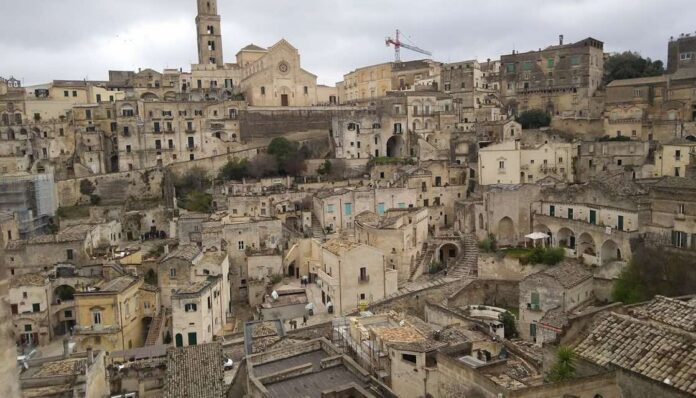
Matera, Italy, the cave city
For thousands of years, people in Matera lived in homes cut into the rock. These neighborhoods, the Sassi, included houses, churches and passageways and date back to prehistoric times.
By the 20th century, families lived crowded together without proper sanitation, some sharing space with animals, and in 1952 the government began moving them to new housing. The empty districts were later recognized for their history, restoration brought people and businesses back, and UNESCO listed the Sassi and their rock churches in 1993. Many of the old cave homes are now hotels and restaurants.
Fatehpur Sikri, India, a capital born from a prophecy
In the 1560s, Emperor Akbar longed for an heir and visited the spiritual teacher Salim Chishti, who by tradition foretold a son. Prince Salim was born in 1569, and Akbar chose the land near Chishti’s home for a new capital.
Building started in 1571, producing red sandstone palaces, courtyards, mosques and grand gateways. In 1585 Akbar moved his court to Lahore, possibly because of water shortages or frontier threats, and historians still debate the reasons. The city survived and became a UNESCO site in 1986.
Four more that sound made up
The rest of the list is just as strange:
- The Uros islands, Peru. On Lake Titicaca, Uros communities build floating islands from totora reeds layered over blocks of roots, adding fresh reeds as the lower layers rot. Tradition says living on the water helped them resist powerful mainland groups.
- Ghadamès, Libya. This oasis town on the edge of the Sahara, called the Pearl of the Desert, has shaded lanes for men and children and a separate network of linked rooftop terraces that women used to move between homes. It became a UNESCO site in 1986.
- Tierradentro, Colombia. Between roughly the 6th and 10th centuries, communities carved burial chambers into volcanic rock, some nearly 40 feet across, with stairs, columns and painted walls. The park protects 162 tombs and was listed by UNESCO in 1995.
- Dholavira, India. This Harappan city on an arid island in Gujarat stored seasonal water in reservoirs as early as the third millennium BC, traded as far as Mesopotamia and lasted about 1,500 years. UNESCO listed it in 2021.
Not one of these needed a novelist. The engineers, kings and families behind them did the inventing themselves.
Based on reporting by Listverse
By Laura Mitchell | Landmarks