
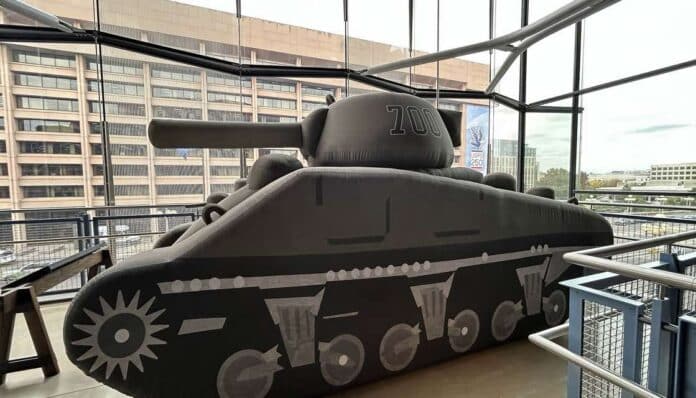
In March 1945, a U.S. Army unit of 1,100 men convinced German forces it was two full divisions, about 30,000 soldiers. Its weapons were inflatable tanks, sound trucks and fake radio chatter, and the deception helped protect thousands of Allied troops crossing the Rhine.
Forgers are usually filed with criminals. In occupied Europe, where Nazi authorities controlled the records used to track and deport people, a false identity card or passport could be the difference between life and death. These are 10 of the deceptions that worked.
The Ghost Army fooled an entire front
The unit’s official name was the 23rd Headquarters Special Troops. Many of its men were artists recruited from schools in New York and Philadelphia, and their kit included rubber tanks, recorded battle sounds and uniforms for units that did not exist.
Near Viersen in March 1945, they posed as two divisions to mislead the Germans about where and when the Ninth Army would cross the Rhine. The ruse pulled enemy attention away from the real crossing and is credited with saving thousands of Allied lives. The story stayed classified for decades, and Congress awarded the unit the Congressional Gold Medal in 2022.
A Dutch workshop made 65,000 fake IDs
The Persoonsbewijzencentrale, or Identity Card Center, was one of the biggest forgery operations in the Dutch resistance. Sculptor Gerrit van der Veen founded it, and from 1942 its members produced roughly 65,000 forged identity documents plus tens of thousands of other papers.
They also stole blank identity cards and ration coupons, giving the forgers genuine materials. In March 1943, members joined an attack on Amsterdam’s population registry, and those involved were arrested. A rescue attempt at Weteringschans prison followed the next year, and most of the group, van der Veen among them, were eventually shot.
The Athens police chief who issued false papers
When German forces took control of Athens in September 1943, the city’s Jewish residents faced deportation. Police chief Angelos Evert had his officers hand out false identity cards to any Jews who asked.
The cards carried Greek Christian names and listed the holder as Greek Orthodox, letting people hide in plain sight. By the war’s end, 560 Athenian Jews and refugees sheltering in the city had survived by posing as Orthodox Christians.
Polish diplomats forged South American passports
In Bern, Switzerland, Polish ambassador Aleksander Ładoś led a group that produced passports from Paraguay, Peru, Haiti and Honduras for Jews in occupied Europe. Consul Konstanty Rokicki helped make the documents, while Jewish activists collected names and raised money.
Citizenship of a neutral country could shield a holder from immediate deportation to the killing centers. The group issued an estimated 8,000 to 10,000 passports, and thousands of people named on them were spared deportation, though the papers could never guarantee safety.
The Marcel Network hid 527 children
In summer 1943, Moussa Abadi, a scholar of medieval literature, warned Bishop Paul Rémond of Nice that the city’s Jews were in danger. The bishop gave Abadi and his partner, Jewish physician Odette Rosenstock, a place to work and opened Catholic institutions across his diocese to Jewish children.
Working under the code name Monsieur Marcel, the pair forged papers and placed children in schools, convents and other refuges. Their network is credited with saving 527 children between 1943 and 1945.
Citizenship papers from El Salvador
Jewish businessman George Mandel found an ally in José Arturo Castellanos, El Salvador’s consul general in Geneva. In 1942 Castellanos named Mandel first secretary of the consulate, and Mandel took the more Spanish sounding surname Mantello.
Together they issued documents declaring thousands of European Jews to be Salvadoran citizens. The certificates were not an escape route, but they gave people facing deportation a claim to protection as citizens of a neutral country.
A Polish officer walked into Auschwitz on purpose
Witold Pilecki volunteered to get inside Auschwitz and report on it. He used the identity card of Tomasz Serafiński, a Polish reserve officer, which he had found in a Warsaw apartment where he was hiding, and gave that name when the Germans seized him in a roundup in September 1940.
Registered as prisoner 4859, he spent more than two and a half years in the camp, building a resistance network and smuggling reports to the Polish underground. He escaped in April 1943 and later wrote a fuller account.
Two doctors invented a typhus outbreak
Polish physicians Eugeniusz Łazowski and Stanisław Matulewicz injected healthy people with inactivated Proteus bacteria, which could produce a positive result on the Weil-Felix test for typhus. They then reported the results to German authorities as an outbreak.
German officials feared the disease, so the fake epidemic kept Polish villagers out of forced labor roundups. A 2025 medical review found the method plausible but corrected a popular legend: there is no support for claims that the doctors saved thousands of Jews, since the people protected were Polish villagers and the number saved is uncertain.
The Curaçao visas and a teenage forger
In 1940, Jan Zwartendijk, a Philips employee in Kaunas, Lithuania, became acting Dutch consul. He wrote in refugees’ passports that no visa was needed to enter Curaçao, a Dutch Caribbean island, giving them a destination on paper even though entry still depended on the governor.
He issued at least 2,345 of these notes. Japanese consul Chiune Sugihara, also in Kaunas, supplied transit visas to Japan, and together their paperwork let thousands of refugees cross the Soviet Union to Japan.
The last forger was a teenager. Adolfo Kaminsky worked in a dry cleaner’s shop and a dairy lab when he realized his stain removing chemistry could also erase marks on documents, and the French Resistance recruited him. His hidden workshop produced as many as 500 papers a week, and he is credited with helping save as many as 14,000 people.
Based on reporting by Listverse
By Thomas Brennan | History