
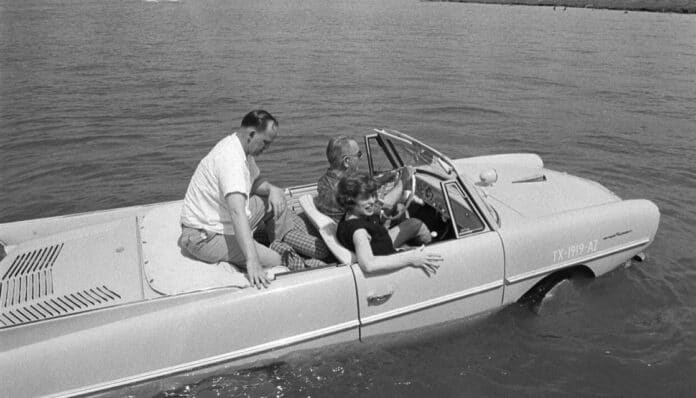
Lyndon B. Johnson had a favorite joke for visitors to his Texas ranch. He would invite a guest for a short drive, steer straight for the lake, and wait for the panic before the car floated off like a boat.
The car was an Amphicar, a convertible built in West Germany in the 1960s that could drive on roads and cruise on water. Only 3,878 were ever made, and about 90% of its sales came from the United States.
A wartime design turned into a toy
Commercial production began in 1961, but the idea went back to World War II. The Amphicar grew out of the Volkswagen Schwimmwagen, an amphibious military vehicle designed by engineer Hans Trippel, a member of the Nazi Sturmabteilung paramilitary branch.
According to German historians Hartmut Berghof and Cornelia Rauh, about 200 Schwimmwagens were built during the war. The design never reached full industrial production because of doubts about how well it would hold up.
After the war, denazification courts sent Trippel to prison, and he served only two years. He then went back to work on his dream of a better amphibious car.
The first Amphicars came off the line in 1961 under the Quandt Group, an industrial empire run by the stepson of Joseph Goebbels. The group still holds stakes in BMW today.
What the Amphicar 770 could do
The first commercial model was the Amphicar 770, a two door, four seat convertible styled for the 1960s. Its bodies were made in Lübeck, and final assembly took place at the DWM factory in Berlin.
A few numbers tell the story:
- Top speed was 70 mph on land and 7 mph on water.
- The body was 15.5 feet long, and the car weighed about 1,738 pounds.
- Double seals on the doors, closed with a lever, kept the water out.
- It sold for $2,800, roughly $20,000 in today’s money.
Cars built in Germany between 1961 and 1968 were shipped to parts of the U.K. and the U.S. Official production ended in 1965, but more were assembled from leftover parts until 1968. It remains the only civilian amphibious passenger car ever mass produced.
Test yourself
How much have you picked up so far?
3 quick questions on what you have read so far. The story continues below.
Why Americans fell for it
The Amphicar found its biggest audience in the U.S. Car dealers and the trade press treated it as a genuine innovation, and Modern Mechanix said it did everything but fly.
Reporters from The New Yorker and Newsday wrote up their own test drives on the river. Demand was strong enough to launch a company, Amphicar America, which took office space in Manhattan and a headquarters in New Jersey, according to the New York Times real estate pages of August 17, 1962.
The president's favorite prank
Johnson was the Amphicar's most famous owner. A 1965 profile of the president described the routine in detail.
A guest would climb in for what sounded like a quick spin. The president would head for the water while the guest shouted that they were about to go in. Johnson would pull the lever that sealed the doors, the car would hit the lake with a splash, and the guest would gasp before realizing they were floating. Then the two of them would chug along at about 5 knots.
The stunt was so well known that it made it into the HBO film All the Way, with Bryan Cranston playing Johnson.
The car had serious uses too. The enthusiast site Amphicar.com says it was marketed for emergency rescue, and the Red Cross sent several to areas at risk of flooding.
Why it sank
By the end of the 1960s the novelty had faded. Gothamist pointed to several reasons the Amphicar never caught on.
Getting into the water required space and a proper ramp, and few existed. The marketing was muddled, leaving buyers unsure whether they were looking at a car or a boat.
It was also hard work to own. After five hours in the water the engine needed greasing, which meant lifting the car and removing the back seats, and salt water corroded it unless it was rinsed thoroughly with fresh water.
The final blow came in 1968, the year the last Amphicar was sold. New federal emissions and safety standards arrived, and the car could not meet them, so the 1968 model could not be sold in the U.S. Losing its main market crushed sales, and a California company bought the remaining parts, which is still the only source of spares.
Still floating today
About 600 Amphicars survive in the U.S., prized by collectors. The 1968 cars are the only ones with a locking steering wheel.
One collector in Orange Park Acres owns a 1968 car even though none were officially imported that year, because a private owner shipped it over. The International Amphicar Owners Club holds summer "swim-in" meetups in different cities, and the largest American one usually takes place in Ohio.
The idea has not died. In 1996 Lotus studied an amphibious car of its own with Neil Jenkins, who built the Jaguar XJ220, and the duck boat tours found in seaside cities also descend from the Amphicar, though accidents on those vehicles, which often carry more than 30 passengers, have made them controversial.
Based on reporting by All That's Interesting
By Trivia News Staff | Culture