
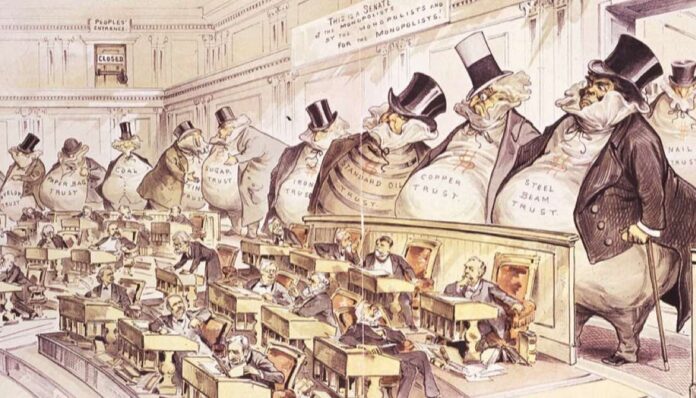
By 1882, John D. Rockefeller’s Standard Oil Trust controlled 90% of America’s oil refineries and pipelines. He was one of a small group of late 19th century tycoons whose fortunes built modern America and earned them a lasting nickname, the robber barons.
The Gilded Age was a time of dazzling wealth and deep inequality. Men like Rockefeller, Andrew Carnegie, Cornelius Vanderbilt and J.P. Morgan turned the United States into one of the world’s great industrial powers, while critics said they did it by crushing competitors, breaking unions and squeezing workers and consumers alike.
Here are nine of the most notorious, and what they left behind.
John D. Rockefeller and Standard Oil
Rockefeller was born in 1839 in Richford, New York, the second of six children, and moved to the Cleveland area as a teenager. He left high school, took a job at a commission firm called Hewitt & Tuttle and soon opened his own.
He invested in his first oil refinery near Cleveland in 1863. Two years later it was the biggest in the region, and he bought out his partners. In 1870 he and several others, including his brother, founded the Standard Oil Company of Ohio, which had bought nearly every refinery in Cleveland by 1872.
The company’s tactics drew public anger and helped lead to the federal Sherman Antitrust Act of 1890. Journalist Ida Tarbell exposed its methods in a 19-part series in McClure’s Magazine between 1902 and 1904, and in 1911 the U.S. Supreme Court broke the trust into more than 30 companies.
Rockefeller was also among the most generous donors in U.S. history. He gave almost $35 million to help found the University of Chicago and, with his son, created Rockefeller University and the Rockefeller Foundation. He died in 1937 at 97.
Andrew Carnegie, from bobbin boy to steel king
Carnegie was born in Scotland in 1835 to a struggling family and arrived in Pittsburgh in 1848, at 13. His schooling ended there, and he went to work long hours as a bobbin boy in a cotton mill.
He moved on to telegraph messenger, then telegraph operator at the Pennsylvania Railroad, and by 1859 he was a division superintendent. In 1865 he founded the Keystone Bridge Company to replace wooden bridges with iron ones, and by 33 he was worth $400,000, about $5 million today.
His workers put in long hours for little pay, and in the Homestead Strike of 1892 ten people died. In 1901 he sold Carnegie Steel to J.P. Morgan for $480 million, earning $250 million personally. By his death in 1919 he had given away $350 million and founded more than 2,500 public libraries.
Test yourself
How much have you picked up so far?
3 quick questions on what you have read so far. The story continues below.
Henry Clay Frick, who shrugged off two bullets
Frick, born in rural Pennsylvania in 1849, co-founded the Frick Coke Company at 21 and was a millionaire by 30. He joined forces with Carnegie around 1882.
During the Homestead Strike, Frick locked workers out and brought in 300 Pinkerton guards. On July 23, 1892, a man named Alexander Berkman shot him twice. Frick telegraphed his family that he was "twice shot, but not dangerously" and was back at work within a week.
He later founded the Frick Collection, an art museum in his former New York City mansion.
Also read: Monopoly Began as Lizzie Magie's 1904 Landlord's Game, a Warning About Greed
Cornelius Vanderbilt, the Commodore
Vanderbilt was born on Staten Island in 1794 and quit school at 11 to work on his father's ferry. He became a steamship captain in 1818, which gave him the lifelong nickname "Commodore," and was a millionaire by 1846.
He then turned to railroads. He owned the whole New York and Harlem Railroad by 1863, and in 1873 he became the first to offer train service from New York City to Chicago.
He built Grand Central Depot, the forerunner of Grand Central Terminal, and gave $1 million to the Nashville school that became Vanderbilt University. He died in 1877.
J.P. Morgan, the banker behind everything
John Pierpont Morgan was born in Connecticut in 1837 to a wealthy banker and followed him into finance, eventually founding the firm that became J.P. Morgan & Company. He helped finance Thomas Edison's early work and, in 1881, had Edison electrify his house.
In 1901 he bought Carnegie Steel and merged it into U.S. Steel. In 1933, 20 years after his death, the Glass-Steagall Act split his firm into three, and his name lives on in Morgan Stanley and J.P. Morgan Chase.
John Jacob Astor, America's first multimillionaire
Astor, a butcher's son, was born in Germany in 1763 and reached the United States in 1784. He opened a fur shop in New York around 1786 and had made $250,000 in the fur trade by 1800.
After the War of 1812 he held a monopoly on the U.S. fur trade, then shifted into New York real estate. When he died in 1848 he left $400,000 for the Astor Library, which later became part of the New York Public Library.
James Buchanan Duke, the tobacco titan
Duke was born in Durham, North Carolina, in 1856. His big bet was on machine-rolled cigarettes, and in 1890, at 33, he helped found the American Tobacco Company, which came to control nearly every tobacco product except cigars.
The Supreme Court ordered it broken up in 1911. In 1924 he created the Duke Endowment, more than $100 million that would fund Duke University.
Jay Gould, the most hated of them all
Gould was born in 1836 in Roxbury, New York, to a poor farming family. To keep Vanderbilt from taking the Erie Railroad, he quietly watered down its stock and bribed state lawmakers.
With his partner Jim Fisk he set off the "Black Friday" gold panic of 1869. He still built the largest railroad empire in the country and left more than $70 million when he died of tuberculosis in 1892.
Leland Stanford, governor and railroad boss
Stanford, born in New York in 1824, followed the Gold Rush to Sacramento in 1852 and ran a mining supply store. He served as California's first Republican governor from 1862 to 1863 and was president of the Central Pacific Railroad from 1861 until his death in 1893.
After his son Leland Jr. died young, Stanford and his wife Jane founded Leland Stanford Junior University on their Palo Alto land in 1885. Today it is simply Stanford University.
Also read: Henry Ford Spent $20 Million on Fordlandia, a Midwest Town in the Amazon That Failed
Based on reporting by All That's Interesting
By Trivia News Staff | History