
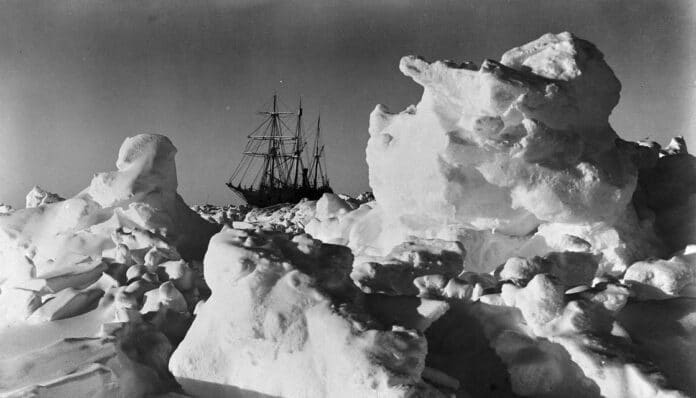
Sir John Franklin’s 1845 Arctic expedition ended with every one of its 129 men dead. Seventy years later, Ernest Shackleton’s ship was crushed by Antarctic ice, and all 28 men aboard Endurance came home alive.
Both voyages set out with big goals, both ships got trapped in ice, and both crews ended up stranded far from help. Following the two stories side by side shows how differently a polar disaster could unfold.
Two expeditions, two very different goals
Franklin sailed from England on May 19, 1845, and his was no reckless gamble. HMS Erebus and HMS Terror were reinforced veterans of Antarctic exploration, fitted with steam engines and heating, and stocked with food for at least three years.
Five men were sent home from Greenland, leaving 129 to push into the Canadian Arctic. Their mission was to chart the last unknown stretches of the Northwest Passage between the Atlantic and the Pacific.
They spent their first winter at Beechey Island, where three men died, then sailed south toward King William Island. From there, a celebrated British expedition turned into one of the great mysteries of exploration.
By 1914, others had already reached the South Pole, so Shackleton aimed for a different first, a crossing of the whole Antarctic continent. Endurance left South Georgia on December 5, 1914, but on January 19, 1915, the ship froze fast in the pack ice of the Weddell Sea.
Test yourself
How much have you picked up so far?
3 quick questions on what you have read so far. The story continues below.
Trapped in the ice
In September 1846, Erebus and Terror were caught in ice northwest of King William Island. One winter passed, then a second, and Franklin died on June 11, 1847, leaving Francis Crozier in command.
Much of what is known comes from the Victory Point Note. An early message on it said all was well, but later additions told a darker story of Franklin dead, other men lost and ships stuck since 1846.
Endurance was stuck too, but the ice around her kept drifting through the Weddell Sea. For about nine months the men lived aboard as she moved with the frozen ocean, until the pressure began twisting her wooden hull.
On October 27, 1915, Shackleton ordered everyone off. His men watched from the ice as the ship slowly broke apart.
Leaving the ships
Franklin's survivors abandoned Erebus and Terror on April 22, 1848. Only 105 of the original 129 were still alive.
They seem to have headed south for the Back River, hoping to reach help linked to the Hudson's Bay Company. That meant trading shelter and stores for an enormous march across the Arctic, and later searchers found only bodies, gear and scattered belongings along the way.
Shackleton's 28 men camped on floating sea ice instead. They saved food, equipment and, crucially, three lifeboats named James Caird, Dudley Docker and Stancomb-Wills.
Hauling the boats over the ice wore the men out, so Shackleton chose to camp and let the drifting pack carry them. When the ice finally broke up in April 1916, they launched the boats and reached remote Elephant Island, standing on solid ground for the first time in about 497 days.
Also read: Violet Jessop Survived 3 Shipwrecks, Titanic Included, and 9 More Real Survivors
What the Inuit saw, and what Shackleton did
Years went by before anyone pieced together Franklin's fate. In 1854 explorer John Rae gathered Inuit accounts of starving Europeans walking south, along with bodies found farther on and objects from the expedition.
The testimony included a terrible detail, that some survivors had turned to cannibalism. Victorian Britain was outraged, and even Charles Dickens attacked the Inuit accounts, though later archaeology backed them up.
Elephant Island was uninhabited and far from shipping lanes, so Shackleton went for help. On April 24, 1916, he and five others set out in the 22 foot James Caird for South Georgia, about 800 miles across some of the roughest seas on Earth.
They landed 17 days later, on the wrong side of the island. Shackleton, navigator Frank Worsley and sailor Tom Crean then crossed its mountains on foot and walked into the whaling station at Stromness on May 20.
How each story ended
No one from Franklin's expedition ever came home. His disappearance set off a long series of searches, many urged on and paid for by his wife, Lady Jane Franklin, which turned up graves, papers and relics but never the ships.
That changed nearly 170 years after he sailed. Parks Canada found Erebus in 2014 and Terror two years later, guided in part by Inuit knowledge that earlier generations had brushed aside.
Shackleton still had 22 men waiting on Elephant Island, and ice and weather beat back several rescue attempts. On August 30, 1916, the Chilean ship Yelcho finally reached them, and every one was alive.
One footnote matters here. A separate group, the Ross Sea Party, was laying supply depots on the far side of Antarctica, and three of its members died, so the claim that the whole expedition survived is true only of the 28 men of Endurance.
Based on reporting by WanderTrivia
By Trivia News Staff | Geography