
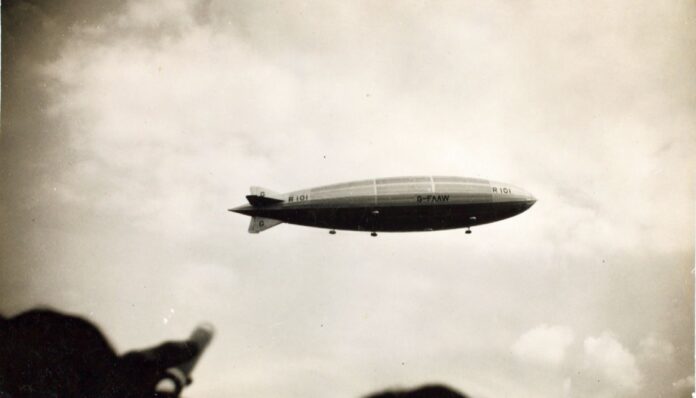
Britain’s R101 airship crashed in France on October 5, 1930, killing 48 of the 54 people aboard. That is more than died in the far more famous Hindenburg disaster seven years later, yet the R101 is almost forgotten today.
Its loss ended the dream of airship travel across the British Empire. The story of how it happened is a tale of government pride, a deadline that could not move and a giant ship that was never really ready to fly.
A short age of giants
The era of the great rigid airship lasted barely 40 years. It began with the first Zeppelin flights in 1900 and ended when the last survivor, the Graf Zeppelin II, was scrapped in 1940.
Count Ferdinand von Zeppelin, a former German Army officer, put the key ideas together into one workable design: a rigid aluminum frame, several hydrogen-filled gas cells, air-filled ballonets to control pressure and water ballast to control height. In 1910 he founded DELAG, the world’s first airline.
Airships could carry more passengers farther and in more comfort than the small airplanes of the day, with little turbulence. Their weakness was the weather, so DELAG never ran a fixed schedule and only flew when conditions allowed.
From war machines to ocean liners of the sky
Zeppelin saw airships mainly as weapons. During World War I, the German Imperial Navy used them for the first aerial bombing raid on London on May 31, 1915, though the raids did limited damage and most of the airships and their crews were eventually shot down in flames.
After the war the lead passed to Britain. In July 1919 the British airship R34 made the first east to west crossing of the Atlantic, from East Fortune in Scotland to Long Island, New York, in 108 hours, and four days later flew home again.
Germany came back in style in 1928 with the LZ-127 Graf Zeppelin, the only truly successful passenger airship. In 1929, with backing from American newspaper owner William Randolph Hearst, it flew around the world from Lakehurst, New Jersey, covering 33,234 kilometers in 21 days, 5 hours and 31 minutes.
The capitalist ship and the socialist ship
That success revived British interest. In 1924 inventor and member of Parliament Sir Charles Burney launched the Imperial Airship Scheme, a plan to link the far-flung empire with a fleet of long range airships.
The Labour government of Prime Minister Ramsay MacDonald cut his proposed 6 airships to just 2 and set up an unusual contest. A private company would build one, the R100, and a government body would build the other, the R101. The press soon called them the “capitalist ship” and the “socialist ship.”
The private R100 was built by Vickers-Armstrong under engineer Barnes Wallis, later famous for the “bouncing bomb” of the Dambusters raid. Among its engineers was Nevil Shute, who would go on to write the novels On the Beach and A Town Like Alice. Built with proven methods, the R100 beat its top design speed by nearly 20 km/h, flew to Montreal in 79 hours in July 1930 and came home in 57.
Test yourself
How much have you picked up so far?
3 quick questions on what you have read so far. The story continues below.
A ship too heavy to lift
The government's R101 was meant to be the most advanced airship ever built, and that ambition produced a string of bad choices:
- A stainless steel frame instead of light aluminum alloy, which left less room for gas cells
- Heavy diesel engines, picked as safer in hot climates
- Gas cells held so loosely that they rubbed against the frame and leaked
- Valves so sensitive that they kept venting precious hydrogen
- Fabric laced on in small panels, most of which rotted and tore before the ship left its hangar
The result could lift only 35 tons, and in the hot thin air of India that would drop to 24. In tests it was sluggish and liable to dive or climb without warning. About its only strength was luxury, with two decks of cabins, a gold-trimmed dining room with potted palms and even an asbestos-lined smoking room.
A deadline set by ambition
By summer 1930 the R101 was nowhere near ready for its planned first flight to Karachi in British India. The R100's triumph in Canada made any delay look like defeat.
Lord Thomson of Cardington, the Secretary of State for Air, pushed hardest. He hoped to become Viceroy of India and believed arriving there aboard the R101 would help, so he timed the flight to coincide with the Imperial Conference in London.
The ship was cut in half and lengthened with an extra gas cell, emerging on October 1 at 236 meters long, a meter longer than the Graf Zeppelin. It had now cost 717,000 pounds of public money, against 500,000 for the R100.
Then it was loaded with cases of champagne and beer, state silverware and a heavy blue carpet. Crew members were allowed 10 pounds of baggage each, while Lord Thomson's luggage came to nearly a ton. He called the ship "as safe as a house," though he quietly bought extra insurance for himself and his valet.
Also read: A Bet Over One Cocktail Sent Joe Duckworth Into a Hurricane's Eye in 1943
The last flight
On the evening of October 4, 1930, the R101 left Cardington with 54 people aboard, 42 crew and 12 passengers, among them Lord Thomson, Director of Civil Aviation Sir Sefton Brancker and Reginald Colmore, Director of Airship Development. Winds were gusting to 60 km/h, and any other flight would have been postponed.
At 6:36 p.m. the ship cast off and promptly began to sink. Nearly two tons of water ballast had to be dumped before it leveled out.
It crawled toward the coast against strong headwinds, at times as low as 150 meters. A resident of Hitchin later recalled seeing the airship heading straight for the house, so low that the people dining inside and the light bulbs in the ceiling were visible.
Over the Channel it flew at barely 300 meters, although airships usually cruised at three times their own length. The radio operator still reported that the passengers had enjoyed an excellent supper and a final cigar before bed.
The final minutes
At 2 a.m. the watch changed as normal. Four minutes later the R101 pitched forward into a steep dive and fell nearly 300 meters before Chief Coxswain George Hunt leveled it.
A crash was now certain. At 2:09 a.m. the ship hit the ground at just 8 km/h at the edge of a forest called the Bois de Coutumes, 50 kilometers northwest of Paris, and burst into flames.
Engineers Joe Binks and Arthur Bell escaped when a ballast tank broke above them and soaked them with water. Foreman engineer Harry Leech clawed his way out of the smoking room and even went back to try to rescue others, but it was too late.
Only eight people got out alive, and two of them, riggers Samuel Church and Walter Radcliffe, later died of their injuries. That left 48 dead. The Hindenburg disaster of 1937 killed 36, so the R101 claimed 12 more lives.
The end of British airships
France held a day of mourning, and 100,000 people escorted the coffins to the railway station. In London, half a million people watched a funeral procession two miles long that took an hour to pass, and the victims were buried in a common grave at Cardington.
The inquiry blamed government haste, concluding the ship would never have left for India that night if public policy had not made it seem so desirable. No charges were brought, because those responsible, Lord Thomson included, had died in the crash.
The exact cause is still unknown. The leading theory is that a gust tore away part of the fabric and a forward gas cell lost much of its hydrogen. Nobody knows what started the fire either, with theories ranging from a severed electrical cable to static electricity or ballast water spilling onto calcium signal flares.
Newspapers demanded the government "Ban the Gas Bags!" The Imperial Airship Scheme was scrapped, and in November 1931 the R100, despite its excellent record, was broken up and sold for barely 600 pounds.
Airships that fell in America too
The R101 was the worst British air disaster up to that time, but not the worst airship disaster. In 1923 the French military airship Dixmude, a former German Zeppelin taken as war reparations, exploded in a thunderstorm off Sicily and killed 52. The U.S. Navy's Italian-built Roma hit power lines near Norfolk, Virginia, in 1922 and exploded, killing 34, after which the Navy filled its airships with safer helium.
Helium could not beat the weather. The USS Shenandoah broke apart in a squall near Caldwell, Ohio, in 1925, killing 14 of its 43 crew, and the USS Akron was thrown into the sea off New Jersey on April 4, 1933, killing 73 of 76 men, the deadliest airship disaster in history.
Her sister ship, the USS Macon, went down off Point Sur, California, in 1935, though all but 2 of her crew were rescued. After the Hindenburg burned in 1937, its sister ship Graf Zeppelin II was used to probe British radar before being broken up for its aluminum in 1940, and it was clear that the future of flying belonged to the airplane.
Based on reporting by Today I Found Out
By Trivia News Staff | History