
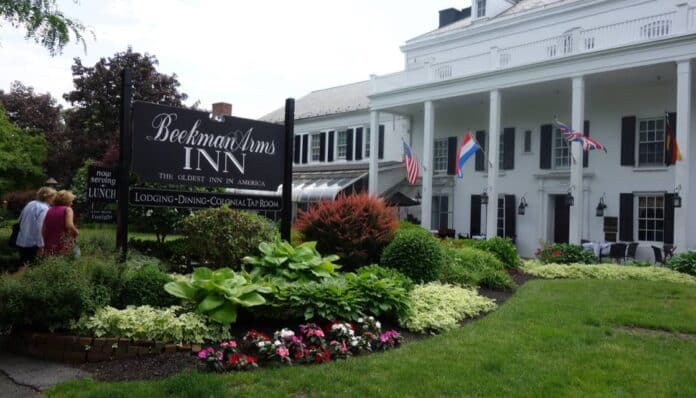
George Washington and Alexander Hamilton stayed at the Beekman Arms in Rhinebeck, New York, and Revolutionary War troops drilled on its front lawn. The inn opened in 1766 and is thought to be the oldest continuously operating inn in the country.
It is one of a small group of American inns old enough to make a guest wonder who looked out the same window 200 years earlier, and why they were traveling. Katherine Orr, a spokesperson for Historic Hotels of America, puts it simply, saying historic hotels hold the stories of their guests and of everything the buildings have witnessed.
Adrian Covert, author of Taverns of the American Revolution, says he picks places to sleep partly for the story he will be able to tell afterward. These four inns supply plenty of them.
The Beekman Arms, Rhinebeck, New York
The site began as the Traphanger Tavern, a simple crossroads stop where travelers watered their horses and ate a meal. It sat in Rhinebeck Village, roughly halfway between New York City and Albany on the Kings Highway, beside an east to west road leading to a busy Hudson River ferry.
That location brought a steady flow of customers, and by 1766 business was strong enough to add an inn, the Beekman Arms. About 160 years after those soldiers drilled outside, Franklin D. Roosevelt, who grew up nearby, gave several important speeches from its columned front porch.
Inside, the lobby still has worn wide plank floors, oil portraits of famous guests and a fireplace that heats the room in winter. The rooms have been modernized but stay small, and the Beekman Tavern draws cooks from the nearby Culinary Institute of America. Rhinebeck itself is easy to explore on foot, which helps explain why the Hudson Valley has drawn visitors since Washington’s day.
Also read: McSorley’s in New York Has Poured Just Two Kinds of Ale for Over 150 Years
Test yourself
How much have you picked up so far?
3 quick questions on what you have read so far. The story continues below.
John Rutledge House Inn, Charleston, South Carolina
Anyone expecting low beams and gloomy rooms will be surprised here. The John Rutledge House Inn is tall and bright, with airy rooms, a facade full of windows and bold paint.
Its history is solid, though. The house was finished in 1763, and its upper stories still carry scars from Civil War shelling by Union ships. John Rutledge himself was a delegate to the First and Second Continental Congresses, served as South Carolina's first president and later its governor, and signed the U.S. Constitution.
Guests at the afternoon tea or the evening brandy, sherry and wine hour in the library can leaf through a scrapbook of clippings and old photographs. They can also step onto the wrought iron balcony above Broad Street and its mansions and townhouses.
Why so few old inns survive in cities
The Rutledge house is unusual because its main building is older than the American Revolution. Covert explains that once the economy began to grow in the early 1800s, wealthier travelers stopped wanting to share a room with strangers.
A new kind of lodging, the hotel, offered a private room, though the bathroom was still shared. Old taverns and inns fell apart, and in cities, where they sat on valuable land, they were torn down.
That is why New York, Boston and Philadelphia have very few truly old places to stay. Many of the inns that did survive stood in quiet towns or on smaller roads that the big highways later passed by.
The Omni Homestead, Hot Springs, Virginia
It takes imagination to picture the original 1766 wooden lodge inside today's grand resort. Early guests came for the same reasons people come now, the Allegheny Mountains and the mineral rich water, long believed to heal.
Thomas Jefferson spent 22 days soaking in the local waters in 1818 to ease his rheumatism. He is one of 24 U.S. presidents who have visited the Homestead. The hotel has seen harder times as well:
- During the Civil War it was taken over as a Confederate hospital.
- Right after Pearl Harbor in 1941, 785 Japanese diplomats and their families were held there for seven months while their return to Japan was negotiated. The U.S. government hoped comfortable treatment would encourage Japan to treat captured Americans gently.
Today visitors can play golf or tennis, and history fans can go down the road to the restored wooden bathhouses and soak in stone pools fed by spring water at 98 to 99 degrees. The Gentlemen's Pool House is an eight sided building around an eight sided pool, the Ladies' Pool House has 22 sides, and both are lit and aired through large round openings in the roof.
The Red Lion, Stockbridge, Massachusetts
The story told by generations of innkeepers is that Silas and Anna Bingham built the Red Lion in 1773 as a general store, tavern and inn on the stagecoach road between Boston and Albany. According to that legend, rebels met there in 1774 to protest Britain's Intolerable Acts and plan their resistance.
Historians are not convinced. Records show the Binghams reached Stockbridge in 1775, and Bingham's Tavern did not open until 1778, so the inn may not be older than the Declaration of Independence, and its Revolutionary role may have been polished by later owners.
The original building, much enlarged over time, burned down in 1896 and was rebuilt quickly enough to reopen the next summer. That may have been when the owners decided its backstory needed a little extra shine.
Also read: Colonial Williamsburg Breakfast Was Cornmeal Hoecakes, Not Today's Pancake Stacks
Tucked into the Berkshires, the Red Lion has still welcomed a remarkable list of guests, including Jane Goodall, Cicely Tyson, Ray Davies and six U.S. presidents. Norman Rockwell, who lived nearby, ate there regularly, and several of his quick sketches hang framed around the inn, whose rooms are spread over several old buildings, including a restored firehouse.
Based on reporting by History.com
By Trivia News Staff | Landmarks