
On July 27, 1943, Army Air Force Lieutenant Colonel Joseph Duckworth flew a small training plane straight into a hurricane off Galveston, Texas, because a group of British pilots bet him he could not. The stake was a single highball.
No one had ever flown into a hurricane on purpose before. Duckworth did it twice that day, and the flight led directly to the Hurricane Hunters, the Air Force squadron that still flies into storms off the U.S. coast.
A storm nobody saw coming
That morning Duckworth was eating breakfast at Bryan Field near Galveston while a Category 2 hurricane closed in on the coast. The storm had arrived as a total surprise, because a wartime radio blackout on ships in the Gulf of Mexico, meant to hide them from German U-boats, had kept any warning from reaching shore.
Sharing his table were British pilots who had come to Texas to learn instrument flying. When they heard about the storm, they bet him that his North American T-6 Texan, the standard single engine American trainer, was too flimsy to survive a trip through the eye. Duckworth accepted.
The father of instrument flying
Few pilots alive were better suited to the dare. Duckworth was born in Savannah, Georgia, on September 8, 1902, graduated as an Army Air Force cadet in 1928, and spent the 1930s flying for Ford Motor Company, Curtiss-Wright Flying Service and Eastern Airlines.
By then he had logged more than 12,000 flying hours and mastered flying on instruments alone. Instrument Flight Rules had grown out of the U.S. Air Mail Service, launched in 1918, whose pilots had to keep schedules at night and in bad weather.
The Air Force recalled him as a major in 1940 and in 1942 put him in charge of instrument training at Bryan Field. He was appalled by what he found:
- Most cadets were trained as if their planes had no instruments at all.
- Instructors told students the blind flying gauges were for airline pilots and kept them locked to protect them.
- Wartime pressure had cut pilot training from one year in 1940 to six months in 1942.
Duckworth set up the first Air Force Standardization Board to test instructors and wrote a new training program and manual. Between May and October 1942 the number of students at Bryan Field nearly doubled while the accident rate fell by more than half, and his system was rolled out across the whole Southeast Training Command that November.
Into the eye
Planes had tracked hurricanes from the outside before. In September 1935 Captain Leonard Povey of the Cuban Army Air Corps spotted the storm that became the Labor Day Hurricane heading for the Florida Keys, and he urged a regular aerial hurricane patrol afterward. But nobody had gone inside one.
Knowing official permission would take hours, if it came at all, Duckworth grabbed the only navigator on duty, Lieutenant Ralph O’Hair, and took off within minutes. As they passed over Galveston, the control tower asked whether they knew a hurricane was coming, and when Duckworth said yes, it asked where to send the search party.
O’Hair later said the plane was tossed about like a stick in a dog’s mouth. The T-6 held together and broke out into the calm eye, where Duckworth noted the shape of the eyewall before flying back out through winds of about 130 mph.
Also read: Disney World and Mount Vernon Sit Under No-Fly Zones, and So Do 8 Other U.S. Sites
The second flight, and the missing drink
Back at Bryan Field, weather officer Lieutenant William Jones-Burdick was waiting on the tarmac and asked to be taken in to collect measurements. Duckworth flew into the storm a second time that same day.
His superiors were alarmed by the unauthorized flights, but there is no record that he was reprimanded. There is also no record that he ever collected his highball.
Duckworth played it down. Airline pilots, he pointed out, already flew through jet stream winds of up to 150 mph, and the only truly awkward outcome would have been an engine failure, which would have made landing nearly impossible.
From a dare to a squadron
The July 1943 hurricane killed 19 people and caused more than $17 million in damage, about $300 million in today’s money. Local officials dropped the radio blackouts, and the Air Force created its first dedicated weather reconnaissance unit, the 3rd Weather Reconnaissance Squadron, nicknamed the Hurricane Hunters.
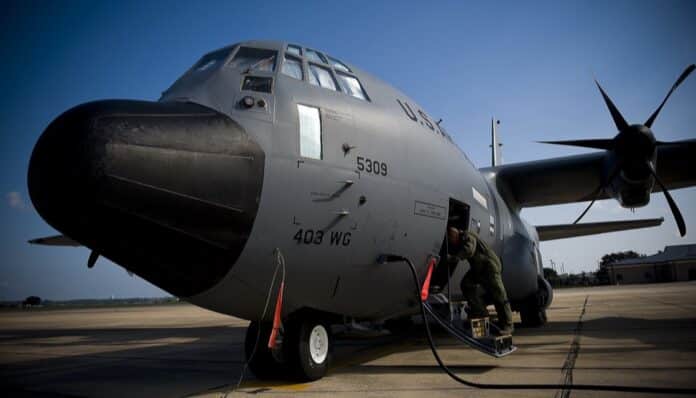
The unit was reborn in 1951 as the 53rd Weather Reconnaissance Squadron, which is still flying today from Keesler Air Force Base in Biloxi, Mississippi. Its 10 WC-130J Super Hercules aircraft carry weather instruments, and the squadron can intercept up to three storms a day with 16 hours’ notice, from the mid-Atlantic to the International Date Line.
Satellites have made tracking far easier, but some readings, such as barometric pressure and wind speed inside a storm, can only be taken by flying in. NOAA runs its own research Hurricane Hunters from Lakeland Linder International Airport in Florida.
What became of Duckworth
He retired from the Air Force in 1955 after commanding Hickam Field in Hawaii, then taught physics at Albion College in Michigan and led the Safety Bureau of the Civil Aeronautics Board. He died in Battle Creek on July 26, 1964, one day short of 21 years after his flight. The source article puts it at almost 19 years, which does not match the dates it gives.
Also read: Alaska Natives Aged 12 to 80 Guarded 6,640 Miles of U.S. Coast in World War II
Based on reporting by Today I Found Out
By Trivia News Staff | General