
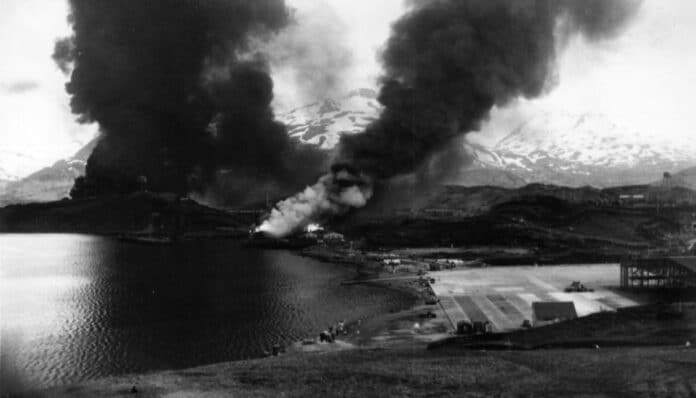
In June 1942, six months after Pearl Harbor, Japanese planes bombed Dutch Harbor in Alaska’s remote Aleutian Islands, and Japanese forces then occupied the islands of Attu and Kiska. It was the first time foreign troops had held U.S. territory since the War of 1812.
Once American forces pushed the Japanese out, military leaders faced a new problem. Someone had to watch the vast, harsh 6,640 mile coastline of northwest Alaska for the rest of the war, and more than 6,300 Indigenous men and women, aged 12 to 80, stepped up to do it.
Who joined the guard
The volunteers formed the Alaska Territorial Guard, or ATG, which was also known by a name many Arctic communities now consider a slur rooted in racism and colonialism. Some Euro-Americans joined, but most recruits came from Tlingit, Aleut, Tsimshian, Haida and Athabascan communities, and especially from the Yup’ik and Inupiaq people of the Bering Sea and Arctic coast.
They knew the land and how to survive brutal winters. Each received a single rifle, a uniform, an army training manual, snowshoes and other gear, and these unpaid sentries learned military drills and how to run communications equipment, becoming the eyes and ears of the U.S. military in western Alaska.
A territory still waiting on statehood
Alaska had been American since 1867, when the United States acquired more than 580,000 square miles of it. Yet it would be 92 years before the Last Frontier became the 49th state, so these defenders were guarding a territory, not yet a state.
Guarding metal, planes and supply routes
The guard protected areas around the lend lease route the United States used to fly aircraft to its wartime ally, Russia. It also watched over the village of Platinum, home to a mine that was the only source of that strategic metal in the Western Hemisphere.
Officers followed the lead of Alaska Natives and used local dogsleds to move between bases. The guard’s duties kept growing:
- moving equipment and supplies and building ATG facilities
- clearing airstrips and support sites for other military agencies
- breaking hundreds of miles of wilderness trail
- setting up and repairing dozens of emergency shelter cabins
- caching food and ammunition for the U.S. Navy along key routes
- fighting fires, carrying out land and sea rescues and training for combat
Also read: A Ghost Army of Rubber Tanks and 9 Other Fakes That Saved Lives in World War II
Faces of the guard
Among the notable members was Holger Jorgy Jorgensen, a bush pilot of Norwegian descent and former Morse code operator who later helped stage a sit in to integrate Nome’s Dream Theater. He went on to speak for Alaska veterans and Alaska Native people at elder and youth events.
Wesley Ugiaqtaq had herded reindeer for the Bureau of Indian Affairs and captained a whaling ship before joining in Utqiaġvik, formerly Barrow. David Ungrudruk Leavitt Sr., also Inupiaq, grew up a subsistence hunter and joined as a teenager, and decades later he flew with an Honor Flight to Washington, D.C., to meet fellow veterans who knew their commander, Marvin Muktuk Marston.
Others were forced from their homes
Not every Alaska Native family was asked to serve. After the Dutch Harbor attack, the military evacuated the Pribilof Islands in the Bering Sea, loading Indigenous families onto crowded ships bound for southeast Alaska.
There they were housed in fish canneries, abandoned mine buildings and other unsafe, unsanitary structures. Of the 881 people detained, about 100 died before the war ended.
Shooting down balloon bombs
The guard stayed on watch even after the fighting moved to Europe and the South Pacific. In the final months of the war, Japan launched 9,000 incendiary balloon bombs designed to ride the jet stream to the American mainland.
ATG members, trained to spot enemy ships and aircraft, identified the balloons and helped shoot them down and disable them.
Recognition took more than six decades
After the war, ATG veterans and their supporters pushed for and won Alaska’s first anti discrimination law, aimed at ending segregation of Indigenous people. Formal recognition of their own service took far longer.
It came only when federal law ordered the defense secretary to issue honorable discharges to the Alaska Native guardsmen, granting them veteran status more than 60 years after they first stood watch. Alaska’s Department of Military and Veterans Affairs then formed a task force to find former members and their families and help them claim benefits, with the stated aim of locating every single one.
Federal money followed to make sure their service would be remembered. In 2012, a group of veterans in Bethel, Alaska, used part of it to build a memorial park honoring the Alaska Territorial Guard.
Also read: Godzilla Was Born From a 1954 H-Bomb Test That Showered a Japanese Fishing Boat
Based on reporting by HISTORY
By Michael Brandt | History