
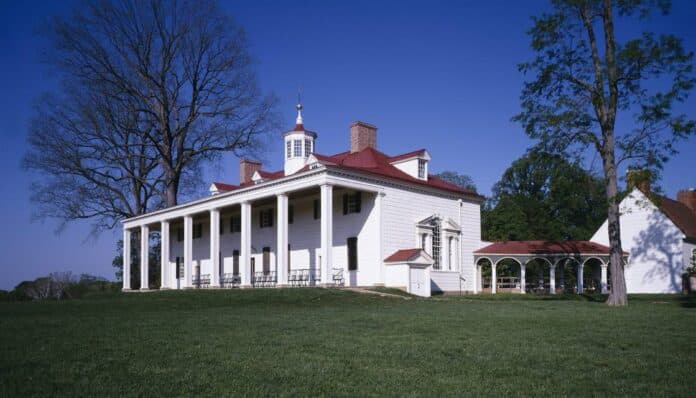
Pilots cannot fly over Walt Disney World, and they cannot fly over George Washington’s home at Mount Vernon either. Both sit inside permanent no-fly zones, the same kind of restricted airspace that protects the White House and secret military bases.
From 35,000 feet nobody can see what lies below anyway, but the rules are real and strictly enforced. Here are the places in America where the sky is closed for good, and the reasons behind each one.
Washington, D.C., the tightest airspace of all
Anyone who has landed at Ronald Reagan Washington National Airport may remember the sharp, sudden turns on approach. That is ordinary flying for one of the most restricted airspaces on Earth.
The Federal Aviation Administration runs the greater D.C. area as a Special Flight Rules Area. Pilots inside it must stay in constant two way radio contact, keep their transponders broadcasting and get explicit clearance.
Inside that sits a Flight Restricted Zone stretching roughly 13 to 15 nautical miles around Reagan National. Deeper still are Prohibited Areas P-56A and P-56B, which permanently close the air above the White House, the U.S. Capitol and the U.S. Naval Observatory to civilian traffic.
Area 51 and its secret airline
Groom Lake, Nevada, better known as Area 51, has fueled alien theories for decades, including an online craze about storming its gates. The gates remain secure, and the sky above is locked down even tighter.
The base does have one exclusive commuter service. Unmarked passenger jets leave every day from a private, heavily secured terminal at Harry Reid International Airport in Las Vegas, carrying employees straight into the restricted zone under the call sign “Janet.”
Why Disney got military grade protection
Since 2003, Walt Disney World in Florida and Disneyland in California have had the same airspace protection as high level military bases. The rule came through Operation Liberty Shield, a federal safety program created after the 9/11 attacks to guard densely crowded places.
Disney had been asking for it since the late 1990s, though. When Animal Kingdom opened in Orlando, low flying planes threatened to upset the animals, and rivals such as SeaWorld were hiring banner towing planes to advertise directly over the parks. A permanent no-fly zone solved both problems at once.
Also read: Mount Rushmore Was Supposed to Have Torsos, and 11 Other Landmark Secrets
Rocket launches and the president’s retreat
The Kennedy Space Center on Florida’s Merritt Island sits inside tightly controlled airspace whenever a launch or other sensitive operation is underway. The FAA sets temporary and permanent flight restrictions during launch windows, and airlines are rerouted well away from the coast to avoid a midair disaster.
Camp David, the presidential retreat in the hills of Maryland, is covered by Prohibited Area P-40. That zone has a radius of three nautical miles every day of the year, and it expands to 10 nautical miles whenever the president or the first family is staying there.
Submarine bases on both coasts
Naval Submarine Base Kings Bay in St. Marys, Georgia, is home port for the Atlantic Fleet’s Ohio class submarines, which carry a large share of the country’s strategic nuclear weapons. The Navy asked for its skies to be closed in late 2005, and the FAA created Prohibited Area P-50.
On the other side of the country is Naval Base Kitsap, formed in 2004 by merging two historic naval facilities across Elliott Bay from Seattle. It is the largest naval facility in Navy Region Northwest and is protected by Prohibited Area P-51, which pilots like to joke about because it has nothing to do with Area 51.
Mount Vernon, protected for its history
Not every closed sky guards weapons. Mount Vernon, Washington’s estate in Virginia, falls under Prohibited Area P-73.
The restriction protects the historic house from the vibration of low flying aircraft and keeps the setting quiet for its millions of visitors. Even professional aerial photographers with drones rarely get permission to fly there, which makes it an unusually calm patch of air in the busy Northeast corridor.
A silent forest and a nuclear plant
The Boundary Waters Canoe Area Wilderness covers more than a million acres of lakes and forest in northern Minnesota, within Superior National Forest. In 1949, President Harry Truman signed an executive order banning aircraft from flying low over it so that campers and canoeists would hear nothing but nature.
The last site is the Pantex Plant northeast of Amarillo, Texas, the country’s main facility for assembling, maintaining and dismantling nuclear weapons. It has not built a weapon since 1991, but it still guards existing warheads and retires old ones under the National Nuclear Security Administration.
Pantex holds a distinction of its own. Of all the nuclear security sites around the country, it is the only one protected by a permanent, highly restricted federal no-fly zone.
The numbered zones at a glance
Several of these sites carry their own prohibited area designation:
- P-56A and P-56B: the White House, the U.S. Capitol and the U.S. Naval Observatory
- P-40: Camp David, 3 nautical miles, widening to 10 when the president is there
- P-50: Naval Submarine Base Kings Bay, Georgia, created after a 2005 Navy request
- P-51: Naval Base Kitsap, Washington
- P-73: Mount Vernon, Virginia
Based on reporting by WanderTrivia
By Megan Caldwell | Landmarks