
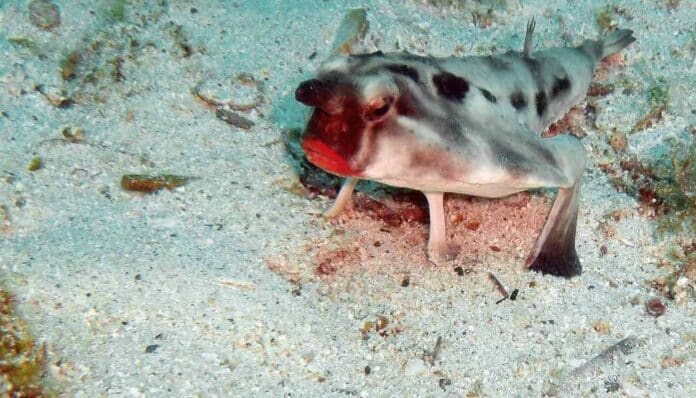
A fish that seems to wear red lipstick, a 6-foot shark that glows in the dark and a bat whose tongue tucks away beside its heart all sound like the work of an image generator. Every one of them is real.
Fake pictures have been around as long as the internet, and modern tools make them more convincing every year. Nature, though, keeps producing creatures stranger than anything invented, often because an odd feature helps them feed, find mates or survive.
A giant fungus and a bat with a record tongue
In 2026, researchers formally described an enormous fungus from China’s Yunnan Province and named it Dianjunus rex. When it reproduces, it grows thick white structures called stromata that can reach 20 inches tall and weigh as much as 4.9 pounds.
Scientists do not yet know why it puts so much energy into growing them. A genetic study estimated that its family line appeared about 65 million years ago, close to the Chicxulub asteroid impact and the mass extinction that followed, though the timing does not prove the impact caused it.
The tube-lipped nectar bat was discovered in Ecuador in 2003 and formally described two years later. It is about the size of a mouse, yet its tongue stretches about 3.3 inches, roughly 150% of its body length and the longest of any mammal relative to its size.
That tongue reaches nectar deep inside flowers that other bats cannot get to. When the bat is not feeding, the tongue pulls back into a tube in its chest, between the breastbone and the heart.
A spider dressed as a fungus
Some fungi infect spiders and sprout from their bodies. In 2025, researchers in the Ecuadorian Amazon found what looked like one of those victims, fuzzy and covered in stalks, until it started to move.
It turned out to be a new species, formally described in 2026 as Taczanowskia waska. The fungus-like growths are part of its own body, a rare case of a spider imitating a fungus that attacks spiders.
Nobody knows why yet. The disguise might scare off predators or help it sneak up on prey, and so far only females have been documented.
Coiled snakes and a ghostly lobster
A study published in 2026 looked at how snakes fit their long bodies inside an egg. Researchers found that the embryo’s body grows faster than its gut, so the body coils around a pillar formed by the gut, which they called the “visceral pillar.”
The twisted arrangement is only temporary. As the embryo develops, the body and gut settle into their normal adult layout.
Most American lobsters are mottled brown, but a few come in blue, yellow, orange, purple or calico. In September 2026, the University of New England received Casper, a white lobster donated by the Maine State Aquarium, and estimates the odds of finding one at about one in 100 million.
A cartoon sea star and a glowing shark
In 2025, a Schmidt Ocean Institute expedition livestreamed a bright orange sea star from the seafloor off Argentina. Viewers thought it looked just like Patrick Star from SpongeBob SquarePants, and it became an internet favorite.
The sea star was not a new species, but the expedition was still a success. At a 2026 workshop, biologists identified 57 new marine species from the specimens it collected.
Kitefin sharks can grow nearly 6 feet long, which makes them the largest known glowing vertebrates. A 2026 study found that they glow on their backs as well as their bellies, and suggested the greenish light may help them find prey on the dark seafloor rather than just hide them.
Brown pandas, orange crocodiles and a fish with lipstick
The final three are familiar animals with a strange twist:
- Brown pandas. A rare brown and white panda lives in China’s Qinling Mountains. In 2024, researchers linked the color to a 25 base pair deletion in a gene called Bace2, found in both copies in two brown pandas and in none of 192 black pandas they checked.
- Orange crocodiles. Some African dwarf crocodiles in Gabon live in caves and hunt bats and cave crickets, and several adults are orange. Researchers suspect years of exposure to bat droppings stained their skin, but that has not been confirmed.
- The red-lipped batfish. This fish lives on the seafloor around the Galápagos Islands, usually 10 to 250 feet down. It walks on modified fins instead of swimming, and nobody knows why its lips are bright red.
Like other anglerfish, the batfish also carries a small lure on its head that may help it attract prey. Ideas that its red lips help it attract or recognize mates are still only theories.
Based on reporting by Listverse
By Rachel Morgan | Geography