
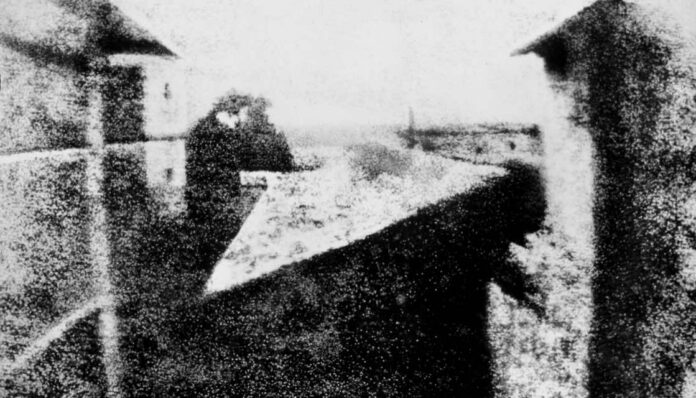
The first photograph in history looks more like a smudged charcoal sketch than a picture. Frenchman Joseph Nicéphore Niépce made it in 1826 or 1827 by pointing a camera obscura out of an upstairs window and leaving a coated pewter plate exposed for about eight hours.
He called the result a first, uncertain step in a completely new direction. Today the image is known as “View from the Window at Le Gras,” and every snapshot taken on a phone traces back to it.
An inventor who started with an engine
Niépce was born on March 7, 1765, and spent much of his adult life experimenting with new technology. His first major invention, built with his brother in 1807, was an internal combustion engine they named the pyréolophore, from Greek words for fire, wind and “I produce.”
As their 10-year patent on the engine was running out, Niépce turned to something new. Starting in 1816, he experimented with what he called héliographie, or “sun writing.”
His first results were frustrating. He managed to make images on paper coated with silver chloride, but they came out reversed as negatives and turned completely dark once they were exposed to sunlight.
Bitumen, lavender oil and a box with a hole
It took him about a decade of trial and error with different chemicals, materials and techniques to get a lasting image. According to the Harry Ransom Center, he dissolved light-sensitive bitumen in oil of lavender and spread the mixture over a pewter plate.
Next he placed the plate inside a camera obscura. The device had existed in some form since at least the 4th century B.C.E., and it is essentially a dark box with a small hole that projects a reversed image of the outside scene onto the inside wall.
As early as 1816, Niépce had written to his brother about using the camera obscura as a kind of artificial eye. He described a little box six inches square on each side, fitted with an extendable tube and a lens.
Test yourself
How much have you picked up so far?
3 quick questions on what you have read so far. The story continues below.
Eight hours by the window
Niépce set the camera near a second-story window of his home at Saint-Loup-de-Varennes, France. Then he waited, for a very long time.
After about eight hours of exposure to sunlight, the plate held an image of the courtyard, the outbuildings and the trees outside. The picture is named after his estate, Le Gras.
It is blurry and hard to read, yet it was the first photograph ever taken. Niépce understood that it was only the beginning, and in December 1827 he described it as the first uncertain step in a completely new direction.
Many people credit him with inventing the camera because of the way he used the camera obscura to make that historic image.
Daguerre takes it further
In 1829, Niépce began working with Louis-Jacques-Mandé Daguerre, another photography pioneer. Niépce died only a few years later, in 1833.
Daguerre went on to create the daguerreotype, which built on Niépce's work in several ways:
- It used highly reflective sheets of silver-plated metal instead of pewter.
- The sheets were treated with fumes before being exposed to light.
- It allowed Daguerre to capture the first photograph showing a human being, a small figure at the left of a picture he took in 1838.
The daguerreotype stayed in use until the 1860s, when newer photographic methods made it obsolete.
From a blurry plate to a phone in every pocket
Through the 19th century, photographers slowly perfected color photography. By the end of the century, inventors had also made advances in moving pictures.
People stopped sitting for painted portraits and started sitting for photo sessions instead. Scenes from around the world no longer had to be described in books, because they could be shown in films and vivid images.
Today most people carry a powerful camera in their pocket and take pictures of their pets, families and favorite views without a second thought. Niépce, by contrast, spent close to a decade on chemicals and techniques before a single faint image survived.
Based on reporting by All That's Interesting
By Trivia News Staff | History