
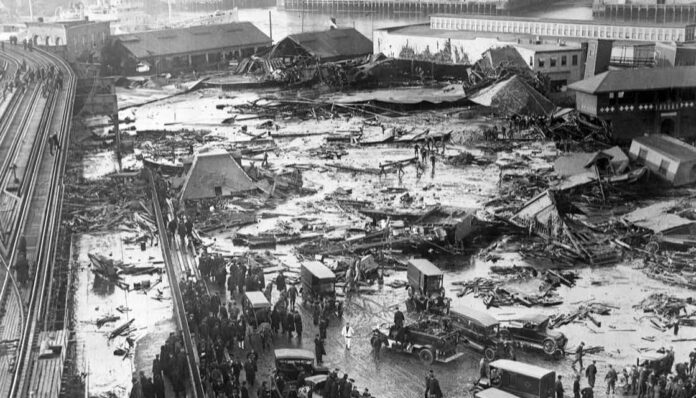
On January 15, 1919, a badly built storage tank in Boston’s North End burst open and released as many as 2.3 million gallons of molasses. A wave of syrup up to 25 feet high rolled through the neighborhood, killing 21 people and injuring 150.
The old saying “slower than molasses” turned out to be wrong. It became one of the strangest disasters in American history, and the cause had been leaking in plain sight for years.
Seconds of chaos in the North End
Just after 12:30 in the afternoon, a tank belonging to the Purity Distilling Company split apart. The molasses poured out in a matter of seconds and spread across a radius of two blocks.
The wave flattened homes and offices and lifted a firehouse off its foundation. It swept away cars and horse-drawn wagons and hit the girders of the Atlantic Avenue elevated railway hard enough to bend them.
Anyone caught in its path was carried off, crushed or drowned. Then the winter air made things worse, because cold molasses thickens, and people trapped beneath it were held in a substance thousands of times thicker than water.
A tank that leaked from the start
The tank’s owner, the United States Industrial Alcohol Company, first claimed that anarchists had blown it up. It soon came out that neighbors had been reporting leaks ever since it was built.
Stephen Puleo, who wrote a book about the flood called Dark Tide, told The Boston Globe that the tank groaned and shuddered every time it was filled. The company’s answer to the complaints was to paint the tank a dark red that hid the leaks, which fixed nothing.
Several problems combined to cause the failure:
- shoddy construction and lax safety testing
- years of overfilling that weakened the steel
- fermentation, which produces ethanol and carbon dioxide inside the tank
- a stretch of unusually warm winter days that sped that fermentation up
The ethanol was the point of the business. It was a key ingredient in munitions and in heavy demand during World War I, so Purity Distilling sold it off.
The carbon dioxide was the danger. As the warm spell raised the pressure inside the already fragile tank, one of its cracks finally gave way and the whole structure tore itself apart.
What witnesses saw
A man named B.E. Kingsley, who worked in an office near the tank, heard a rumble he first mistook for the elevated train. When the noise kept going, he looked out the window and saw that the tank was simply gone.
In its place, he told the Globe, was a giant wave of molasses rushing toward his office. Moments later it burst through the doors and windows and knocked him and the clerks over “like nine-pins.”
The Boston Post reported that there was no way to outrun it. Most of the victims died of suffocation, because once the molasses covered a person’s face it was almost impossible to clear.
Rescue and cleanup
Crowds rushed to the scene, and rescuers used hatchets and crowbars to reach people pinned under wreckage. Part of the elevated train trestle had collapsed, and the streets were littered with debris from ruined vehicles and buildings.
For four days, Red Cross workers, police, firefighters and U.S. Army and Navy personnel searched the rubble. The flood even pushed aside the next day’s other big news, a state ratifying Prohibition.
Freeing survivors took hours, and cleaning up took months. Horses were trapped too, and many died struggling in the sticky mass.
The bill came later
The final count was 21 dead and 150 injured, with more than $7 million in property damage, which would be over $100 million today.
Lawsuits followed, and after three years of hearings the company paid more than $600,000 in out of court settlements to victims and their families, more than $8.4 million in today’s dollars.
Much of the site now lies within Langone Park. Apart from a commemorative plaque at the park entrance, nothing marks the spot where a wall of molasses once swept through the North End.
Based on reporting by All That’s Interesting
By Michael Brennan | History