
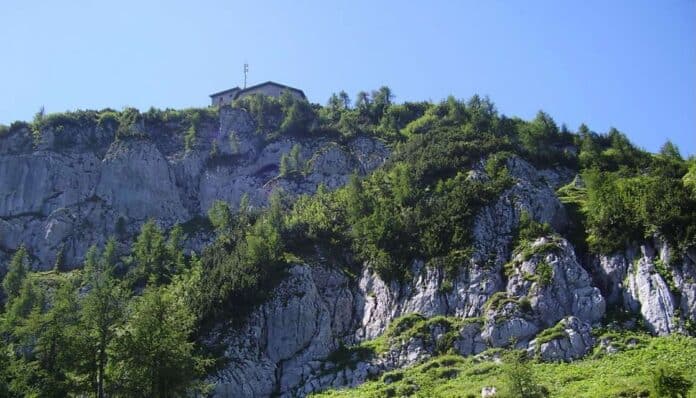
The Eagle’s Nest is one of the most famous buildings of the Nazi era, yet Adolf Hitler went there only about 14 times. He reportedly disliked heights, found the air too thin and worried that lightning would hit its brass lined elevator.
That gap between reputation and reality runs through the whole story. The mountaintop tearoom above Berchtesgaden, in the Bavarian Alps, became a symbol of a Nazi mountain fortress that never really existed, and in October 2026 the building was gutted by fire.
A tearoom at the top of a Nazi enclave
The Eagle’s Nest was the last major building added to the Obersalzberg enclave, which was turned into a heavily guarded refuge for Hitler and his inner circle after 1933. Hitler had a house there called the Berghof, or “Mountain Manor,” and so did Hermann Göring, Heinrich Himmler and Martin Bormann.
An SS unit lived in barracks on site and patrolled the grounds. Beneath them ran miles of tunnels holding command centers, luxurious air raid shelters, food stores and vaults for looted art.
Its formal name is the Kehlsteinhaus, after the Kehlstein mountain it sits on. It was one of the few Obersalzberg buildings to come through both the war and the demolitions that followed, because in 1952 the Bavarian government tore down much of what remained to keep it from drawing neo-Nazi pilgrims. The Eagle’s Nest was spared and later became a tourist attraction.
The tunnel and the brass elevator
Getting there was part of the show. A 4 mile road was blasted through mountain granite to reach it, a feat seen as an engineering marvel at the time.
Visitors then walked a 400 foot tunnel to an elevator that could carry more than 50 people. It was fitted with polished brass panels, green leather seats and ornate mirrors, and it climbed more than 400 feet to the teahouse in 41 seconds.
From the summit, at 6,017 feet, the view took in the Bavarian and Austrian Alps. On a clear day guests could see Salzburg, about 15 miles away.
Not a birthday present, despite the legend
A common story says Bormann built the Eagle’s Nest as a gift for Hitler’s 50th birthday. That is not quite right.
Bormann, who came to control much of Hitler’s daily life, began the project in 1937 as a showpiece of German engineering for visiting diplomats. It happened to be finished in time for April 20, 1939, so Bormann handed it over as a present, complete with lavish furnishings that included a red marble fireplace sent by Benito Mussolini.
Architectural historian Despina Stratigakos of the University at Buffalo, author of the 2015 book Hitler at Home, says the timing was a convenient coincidence rather than the plan. She also notes that Hitler preferred to stroll down to the Mooslahnerkopf teahouse, a smaller and plainer spot much lower on the enclave.
Also read: The Tower of London Held Polar Bears, Spies and a Nine-Day Queen
The fortress the Allies feared
By the end of the war, Allied planners were worried about a final Nazi stand in an “Alpine Redoubt” spread across the mountains of Bavaria and Austria. The Eagle’s Nest became its symbolic heart.
Some Allied reports described the tearoom as a command center, even though it was little more than a café Hitler rarely used. Propaganda minister Joseph Goebbels fed those fears on purpose, leaking word through neutral countries that any attack in the Alps would meet fierce resistance.
300 bombers and a building they missed
On April 25, 1945, more than 300 Royal Air Force Lancaster bombers struck the Obersalzberg complex. They badly damaged many buildings, including the Berghof.
The Eagle’s Nest came through untouched. A likely reason is that a small target on a mountain peak was very hard to hit with the carpet bombing methods of the day.
Who really got there first
The Band of Brothers version of events is not the whole picture. On May 4, 1945, four days before Germany surrendered, troops from the U.S. 3rd Infantry Division took the Obersalzberg enclave against light resistance, reaching the road to the Eagle’s Nest but going no farther.
Hours later, soldiers of the French 2nd Armored Division joined them, and it was the French who first climbed to the summit and secured the building. The next day the 506th Parachute Infantry Regiment of the U.S. 101st Airborne Division took over the site.
That unit was later credited with capturing the tearoom, both in Stephen Ambrose’s book Band of Brothers and in the HBO series based on it. The American soldiers also helped themselves to the rare wines and cigars stockpiled for the Nazi leadership.
Based on reporting by History.com
By Daniel Hartley | History