
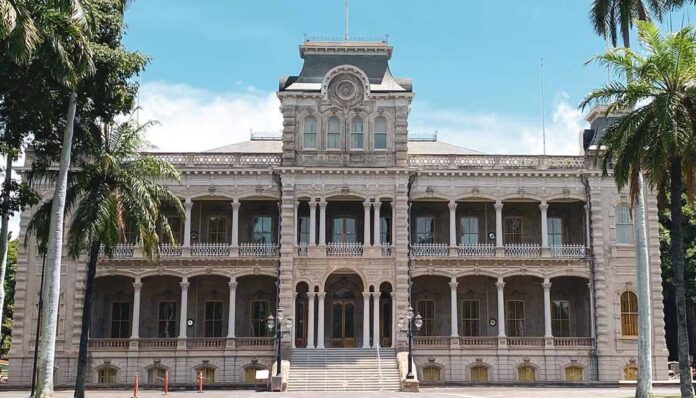
The United States was born out of an anti monarchical fervor, so there is something fitting about where its only royal palace stands. It sits more than 4,700 miles from the nation’s capital.
Among the high rises and palm trees of downtown Honolulu is Iolani Palace, the home of Hawaii’s 19th century royal dynasty. It is the only building on American soil that ever housed a reigning monarch.
The king who wanted something grander
King David Kalakaua came to power in 1874 and was not impressed by what he inherited. His predecessors had lived in a deteriorating coral block building, and he decided to tear it down.
What he wanted in its place was an ostentatious residence in the style of the grand palaces he had seen while touring Europe some years earlier. Getting it took patience. The king known as the Merrie Monarch went through three architects before the design satisfied him.
Six towers and a bill of $350,000
The finished building was a concrete facing brick structure marked by six towers, with open air verandas running around all sides. The style has a name of its own: American Florentine.
Inside were the rooms a monarch needed for entertaining dignitaries. The lavish Throne Room, the State Dining Room and the Blue Room sat on the ground floor, with a massive koa wood staircase climbing to the private chambers above.
The luxuries went further than decoration. Indoor plumbing and a telephone pushed the final bill into the neighborhood of $350,000 before the palace opened in 1879, and that was before electricity was installed in the late 1880s.
Also read: 10 Washington, D.C. Travel Secrets Most Tourists Learn Too Late
The king also wrote the national anthem
Kalakaua was a patron of the arts, and his interests reached past architecture. In 1876 he teamed up with royal bandmaster Henry Berger to compose “Hawai’i Pono’i.”
The song was written as a tribute to Kamehameha I, the founder of the kingdom. It remains one of the clearest surviving pieces of the monarchy Kalakaua was trying to display through the palace itself.
A decade of use, then a coup
All that extravagance served Hawaii’s rulers for a little over ten years. Kalakaua’s sister and successor, Lili’uokalani, was deposed in an 1893 coup orchestrated by American businessmen.
After that the palace stopped being a home. It became office space for the provisional government, then the territorial government, then the state government, a run that lasted until 1969.
It reopened to the public as a museum in 1978. What it preserves now is a reminder of Hawaii’s years as a sovereign nation, and of America’s complicated history with monarchies.
The other American buildings called palaces
A handful of other structures in the United States carry the title without ever having housed a monarch. They were the homes of colonial authorities instead.
- The Governor’s Palace at Colonial Williamsburg housed seven British appointed governors in Virginia and two American elected ones, before the original building burned to the ground in 1781
- Tryon Palace in New Bern, North Carolina, opened its doors to just two royal governors and was also destroyed by fire, then rebuilt after the Second World War
- The Palace of the Governors in Santa Fe, New Mexico, is more than 400 years old and is the oldest public building built by European settlers still in use in the country
- The Spanish Governor’s Palace in Texas is the only surviving building of an 18th century presidio that guarded the settlement of San Antonio
The San Antonio building had the strangest afterlife of the four. Before the city restored it in 1930, it had served at various points as a pawn shop, a tire shop and a saloon, which is probably not what any government building expects of its retirement.
Also read: Why Neon Took Over Route 66, and What the Surviving Signs Mean Now
Based on reporting by Interesting Facts and the National Park Service
By Ruth Castellano | Landmarks