
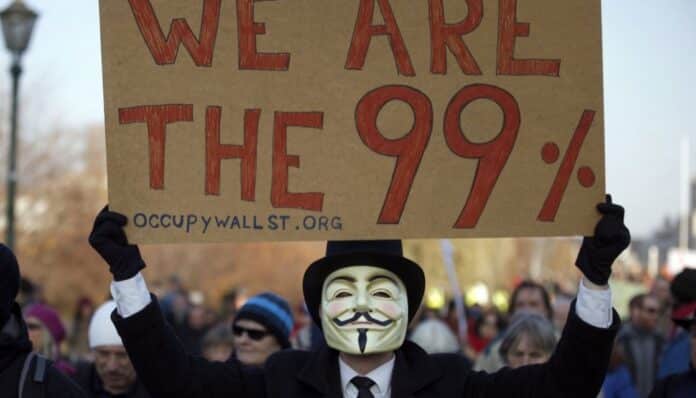
Every 5 November, bonfires burn across the United Kingdom to mark a plot that did not work. The same face the holiday mocks now turns up at protests on the other side of the world, moulded in white plastic with a thin moustache and a fixed grin.
The mask belongs to Guy Fawkes, an Englishman executed more than four centuries ago. Asking why he is tied to that mask is a little strange, because the mask is his face, or at least a stylized version of it.
The better question is how a 17th century conspirator turned into a symbol for people fighting tyranny. Fawkes might have slipped into obscurity altogether if media depictions had not kept him alive, and political groups then took those depictions and ran.
The man who was not the mastermind
Guy Fawkes was an English Roman Catholic who wanted the Protestant oppression of his people to stop. He is the best remembered figure in the Gunpowder Plot of 1605, the attempt to blow up Parliament, and he did not plan it.
The conspirators wanted to kill England’s Protestant leadership and clear the way for a Catholic ruler. Fawkes was close to a last minute addition to that group.
What they needed was someone who would not be recognized easily while rigging gunpowder in a cellar underneath the Parliament building. Fawkes fit, because he had served as a soldier in the Netherlands fighting for Spain.
Caught on 5 November, dead by January
He was arrested on 5 November 1605, before he could carry out the plan. He was tortured until he gave up the names of his fellow conspirators.
His death came a few months later, on 27 January 1606, and not in the way the sentence intended. He jumped or fell from the execution platform he was meant to die on and broke his neck.
A holiday built on a failure
Celebrating an assassination attempt that failed sounds strange, and the English government built a holiday out of it anyway. Part of the purpose was to warn off anyone with similar plans, and part of it was to rub the failure in the faces of Catholics, who were persecuted harder after the plot than before it.
To mark the 5th of November, known as Guy Fawkes Day or Bonfire Night, the English lit bonfires and set off fireworks. They also built effigies of Fawkes to burn in them.
Centuries of commemorating his failure made him a familiar villain. The holiday draws smaller crowds now, but it is still kept.
V for Vendetta put the face on a mask
Novels, poems and other writing carried the story of Fawkes and the Gunpowder Plot through the centuries. The mask itself did not reach public consciousness until the 1980s.
That was when Alan Moore and David Lloyd created the graphic novel V for Vendetta. Its main character, V, wears a mask of Fawkes’s face both to stay anonymous and to link his own anti fascist mission to the plot of 1605. V sees Fawkes as a man worth emulating, someone unafraid to use violence to change a government.
When the film adaptation arrived in 2005, Warner Bros. handed out replica masks as part of the marketing campaign. People inspired by the film began wearing them to protest unjust laws and corrupt governments. In 2008, the activists of Anonymous picked the mask as both a disguise and a representation of the group.
Why Anonymous settled on it
Anonymous is a collective of internet hackers who use their skills against governments, billionaires and corporations worldwide. The group has never said outright why it chose this particular mask.
The explanation most people reach for is a specific scene in the film, in which a crowd wearing the masks marches on Britain’s Parliament. Whatever the real reason, the link is now beyond argument, and both the mask and the group read as protest, and sometimes as anarchy.
From villain to anti-hero
There is an irony sitting underneath all of it. Fawkes spent centuries as England’s stock villain, burned in effigy every autumn, and his face now stands for anti establishment and anti authoritarian feeling.
The mask of a man who was caught has become the face of people who need not to be seen. When you are committing acts of resistance, hiding behind the features of a failed rebel beats revealing your own identity and risking failure yourself.
Based on reporting by Mental Floss, Britannica and the London Museum
By Dana Whitfield | Culture