
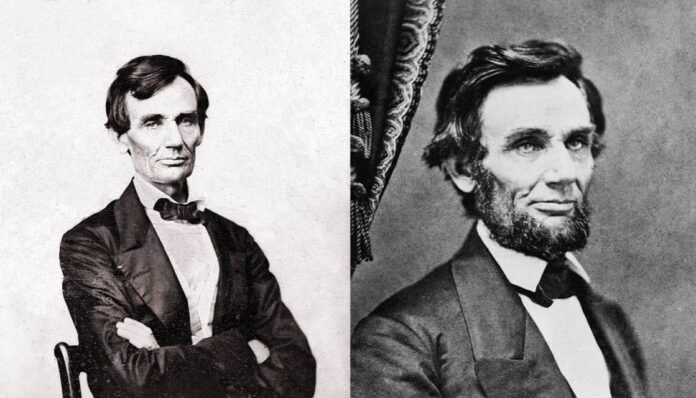
In October 1860, Abraham Lincoln was a few weeks away from winning the presidency and had never worn a beard in his life. Then a letter reached him in Springfield, sent from Westfield, New York, a small town in Chautauqua County.
It was written by an 11 year old named Grace Bedell. Her father had come home from the fair with a campaign picture of Lincoln and his running mate Hannibal Hamlin, and she had notes.
The exchange gets retold every November as a sweet story about a little girl and a future president. The full paper trail is stranger than that, and rather more political.
What Grace actually wrote
Bedell’s letter is dated 15 October 1860 and now sits in the Burton Historical Collection at the Detroit Public Library. It reads like a campaign memo from a very confident child.
She told Lincoln she had four brothers, and that some of them would vote for him anyway. If he grew whiskers, she would handle the rest.
“You would look a great deal better for your face is so thin,” she wrote. “All the ladies like whiskers and they would tease their husbands to vote for you and then you would be President.”
She also asked whether he had any little girls her age, complimented the rail fence around his picture, and reported that her baby sister was “nine weeks old and is just as cunning as can be.” She signed off with an instruction rather than a request: “Answer this letter right off.”
He answered in four days, and said no
Lincoln wrote back on 19 October. “I regret the necessity of saying I have no daughters,” he told her, before listing his three sons.
On the whiskers he was unconvinced. He had never worn any, and he asked whether people would not call it a silly affectation if he started now.
Transcriptions of that sentence differ by a word or two, which is a small problem of its own. The original is in private hands.
Also read: 15 Vice Presidents Who Made It All the Way to the Oval Office
The letter nobody mentions
Grace was not the first person to raise the subject. Three days before she wrote, on 12 October, an anonymous group calling themselves the True Republicans sent Lincoln a request from New York City.
They had been wearing his picture on campaign badges and had studied it closely. Their verdict was that “these medals would be much improved in appearance, provided you would cultivate whiskers, and wear standing collars.”
Their postscript was blunter than anything an 11 year old put on paper. “We really fear votes will be lost to ‘the cause’ unless our ‘gentle hints’ are attended to,” they wrote. That letter sits in Lincoln’s papers at the Library of Congress.
The razor went down anyway
Within roughly a month of hearing from Grace, Lincoln stopped shaving. By mid November his friends were teasing him about it, and a Chicago photographer named Samuel G. Alschuler caught the early stages of the beard on 25 November 1860.
Whether Grace caused any of it is a question the Library of Congress declines to answer. Its position is that there is no way to know what made Lincoln put the razor down, or how much the letter had to do with it.
Lincoln told the story himself
He gave his own version on 16 February 1861, when his inaugural train stopped at Westfield. He described the letter to the crowd that had gathered.
The Philadelphia Inquirer reported his words. “She advised me to let my whiskers grow, as it would improve my personal appearance; acting partly upon her suggestion, I have done so; and now, if she is here, I would like to see her.”
A boy perched on a post shouted, “There she is, Mr. LINCOLN,” and the president elect stepped down from the car and “gave her several hearty kisses” while the crowd cheered.
What happened to Grace Bedell
She wrote to Lincoln once more, in January 1864, this time asking for help getting a job at the Treasury Department. There is no record that he ever answered.
She later married a Union veteran named George Billings and moved to Delphos, Kansas, where she died in 1936. Her letter and his reply finally shared a display case in 2009, when the Detroit Public Library and the Benjamin Shapell Family Manuscript Foundation lent them to a Library of Congress exhibition for Lincoln’s bicentennial.
As far as the curator knew, it was the first time the two documents had ever been shown side by side.
Also read: What the Pilgrims Actually Ate at the First Thanksgiving in 1621
Based on reporting by Mental Floss, the Library of Congress and the Detroit Public Library
By Harold Meeks | History