
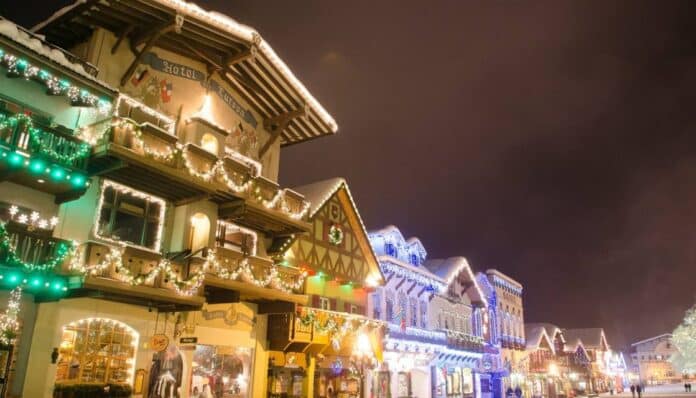
In 1969, a fading lumber town in the North Georgia mountains gave itself a new face. Business owners in Helen hired artist John Kollock to redesign the downtown after the Bavarian towns he had seen while stationed in Germany, and the Alpine storefronts have been pulling in visitors ever since.
Helen is one of 10 towns Listverse rounded up for travelers who want a taste of Europe without crossing the Atlantic. Some were founded by immigrants who brought their customs with them. Others put on a European look much later to win tourists. Several are at their best in the weeks before Christmas.
The towns immigrants built
Bishop Hill, Illinois. Swedish immigrants founded this village in 1846. Its surviving colony era buildings now hold museums, shops and other businesses, and the village is a National Historic Landmark. It does not try to copy modern Sweden. Its pull is quieter: old buildings, a village green and streets laid out by a 19th century immigrant community.
Mount Angel, Oregon. German immigrants settled Mount Angel, and Bavarian style storefronts give it an Old World look, with a Benedictine abbey and monastery close by. Its biggest draw is Oktoberfest, a German and Swiss celebration held there since 1966.
Lindsborg, Kansas. Swedish immigrants founded Lindsborg in 1869, and it still calls itself “Little Sweden, USA.” Look for its colorful Dala horses around town, modeled on the carved wooden horses linked with Sweden. Its heritage shows up in daily life, not just on festival weekends.
Test yourself
How much have you picked up so far?
3 quick questions on what you have read so far. The story continues below.
Windmills and tulips
Holland, Michigan. Visitors can tour DeZwaan, a working Dutch windmill, or Nelis' Dutch Village, where buildings and demonstrations show off Dutch culture. The famous Tulip Time festival comes in spring, with tulips, parades and traditional dancing in the streets. Holland is bigger and more modern than a tiny village, but its landmarks keep the heritage visible.
Pella, Iowa. Dutch immigrants founded Pella in 1847. Its best known landmark is the Vermeer Windmill, which was designed and built in the Netherlands, then shipped to Iowa and put back together. Pella has its own spring Tulip Time, and in winter it runs Kerstmarkt, a Dutch Christmas market.
Also read: Colonial Williamsburg Has Nearly 500 Buildings, and 4 More Living History Museums
Swiss and German roots in the Midwest
New Glarus, Wisconsin. Swiss immigrants from the Canton of Glarus founded New Glarus in 1845. It keeps that history alive with Swiss style buildings, food, festivals and the Swiss Historical Village, whose buildings and exhibits show how the founders lived. Its chalet style details feel like part of the town rather than a theme added for visitors.
Frankenmuth, Michigan. Frankenmuth's story also starts in 1845, when missionaries and settlers from Bavaria arrived in Michigan's Saginaw Valley. The name means "courage of the Franconians," a nod to their roots in Franconia. Today it is known for Bavarian style buildings and German food, and it is a big holiday stop thanks to Bronner's CHRISTmas Wonderland, a huge store devoted to Christmas decorations.
A Danish town in California
Solvang, California. Danish American educators founded Solvang in 1911 to preserve their culture and start a Danish folk school. Windmills, Danish style buildings, bakeries and museums make the heritage easy to spot, including the Elverhøj Museum and the Hans Christian Andersen Museum. At Christmas, Julefest brings lights, markets and seasonal events to the Santa Ynez Valley.
The two that reinvented themselves
Not every town on the list has European roots. Two chose the look on purpose to survive.
- Helen, Georgia was a small mountain town with a dying lumber economy when its 1969 makeover began. It was never a German settlement. Today it offers shops, restaurants, mountain scenery and an Oktoberfest, and visitors can walk along the Chattahoochee River while the storefronts suggest Bavaria.
- Leavenworth, Washington was struggling in the early 1960s when local leaders decided to remake the town to match the Alpine scenery around it. The result is a downtown of Bavarian inspired buildings tucked into the Cascade Mountains.
Leavenworth holds festivals all year, but winter is its season. Its Christmas Lighting Festivals fill the town with lights and holiday crowds and have made it one of the best known Christmas destinations in the country.
Neither town has centuries of history behind its charm. What they have is a commitment to an identity they picked for themselves, and, in Leavenworth's case, snowy mountains that do a lot of the decorating.
Also read: The 2026 Rockefeller Center Tree Is 76 Feet Tall, and Its Owner Suspected a Prank
Based on reporting by Listverse
By Trivia News Staff | Geography