
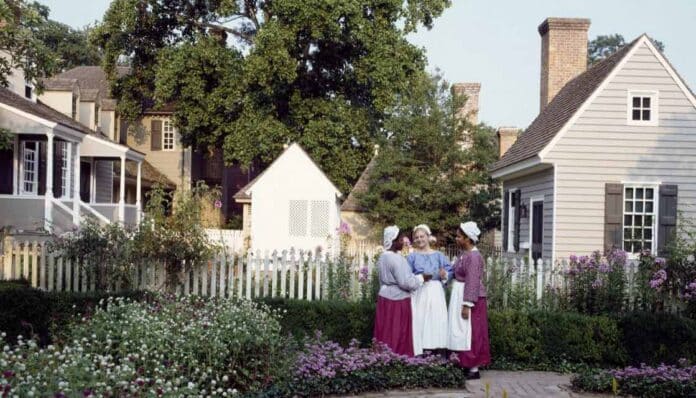
Colonial Williamsburg covers 301 acres and holds nearly 500 structures, from taverns and merchant shops to privies and the cabins of enslaved people. It is one of the oldest and best-known living history museums in the United States, and it is far from the only place where the past still walks the streets.
At a living history museum, costumed interpreters go about everyday work, from churning butter to shoeing horses, while visitors wander historic buildings and watch. The idea is to show how people actually lived rather than describe it on a placard.
Why these museums feel different
Ron Hurst, chief mission officer at Colonial Williamsburg, says sites like his reach visitors that a glass display case might not. They use reenactors, historic trades, music, gardens and animals to engage touch, smell, hearing and even taste, in addition to sight.
Because people learn in different ways, he argues, a richer sensory experience reaches more of them. Here are five living history museums around the country that put that idea to work.
Colonial Williamsburg, Virginia
Williamsburg’s moment in the spotlight ended in 1780, when Virginia moved its capital to Richmond. Many of the old streets and buildings slowly decayed after that.
Starting in the 1920s, John D. Rockefeller Jr. and his wife, the art lover Abby Aldrich Rockefeller, began quietly paying to buy, preserve and restore buildings from the town’s colonial peak. Some of what visitors see is original, while other buildings were rebuilt from the old plans, including the Governor’s Palace, where British power sat before the Revolution.
For decades the museum told a tidied-up version of the story, with workers rushing to clean up after horses on Duke of Gloucester Street and buildings kept freshly whitewashed. In 1979 the foundation that runs it switched to a more realistic living history approach. That change brought back the lives of enslaved people, who made up more than half of the town’s population in the Revolutionary era.
Test yourself
How much have you picked up so far?
3 quick questions on what you have read so far. The story continues below.
Kona Coffee Living History Farm, Hawaii
Early in the 20th century the Uchida family left Japan for Hawaii to grow coffee, and three generations lived on their 7-acre property in Kona. The museum built from their homestead focuses on the years from the 1920s to 1945, when the family moved from traditional Japanese ways toward more American habits.
The eight Uchida children took homemade onigiri to school. Today a costumed docent shows how their mother shaped warm rice around pickled plums, wrapped the balls in seaweed and packed them into tin lunchboxes.
Inside the house, the children's handmade toys, a baseball bat and a bulky typewriter sit beside rice paper, a calligraphy brush and ink. Outside, an interpreter rolls a retractable tin roof over the drying coffee beans to shield them from rain and shows off a ladder built to stay steady on uneven ground.
Also read: Colonial Williamsburg Breakfast Was Cornmeal Hoecakes, Not Today's Pancake Stacks
Old Sturbridge Village, Massachusetts
Old Sturbridge Village looks the way prosperous New England towns did in the early 1800s, with whitewashed houses, a tavern, shops and a steepled church gathered around a grassy common. Women in starched mobcaps and men in homespun work clothes go about daily life as it was in the 1830s.
The museum covers 200 acres. Beyond the town center are working farms, livestock barns, a school and three mills, and visitors can stop to watch the blacksmith and the cabinetmaker at work.
Its staff are quick to point out that life there was not simpler. The region was changing fast, as the abolitionist movement gained strength and new ideas about women's rights took hold.
The Tenement Museum, New York City
In 1900 the Lower East Side of Manhattan was the most densely populated neighborhood in the world. Its narrow streets and packed tenements were often the first stop for immigrants fresh from Ellis Island.
The Tenement Museum lets visitors climb the stoops of two apartment buildings and step into recreated homes. Some 15,000 families are thought to have lived in those two buildings between the 1860s and the 1980s.
Guided tours visit the apartments of 12 of those families, who came from:
- China, Germany and Ireland
- Eastern Europe and Russia
- Greece and Italy
- Puerto Rico
Costumed interpreters tell each family's story while working in their homes, surrounded by belongings, some of which were already in the buildings when the museum took them over. The museum also runs daily neighborhood walking tours and food tours.
Also read: The Beekman Arms Has Housed Travelers Since 1766, and 3 More Historic American Inns
Mystic Seaport Museum, Connecticut
From the 1600s through the 1800s, Mystic was a busy riverside village whose shipyards built entire fleets. Around them grew the trades that kept a seafaring town running, including instrument shops, barrel makers, a printing office, a post office, rigging lofts and ropewalks.
By 1929 shipbuilding had largely moved to deepwater ports, and the Marine Historical Association was founded on the riverfront. It kept 60 buildings left from the 19th-century boom and brought in more historic structures from around New England to recreate a compact seaport village.
Today the 19-acre campus is full of coopers, ship captains, ministers and shipwrights, and a real Yankee whaler is tied up at the wharf. Visitors can learn to climb rigging or tie a knot, watch a figurehead being carved, sing along to a sea chantey and catch a twice-daily planetarium show on how sailors steered by the stars.
Based on reporting by History.com
By Trivia News Staff | Landmarks