
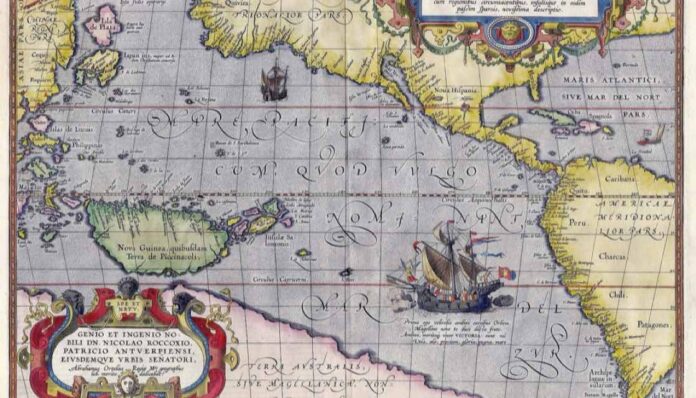
On November 28, 1520, three battered ships came out of a narrow passage near the tip of South America into open water. Their commander, the Portuguese navigator Ferdinand Magellan, became the first European explorer to reach the Pacific from the Atlantic, and he is said to have wept with joy when he saw it.
The water ahead looked so calm that he called it Mar Pacifico. The name comes from the Latin pacificus, meaning tranquil, and the ocean has carried it ever since.
A Portuguese sailor working for Spain
Magellan was born around 1480 in Sabrosa, Portugal, into a family of minor nobility. At 12 he and his brother Diogo went to Lisbon to serve as pages at the court of Queen Leonora, where he heard the stories of Portugal and Spain racing each other for the spice trade.
Spices were then at the center of the world economy, much as oil is today. Cinnamon, clove, nutmeg and above all black pepper could not be grown in Europe. Europeans had reached the Spice Islands, the Moluccas in modern Indonesia, by sailing east, but nobody had yet reached them by sailing west.
King Manuel of Portugal turned down Magellan’s plan to try again and again. In 1517 Magellan gave up his Portuguese nationality and moved to Seville, arriving with no connections and little Spanish. Within a year he had married into a well-connected family, and soon he was in front of Spain’s King Charles I, who was only 18 and agreed to back him.
Five ships and 270 men
The fleet sailed from Spain on September 20, 1519, with five ships, the Trinidad, San Antonio, Concepcion, Victoria and Santiago, and about 270 men. It crossed the Atlantic, then worked down the coast of South America looking for a way through to the other side.
The search went badly for months. The crew spent the winter of 1520 at Port St. Julian in Patagonia, where the Spanish captains mutinied at midnight on Easter against their Portuguese commander. Magellan crushed the revolt, executed one captain and left another ashore when the fleet sailed on in August. The Santiago had by then been wrecked in a storm while scouting ahead.
Test yourself
How much have you picked up so far?
3 quick questions on what you have read so far. The story continues below.
38 days through the strait
On October 21, 1520, Magellan finally found the passage he had been hunting. It lies near the tip of the continent, between Tierra del Fuego and the mainland, and it now bears his name as the Strait of Magellan.
Getting through took 38 days in cold, dangerous water. Early on, the crew of the San Antonio forced their captain to turn back, and the ship fled home to Spain. That left three ships to come out the far end on November 28.
Also read: Franklin's Arctic Expedition Lost All 129 Men, While All 28 of Shackleton's Survived
The ocean was bigger than anyone thought
Magellan expected a quick crossing. Instead it took 99 days, and by the end the men had run out of food and were chewing the leather on their gear to stay alive.
The fleet reached Guam on March 6, 1521. Ten days later it anchored at Cebu in the Philippines, only about 400 miles from the Spice Islands.
The calm that gave the ocean its name was misleading. The Pacific is regularly hit by typhoons, hurricanes and tsunamis that have done serious damage to its islands and coasts.
The captain who never got home
Magellan never reached the Spice Islands. The chief of Cebu converted to Christianity and persuaded the Europeans to help him against a rival on the neighboring island of Mactan. Magellan led the attack himself, against his men's advice, and on April 27, 1521, he was struck by a poisoned arrow and left behind by his retreating crew.
The survivors went on with two ships and reached the Moluccas on November 5, 1521, where they filled the holds with spice. One ship tried to sail back across the Pacific and failed.
The other, the Victoria, kept going west under the Basque navigator Juan Sebastian de Elcano. It crossed the Indian Ocean, rounded the Cape of Good Hope and reached Sanlucar de Barrameda in Spain on September 6, 1522. It was the first ship to sail around the globe, and only 18 of the original 270 men came home on it.
What the voyage proved
The western route through the strait was too long and dangerous to become a practical road to the spices. What the expedition gave Europe instead was a far clearer picture of the planet: a huge ocean nobody there had known about, and proof that the world was much larger than people had believed.
One of the 18 survivors, the Italian scholar Antonio Pigafetta, kept a journal of the whole voyage. It is still one of the key records of what the crew saw along the way.
Also read: An Island on Google Maps Was Not There in 2012, and 7 More Places That Never Were
Based on reporting by HISTORY
By Trivia News Staff | Geography