
The longest running weekly radio program in the world began on November 28, 1925, in an office building in downtown Nashville. It was not called the Grand Ole Opry yet, and it was not really meant to be a music institution. It was a way to get people to notice an insurance company.
That company was the National Life and Accident Insurance Company. A month earlier it had put a radio station on the fifth floor of its headquarters, and the call letters WSM stood for its slogan, “We Shield Millions.”
A fiddler in his 70s and a newspaperman
The station hired George Dewey Hay as program director in November 1925. Hay was a former newspaper reporter from Memphis who had already helped organize a similar show in Chicago, the WLS National Barn Dance.
The first broadcast had Hay as the announcer and a fiddler in his 70s, known as Uncle Jimmy Thompson, playing the tunes. The music was what people then called hillbilly music. The show caught on at once, and by that December the WSM Barn Dance was a weekly Saturday night program.
Hay, who went by the nickname “the Solemn Ol’ Judge,” steered most of what the show became in those first years. In 1927 he gave it a new name on the air. The hour before had been music drawn largely from grand opera, he told listeners, and from then on they would hear the Grand Ole Opry.
Fans who watched through a window
Early fans did not have seats. They came to the building and stood in the hallway, watching the broadcast through the studio window. The station kept building larger studios to hold them, including one that seated about 500 people.
After that the show kept outgrowing its homes:
- 1934: the Hillsboro Theater, about three miles from downtown, around the time sponsored segments arrived
- 1936: the 3,500-seat Dixie Tabernacle in East Nashville, a religious meeting hall, where tickets had to be booked ahead although admission was still free
- 1939: the War Memorial Auditorium, with only 2,200 seats, which is why the Opry began charging admission there, 25 cents
- 1943: the Ryman Auditorium, the home that made it famous
Test yourself
How much have you picked up so far?
3 quick questions on what you have read so far. The story continues below.
The Mother Church of Country Music
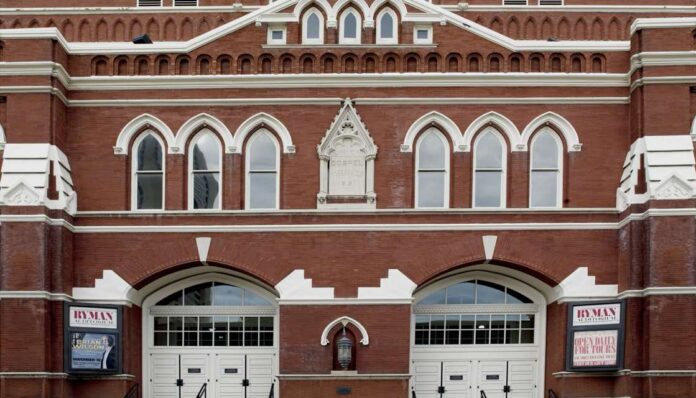
The Opry moved into the Ryman in June 1943. It was a 2,300-seat Victorian revival house downtown, and it soon earned the nickname "the Mother Church of Country Music."
Some of the best known nights in country music happened there. Hank Williams made his Opry debut in 1949 and was called back for six encores, a record. Elvis Presley played the Opry exactly once, in 1954.
The Ryman era ended on March 15, 1974, with George Morgan singing his hit "Candy Kisses." Morgan was the father of 1990s country star Lorrie Morgan. The very next night the show broadcast from the new 4,400-seat Grand Ole Opry House at the Opryland USA theme park.
A president with a yo-yo
That opening night at the new Opry House was a show of its own. Roy Acuff sang "The Wabash Cannonball," and President Richard Nixon came onstage and spun a yo-yo. The crowd also sang "Happy Birthday" to First Lady Pat Nixon.
Before the last broadcast from the Ryman, an eight-foot section of its stage was cut out and set into the floor of the new house as a circle of lighter wood. It sits in the center of the stage to this day. It also ties the building to the Opry's unofficial theme song, "Will the Circle Be Unbroken."
That song goes back to the Carter Family's 1935 hit "Can the Circle Be Unbroken," which was adapted from a hymn written in 1907. Right after the final Ryman broadcast in 1974, Johnny Cash and June Carter Cash were among the performers who joined in a jam session of it onstage.
Television, a theme park and a rescue
The Opry's first live television performance was a PBS fundraising special in 1978, and regular TV broadcasts began in 1985. Opryland USA closed in 1997 and was later torn down, but the Opry House stayed and kept drawing visitors.
The Ryman itself fell badly into disrepair after the Opry left. Emmylou Harris played a concert there in 1991, and the live album that followed in 1992 turned saving the building into a cause. The restored Ryman reopened in 1994, became a National Historic Landmark in 2001, and still hosts Opry broadcasts during the winter months.
Who gets to be a member
Opry membership is by invitation, based on record sales, radio play and standing in the industry. The names who became staples read like a history of the genre: Uncle Dave Macon, Roy Acuff, Ernest Tubb, Bill Monroe with Earl Scruggs, Hank Williams, Eddy Arnold, Tennessee Ernie Ford, Kitty Wells and the comedian Minnie Pearl.
In its first 100 years, only three Black artists were made members. They were harmonica player DeFord Bailey, one of the earliest performers on the show, Charley Pride in 1993 and Darius Rucker in 2023. Pride had become the first Black solo singer to appear at the Opry in 1967, and two years later Linda Martell became the first Black woman to perform there.
Also read: Record Stores Can Do Two Months of Sales Today, and the Beatles Are on Gold Vinyl
The Opry marked its 100th anniversary in 2025 with events all year and a televised concert in March. WSM still carries the show on the radio every week, just as it did in 1925, and it now streams as well.
Based on reporting by Encyclopaedia Britannica
By Trivia News Staff | Culture