
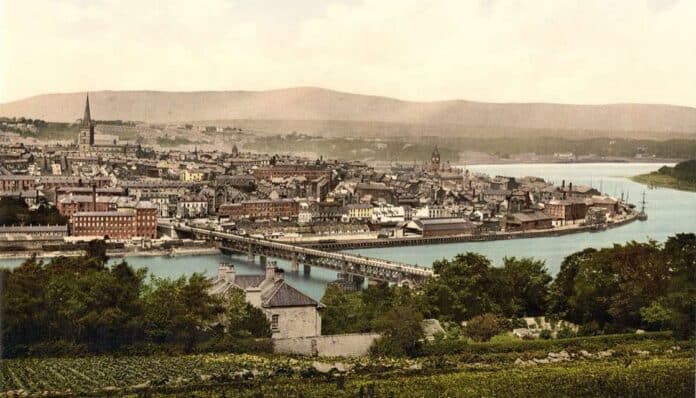
Plenty of people assume the fight over Derry and Londonderry is a modern one. In fact the Northern Irish city has carried the official name Londonderry since 1613, and more than 400 years later, which name you use still says something about where you stand.
Cities rename themselves for the same reasons people do: a conquest, a new ruler, a fresh start, or a wish to reclaim an older identity. Here are ten well known cities whose names have changed, some of them more than once.
Derry, or Londonderry, Northern Ireland
The original Irish name was Daire, meaning “oak wood,” which English speakers turned into Derry. In the 17th century wealthy Londoners settled in the area as part of a push to strengthen Protestant influence, and the city became Londonderry.
Many locals never accepted the change. Four centuries on, choosing one name or the other remains a political statement.
New York City, United States
America’s largest city was always new, just not always New York. The Dutch founded it in 1624 as the seat of the New Netherland colony, built around Fort Amsterdam, and called it New Amsterdam.
In 1664 British forces led by the Duke of York took the territory. New Netherland became the Province of New York, and New Amsterdam became New York City.
San Francisco, United States
The name San Francisco is older than the city itself. A Catholic mission and a presidio had used it since 1776, and the bay was named after them.
The settlement that grew there in 1834, however, was called Yerba Buena, after a mint herb that grew all over the area. Once California became American territory, the town took the name San Francisco so that city and bay would match.
Mumbai, India
The 1995 switch from Bombay to Mumbai was a return to the city’s roots rather than a whim. Before European rule, people on the seven islands that make up the city worshipped a patron goddess, Mumba Ai or Mother Mumba, and locals and visitors alike called the place Mumbai.
After the islands passed to the Portuguese, the name became Bom Bahia, or “good bay,” which the British later turned into Bombay. Some people still use the old name, and it remains a sore point.
Ho Chi Minh City, Vietnam
One of Vietnam’s largest and wealthiest cities started out with a Khmer name, Krŭng Prey Nôkôr, or “forest kingdom city.” Under French colonial rule it was known as Saigon, and it served as the capital of South Vietnam during the Vietnam War.
After reunification it was renamed in honor of North Vietnamese leader Ho Chi Minh. In everyday speech locals still tend to say Saigon for the city center and Ho Chi Minh City for the wider metropolitan area.
Istanbul, Turkey
The city’s names track its long history. It began as Byzantium, and in 324 CE the Roman emperor Constantine the Great refounded it as Constantinople, a name that survived the fall of the Eastern Roman Empire and carried on under the Ottomans.
In the early 20th century Turkish authorities pushed the popular name Istanbul as the official one. It comes from the Greek phrase eis ten polin, meaning “to the city.”
Also read: Africa Is 14 Times Bigger Than Greenland, and the Mercator Map Hides It
Toronto, Canada
The area has been called Toronto for more than four centuries, from the Mohawk word tkaronto, “where trees are standing in the water,” which was also the name of the first European fort there. The city itself, though, was founded in 1786 as York, nicknamed Little York to avoid confusion with York in England and New York.
It only became Toronto in 1834, less than 200 years ago.
St. Petersburg, Russia
Czar Peter the Great founded the city in 1703 and named it for the Apostle St. Peter, using the German ending -burg, meaning “city,” a nod to his Prussian influences. The name has changed several times since:
- Petrograd, adopted during World War I, using the Russian ending -grad that locals already favored.
- Leningrad, from 1924, in honor of Vladimir Lenin.
- St. Petersburg again, after a 1991 referendum in which more than half of residents voted to bring back the historic name.
Beijing, China
The move from Peking to Beijing was arguably a correction rather than a new name. The city has had many names over more than 3,000 years, but Beijing, meaning “northern capital,” has been in use since the 1400s.
Peking was a romanized spelling popular in the West that did not match the Pinyin system China adopted in 1979. Beijing is much closer to the real pronunciation, and China pressed for it internationally with great success.
Oslo, Norway
Norway’s capital has come full circle. Vikings founded it as Ánslo or Óslo in 1040, and it kept that name even after Norway was united with Denmark in the 16th century.
A fire destroyed Oslo in 1624, and the rebuilt city was named Christiania, sometimes spelled Kristiania, after King Christian IV. Norway separated from Denmark in the early 19th century, but the capital did not get its original name back until 1925.
Also read: The Great Lakes Had Dozens of Names Before 1744, From Lac du Chat to Karegnondi
Based on reporting by WanderTrivia
By Daniel Mercer | Geography