
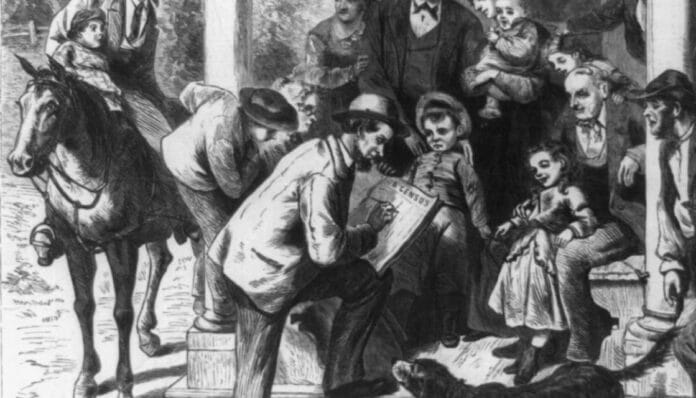
In 1880, the U.S. Census wanted to know how hard American libraries chased people who did not return their books. It asked whether fines were collected, whether reminder notices or messengers went out, and how many volumes had simply vanished.
That was not a one off. Alongside the familiar headcount, 19th century census takers sent out separate inquiries on farms, factories, towns and businesses, records the National Archives calls nonpopulation schedules, and some of them wandered into very strange territory.
1. Overdue library books
The 1880 library schedule covered books, staff, money, opening hours and readers, then zeroed in on borrowers who failed to bring things back. It even asked how many notices had been sent.
This was not a plan to send federal agents after readers. It was an audit of how libraries ran, and it also separated books taken home from books read on site and asked what kinds of books different readers wanted.
2. Homemade goods
The 1850 agricultural census included a box for the value of goods a family made at home. The instructions were clear that these items counted whether the family sold them or used them, so no sale was needed.
There was even a rule against padding the figure. Any raw material a family bought had to be left out, so the total reflected goods made from the family’s own produce or the labor added to purchased materials.
3. Silk cocoons in Connecticut
Connecticut’s 1850 farm tables listed silk cocoons next to flaxseed, maple sugar and molasses. The state reported 328 pounds of cocoons, and 221 pounds of that came from Windham County alone.
That was the weight of cocoons counted as farm produce, not finished silk or mills. Next to the millions of pounds of butter and cheese in the same tables it was tiny, yet the form still gave cocoons a column of their own.
Also read: Members of Congress Still Get Paid in a Shutdown, and 3 Other Capitol Hill Myths
4. The character of every newspaper
In 1850 the census asked for the type and circulation of every newspaper and magazine in a district. Categories included scientific, literary, political, religious, medical and agricultural.
Connecticut reported 46 publications. Of those, 28 were political, and one landed in the deflating category of not defined. The tables also kept circulation separate from the number of copies printed each year, since those two numbers are not the same thing.
5. Church seats
The 1850 count approached religion with a practical question, which was how many people a house of worship could seat. It recorded denominations, property values and the number of sittings.
Halls and chapels used regularly for worship counted too, and there were rules for rented spaces and for religious groups that owned property but had no building. The government was measuring the room, not anyone’s faith.
6. Who hauled away dead animals
One of the 1880 city schedules asked how dead animals were removed, what happened to them afterward, how many were removed by kind and what it cost each year. Cities were also asked to describe what worked and what did not, and to supply their rules.
These questions sat inside a broader survey of street cleaning, garbage, ashes and household waste. The surviving form does not prove every city answered, and it gives no national total, but it shows how far the inquiry reached.
7. Alaska’s fur seals
The 1880 census publications included Henry W. Elliott’s report on Alaska’s seal islands, covering the islands, the fur trade and the animals’ lives, with surveys and maps of breeding grounds. His observations came mostly from visits in 1872 to 1874, plus another inspection in 1876.
To estimate the herd, Elliott measured how much ground the crowded breeding colonies covered and used that as a guide to their numbers. It was his period method, not a modern count.
8. Old oyster shells
A census report on the oyster trade, published in 1881, followed the shells as well as the catch. It covered samples of oyster shell lime sent to the Connecticut Agricultural Experiment Station in November 1879, along with chemical analyses and their value to farmers.
Shells from New Jersey were also carried as ballast on oyster boats bound for Chesapeake Bay, then dumped overboard so young oysters had something to settle on.
9. The ice harvest
Henry Hall’s report on the American ice industry opened with consumption in 20 major cities from October 1, 1879, through September 30, 1880. He warned right away that the winter of 1879 to 1880 had brought a partial failure of the ice crop in several states, so summer use came in below a normal year.
Hall also admitted that exact business statistics were lacking, and treated his figures as a starting point rather than the final word.
10. Forests lost to fire
The 1880 forest report counted woodland destroyed or damaged by fire. Ohio reported 74,114 acres burned during the census year, with an estimated loss of $797,170.
The main culprits named in Ohio and Indiana were the same:
- careless land clearing
- hunters
- sparks from locomotives
These were reported figures and assessments of the time, not measurements made with modern tools. Even so, the census was doing more than counting what the country had, and was also adding up what it was losing.
Also read: Celery Was a Status Symbol in the Gilded Age, and 4 More Foods the Rich Craved
Based on reporting by Listverse
By Thomas Avery | General