
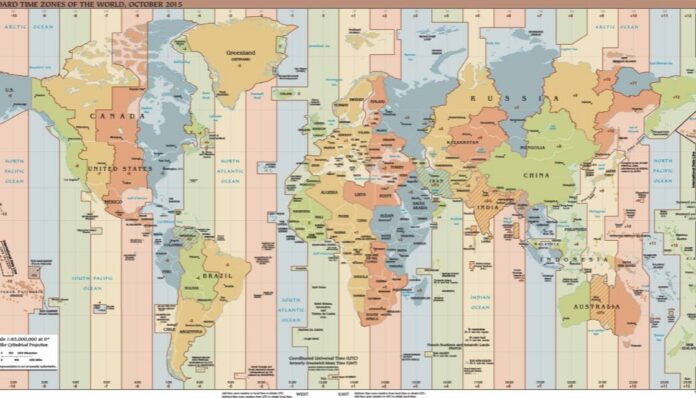
The country with the most time zones in the world is not Russia, the United States or China. It is France, with 12, or 13 if you count the slice of Antarctica it claims.
Most people assume a long list of time zones requires an enormous landmass. In practice, the count often depends on colonial history and scattered overseas territories, which is why small European nations can outrank giants. Here is how ten countries stack up, building to the record holder.
Mexico: 4 time zones
Mexico runs from the Caribbean across the Sierra Madre to the Pacific and the Baja California peninsula, and it uses four official standard zones. They are arranged to line up tourist areas with the time on the U.S. coasts and to keep the major cities together.
The Southeast Zone, created in 2015 at UTC-5, covers only Quintana Roo, home to Cancun, Cozumel and the Riviera Maya. The Central Zone at UTC-6 includes Mexico City, the Pacific Zone at UTC-7 covers the Gulf of California, and the Northwest Zone at UTC-8 applies to Baja California.
Brazil: 4 time zones
Brazil stretches more than 2,670 miles from east to west and covers nearly half of South America, yet it uses only four standard zones. The easternmost, at UTC-2, applies just to offshore Atlantic islands such as Fernando de Noronha.
UTC-3 is the official national time and the country’s financial and political heartbeat. Amazon Time at UTC-4 covers much of the central and southern Amazon basin, and Acre Time at UTC-5 covers the state of Acre and 13 neighboring municipalities.
New Zealand: 5 time zones
New Zealand looks like two modest islands, so its total surprises people. The mainland runs on New Zealand Standard Time at UTC+12, while the Chatham Islands, about 500 miles east, use an unusual offset of UTC+12:45.
Add the associated states and territories of Tokelau at UTC+13, Niue at UTC-11 and the Cook Islands at UTC-10, and the count reaches five. Traveling between them means hopping back and forth across the International Date Line.
Test yourself
How much have you picked up so far?
3 quick questions on what you have read so far. The story continues below.
Denmark: 5 time zones
The Kingdom of Denmark includes the mainland in Northern Europe plus two autonomous territories, Greenland and the Faroe Islands. Mainland Denmark sits at UTC+1 and the Faroes at UTC+0.
Greenland, the largest island on Earth that is not a continent, spans four zones on its own. They run from UTC-4 in the far west to UTC+0 at the Danmarkshavn weather station on the northeast coast, which brings the realm to five in total.
Also read: Africa Is 14 Times Bigger Than Greenland, and the Mercator Map Hides It
Canada: 6 time zones
Canada, the world's second-largest country by land, covers almost 90 degrees of longitude, which works out to six standard zones:
- Pacific Time, UTC-8, in British Columbia
- Mountain Time, UTC-7, in Alberta and the Northwest Territories
- Central Time, UTC-6, in Saskatchewan and Manitoba
- Eastern Time, UTC-5, in Ontario and Quebec
- Atlantic Time, UTC-4, in Nova Scotia and New Brunswick
- Newfoundland Time, UTC-3:30, on Newfoundland Island
That odd half-hour offset dates to 1935 and reflects how far Newfoundland juts out into the Atlantic.
Australia: 9 time zones
The Australian mainland has three main zones: Western at UTC+8, Central at UTC+9:30 and Eastern at UTC+10. Daylight saving adds extra half-hour variations in some regions.
Counting its external territories, Australia reaches nine. They include the Cocos (Keeling) Islands at UTC+6:30, Christmas Island at UTC+7, Lord Howe Island at UTC+10:30 with a daylight saving shift of only 30 minutes, Norfolk Island at UTC+11, the Heard and McDonald Islands at UTC+5 and the Australian Antarctic Territory, which spans UTC+5 to UTC+8.
United Kingdom: 9 time zones
The British Isles themselves use a single zone, Greenwich Mean Time at UTC+0, which becomes British Summer Time at UTC+1 in the warmer months. The legacy of empire pushes the total to nine.
The extra zones belong to 14 British Overseas Territories, including Bermuda at UTC-4, the Cayman Islands at UTC-5, the Pitcairn Islands at UTC-8, Gibraltar at UTC+1, Akrotiri and Dhekelia on Cyprus at UTC+2 and the British Indian Ocean Territory at UTC+6.
Russia: 11 time zones
Unlike most countries here, Russia gets its 11 zones from one continuous landmass. It stretches across northern Eurasia from Eastern Europe to the Bering Strait opposite Alaska and covers roughly 10% of the world's land.
The zones run from Kaliningrad on the Baltic Sea at UTC+2 to Kamchatka and Chukotka in the far east at UTC+12. A trip on the Trans-Siberian Railway crosses seven of them over several days.
United States: 11 time zones
The United States ties Russia at 11. The 48 contiguous states use four standard zones, Eastern at UTC-5, Central at UTC-6, Mountain at UTC-7 and Pacific at UTC-8.
Alaska at UTC-9 and Hawaii and the Aleutian Islands at UTC-10 bring the states to six. Territories add the other five: Puerto Rico and the U.S. Virgin Islands on Atlantic Time at UTC-4, American Samoa at UTC-11, Guam and the Northern Mariana Islands on Chamorro Time at UTC+10, and uninhabited Pacific outposts such as Howland and Baker Islands at UTC-12.
Also read: Arizona and Hawaii Skip Daylight Saving Time, and Here Is Why
France: 12 time zones
Mainland France uses one zone, Central European Time at UTC+1. Its overseas departments, collectivities and territories are what give it the world record of 12, or 13 with Adelie Land in Antarctica.
Those regions sit in the Atlantic, Pacific and Indian Oceans: French Guiana at UTC-3, Guadeloupe and Martinique at UTC-4, Saint Pierre and Miquelon off Canada at UTC-3, Mayotte at UTC+3, Reunion at UTC+4, French Polynesia across UTC-10, UTC-9:30 and UTC-9, New Caledonia at UTC+11 and Wallis and Futuna at UTC+12. Spread around the whole globe, they mean the sun never sets on modern France.
Based on reporting by WanderTrivia
By Trivia News Staff | Geography