
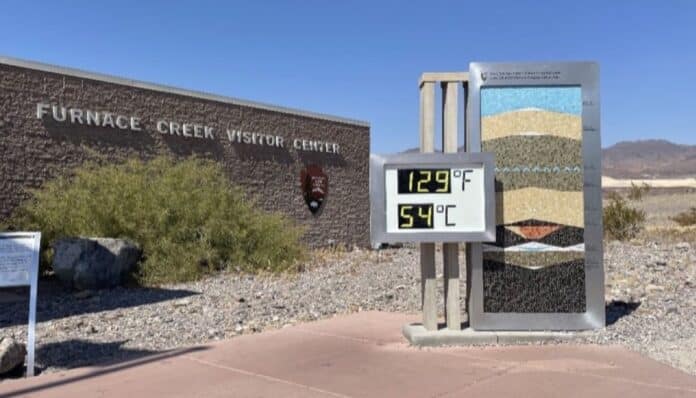
On one day in 1913, the thermometer at Furnace Creek in Death Valley climbed to 134°F. Seventy years later, on July 21, 1983, a Russian research station in Antarctica dropped to -128.6°F.
Those are the hottest and coldest air temperatures ever officially recorded on Earth, and they sit 262.6 degrees apart. Here is where the rest of the planet’s limits are, from the bottom of the sea to the top of the world.
The hottest: Death Valley, California
Death Valley lies in the northern Mojave Desert, near the Nevada line. The valley floor is so low that the mountains around it trap the hot air, and dry skies and steady sun do the rest.
The name oversells it a little. More than 1,000 kinds of plants have been found in the national park, and after an unusual rain the desert can bloom with wildflowers.
The coldest: Vostok Station, Antarctica
Vostok sits near the middle of the East Antarctic Ice Sheet, about 800 miles from the South Pole and more than two miles above sea level. The height, the very dry air and months of winter darkness make it about as cold as a place can get.
The ice underfoot is an archive. Scientists at Vostok have drilled deep enough to bring up ice that records what Earth’s climate was like hundreds of thousands of years ago.
The driest and the wettest
Some parts of Chile’s Atacama Desert get almost no rain. The Andes block moist air from the east, and the cold Humboldt Current offshore keeps rain clouds from forming, which makes it the driest place outside the poles. NASA has tested instruments there for future missions to Mars, because some of it looks the part.
At the other end is Mawsynram, a village of about 4,000 people in northeastern India. Monsoon winds off the Bay of Bengal hit the Khasi Hills, rise and let go of their water.
An average year brings around 460 inches, enough to fill a tank 38 feet deep. People there use bamboo rain covers and build roofs designed for the downpours.
Also read: The 1936 Heat Wave Pushed Kansas to 116 Degrees and Got Shorts Legalized in Yonkers
Test yourself
How much have you picked up so far?
3 quick questions on what you have read so far. The story continues below.
The highest, with a catch
Mount Everest stands 29,032 feet above sea level on the border of Nepal and China. Thin air, freezing cold and sudden storms make it dangerous, and hundreds of people still reach the top every year.
Everest is the highest point above sea level. It is not the point farthest from the center of the Earth. That is Mount Chimborazo in Ecuador, because the planet bulges around the Equator.
The lowest dry land: the Dead Sea
The shore of the Dead Sea, between Israel and Jordan, is about 1,400 feet below sea level, the lowest exposed land on the planet. No river carries its water out, so the water evaporates and the salt stays.
Most water life cannot survive in it, which explains the name. The same salt makes swimmers float with almost no effort.
The deepest: Challenger Deep
About 200 miles southwest of Guam, at the southern end of the Mariana Trench, the seafloor falls to roughly 36,000 feet. You could set Everest inside and still have more than a mile of water over its peak.
The pressure there is more than 1,000 times what it is at sea level. The spot is named for the British ship HMS Challenger, whose crew first measured the trench in 1875.
Something lives even there. Scientists have found shrimplike amphipods, sea cucumbers and giant single-celled creatures called xenophyophores.
Two giants of South America
Salar de Uyuni in Bolivia is the largest salt flat on Earth, more than 4,000 square miles of white left behind by prehistoric lakes. It lies over 12,000 feet above sea level. In the rainy season a thin sheet of water turns it into a mirror so perfect that the horizon nearly vanishes, and beneath the crust are large deposits of lithium, the metal used in modern batteries.
The Amazon is the largest tropical rainforest, about 6.5 million square kilometers, or 2.5 million square miles. It spreads across nine South American countries and territories, with the biggest share in Brazil, and is home to jaguars, giant river otters and pink river dolphins.
Also read: An Island on Google Maps Was Not There in 2012, and 7 More Places That Never Were
The tallest waterfall, named for a stranded American
Angel Falls drops from a flat-topped mountain called Auyán-tepui in Venezuela's Canaima National Park. Its total height is 3,212 feet, and the longest unbroken plunge is about 2,648 feet.
The falls carry the name of American pilot Jimmy Angel, who landed his plane on top of the mountain in 1937. It got stuck. Angel and his companions walked for 11 days to reach safety, and the plane stayed up there for more than 30 years, until it was finally removed in 1970.
Put together, the records make for a lopsided planet:
- hottest: 134°F, Death Valley, 1913
- coldest: -128.6°F, Vostok, 1983
- wettest: about 460 inches of rain a year, Mawsynram
- highest: 29,032 feet, Everest
- deepest: about 36,000 feet, Challenger Deep
Also read: France Has 12 Time Zones, One More Than Russia or the United States
Based on reporting by WanderTrivia
By Trivia News Staff | Geography