
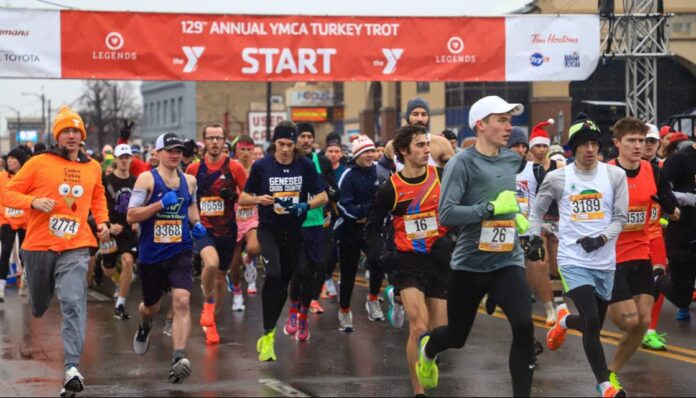
On Thanksgiving morning, Nov. 26, 1896, six men in Buffalo, New York, lined up for a footrace. Nobody recorded why they did it. Exactly 130 years later, that little race is the oldest footrace in the world that has never missed a year, and turkey trots now draw more than a million Americans every Thanksgiving.
Most people would guess the marathon holds that title. It does not, and the reason is a matter of a few months and a few wars.
Older in spirit, younger in streak
The marathon is built on the legend of a Greek messenger who ran roughly 25 miles to Athens with news of victory over the Persians, then collapsed and died. The modern Olympic marathon was first run in Athens in 1896, about seven months before the Buffalo race.
The Olympic race then skipped 1916, 1940 and 1944 because of the world wars. Buffalo kept going. “We’ve managed to survive and keep running continuously, including through the Great Depression and world wars, and we’re so proud of it,” says Geoffrey Falkner, vice president of brand experience at the YMCA Buffalo Niagara, which runs the event.
A winner, then a cheater
Henry A. Allison won that first race, beating five other runners over a 5-mile course through downtown Buffalo. It did not stay casual for long.
Within three years the race had its first cheating scandal. In 1899 a Buffalo team runner named John Coleman was caught riding in a wagon for part of the course, and the victory went to the team from Rochester instead.
Today the front of the pack is still made up of serious and elite runners. Further back are first timers and people in costumes. “They’re in the back, but they’re running in costumes, which makes it a little more challenging,” Falkner says.
Also read: Princeton and Yale Played the First Thanksgiving Football Game in 1876, Before 1,000 Fans
Test yourself
How much have you picked up so far?
3 quick questions on what you have read so far. The story continues below.
The idea spreads
Buffalo arrived just as Americans caught running fever. The Boston Marathon began in 1897, and Thanksgiving Day races started appearing around the country soon after, some of them borrowing the turkey trot name. A few of the early ones:
- 1907, New Orleans: the club that became the New Orleans Athletic Club started a Thanksgiving race
- 1907, Yonkers, New York: what became the Yonkers Marathon began on Thanksgiving, and its winner, Johnny Hayes of New York City, went on to win the 1908 Olympic marathon
- 1912, Cuero, Texas: a turkey trot joined the calendar
- 1916, Troy, New York: another followed four years after Cuero
The jogging boom
The next big wave came with the running boom of the 1970s and 1980s, when "jogging" became an everyday word. An estimated 25 million new runners took up the sport, and many found their way to a Thanksgiving start line.
By the early 1980s, turkey trots had launched in Webster, New York, as well as Denver, Alexandria, Virginia, Dana Point, California, Chicago and Detroit. Towns have kept adding their own ever since.
The numbers now are large. More than 1.3 million people registered for a turkey trot in 2025, according to the race sign-up site RunSignup, and that one site alone listed more than 1,000 separate races. Most are 5K races, with 1 mile and 10K the other popular distances.
Also read: Swanson Had 260 Tons of Unsold Turkey in 1953, and It Became the TV Dinner
The pandemic year
The closest the Buffalo streak came to breaking was 2020. Many races around the country went virtual or were canceled outright during COVID-19.
Buffalo held a lottery for 125 in-person places and let everyone else run on an app. "Logistically that was a challenge, but we said, 'We're not stopping for anything,'" Falkner says. Thousands took part virtually, and the streak survived.
Where the money goes
Nearly every turkey trot today raises money for a charity or nonprofit, commonly a local YMCA, a food bank, an animal shelter or a group working against hunger or homelessness.
In Buffalo, the race has paid for hundreds of children to go to YMCA summer camps free or at a reduced rate. It also funds free and low-cost swimming lessons, which matter in a city sitting on the shore of Lake Erie.
The race now draws more than 14,000 runners, and Falkner expected this year's edition to sell out once again. His advice to everyone else is simple: try your local trot, or come to the original. "We're looking forward to continuing it for another 131-plus more years," he says.
Based on reporting by HISTORY
By Trivia News Staff | Culture