
The history of technology is full of happy accidents. Penicillin was one. So were Popsicles and Velcro.
The accident that changed daily domestic life more than any of them is sitting in almost every American kitchen. About 90% of American homes have a microwave, according to the U.S. Bureau of Labor Statistics, and before the Second World War nothing like it existed, or had even been imagined.
It started as a weapon
The path to the kitchen ran through the war. Allied forces gained a real tactical advantage by deploying the first true radar system, and that success pushed a great deal of research into microwaves and into the magnetrons that generate them.
A magnetron is a type of electron tube. Understanding them well was a specialist job, and the people who did it were working for defense contractors rather than appliance makers.
The chocolate bar in his pocket
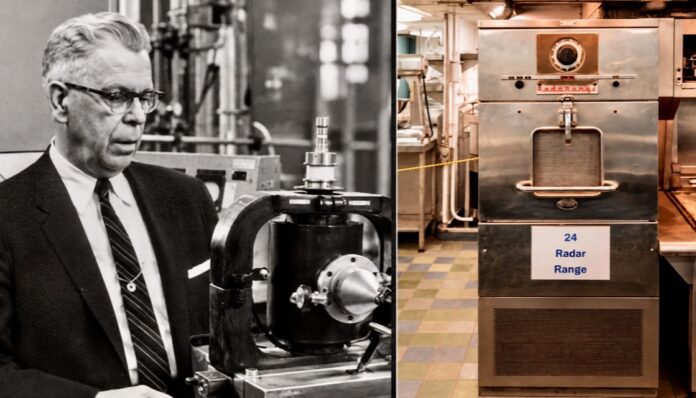
Around 1946, Percy Spencer, an engineer and magnetron expert at the aerospace and defense company Raytheon, walked in front of an active radar set.
The microwaves melted a chocolate bar in his pocket. Some accounts say it was a peanut cluster bar instead, which does not change the outcome.
What matters is what Spencer did next. Rather than treat it as a mess to clean up, he ran further experiments with eggs and popcorn kernels, and worked out that microwaves could cook a wide range of food.
The first one weighed 750 pounds
Raytheon patented the invention shortly afterward, and by 1947 the company had released its first microwave oven. It was called the RadaRange, and it weighed 750 pounds.
That is not an appliance anyone was putting on a kitchen counter. It took decades of improvement, and a long slide in price, before microwaves were affordable for ordinary households.
Once they were, the adoption was close to total. An object that began as a by-product of military radar research became one of the most ubiquitous things in a modern kitchen.
Accidents that paid off
Spencer’s chocolate bar belongs to a small category of discoveries where the scientist was looking at something else entirely.
- Penicillin, found in a contaminated culture rather than a planned experiment
- Popsicles, the result of a drink left out in the cold
- Velcro, which came from examining burrs caught on clothing
- The microwave oven, from a ruined snack in an engineer’s pocket
Each of them required somebody to notice the anomaly rather than clean it up. That is the part that does not happen by itself.
The other accident, in a field in New Jersey
The best companion story to Spencer’s comes from 1964, at Bell Labs outside Holmdel, New Jersey. Radio astronomers Arno Penzias and Robert Wilson were losing patience with their antenna.
The equipment kept picking up a persistent buzzing noise. They suspected the machine itself, then nearby New York City, then the pigeons nesting in the antenna.
Every explanation was checked and ruled out, and the hum stayed no matter where in the sky they pointed. After talking to astronomers at Princeton University, the pair realized what they had: the cosmic microwave background, the leftover radiation from the big bang and direct evidence of the beginning of the universe roughly 13.8 billion years ago.
Fourteen years later they were awarded the Nobel Prize in physics for it. Two of the defining microwave discoveries of the 20th century, the one that heats leftovers and the one that dates the universe, both began with somebody refusing to ignore something odd.
Based on reporting by Interesting Facts and Popular Mechanics
By Dale Prescott | General