
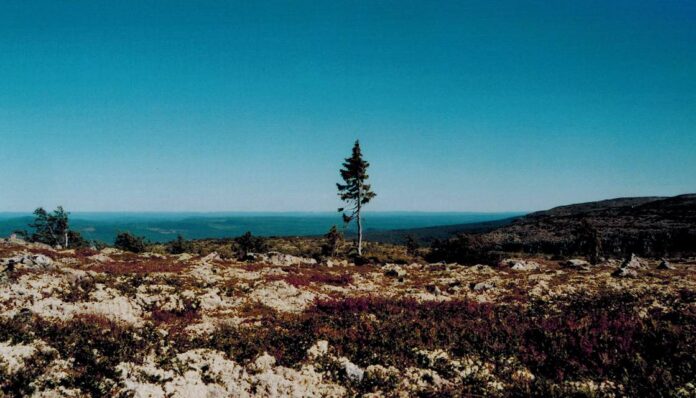
Old Tjikko, a Norway spruce on Fulufjället Mountain in Sweden, is estimated to be more than 9,500 years old. That puts its start around 7550 B.C.E., before recorded human history began.
Yet scientists did not find it until 2004, and it still does not hold the title of world’s oldest tree. The reason lies underground.
A small tree with a long past
At first sight Old Tjikko is unimpressive, a spindly, sparse spruce only about 16 feet tall. It grows in Sweden’s Dalarna province, nearly 900 meters (about 2,950 feet) above sea level.
According to Science Norway, it took root after the last ice age. It kept growing through the rise and fall of the Roman Empire and two world wars without anyone noticing it.
Hidden as a shrub
For most of its life the tree grew as a krummholz, a low, shrubby form that trees take on in harsh mountain conditions. It did not look like a tree at all.
Warming temperatures eventually let it shoot up into a proper trunk. Scientists Leif Kullman and Lisa Öberg documented it in 2004, and Kullman told CNN in 2008 that the spruce could be seen as a tree only because of the climate warming that began around 1915.
The tree was named after Öberg’s Siberian husky, Tjikko. Carbon dating of the material beneath it produced the 9,500 year estimate.
Why it is not the record holder
The official title of world’s oldest tree belongs to Methuselah, a Great Basin bristlecone pine in the mountains of California. Methuselah is almost 5,000 years old and has been growing since about 2800 B.C.E., which makes it thousands of years younger than Old Tjikko.
The difference is that Old Tjikko is a clonal tree. Its root system is ancient, but the part above ground keeps renewing itself:
- Each trunk lives for about 600 years, according to Science Norway.
- When a trunk dies, a new one sprouts from the same root stock.
- The tree has had many trunks since 7550 B.C.E., while the roots have stayed the same.
Kullman explained to National Geographic in 2008 that this gives the tree a very long life expectancy. Methuselah, by contrast, is a single standing tree whose trunk really is close to 5,000 years old, which is why it keeps the record.
Other ancient clones
Old Tjikko is not the only tree of its kind. In Utah, a huge colony of quaking aspen known as Pando grows from one root system estimated to be anywhere from 8,000 to 80,000 years old.
Pando’s individual trunks are only about 100 years old. Because its true age is so uncertain, nobody can say whether it is older or younger than Old Tjikko.
Damaged in 2023, but alive
Heavy snow battered the spruce in the winter of 2023, Science Norway reported. A mountain guide who visited found that a large piece of its tip had snapped off, leaving a tree once shaped like a Christmas tree looking stunted.
The guide, Tommy Lönnebacke, told the Swedish broadcaster SVT that about one meter (three feet) was gone, but that Old Tjikko would survive. The root system, the real source of its age, was untouched.
You can visit it
Methuselah’s exact location is kept secret to protect it, but Old Tjikko is open to visitors. A sign at the visitor center in Fulufjället National Park tells its story in the tree’s own voice.
The sign explains how Lisa named it after her dog, and jokes that the tree is a bit older than the dog. It adds that the tree has lost count of its years and enjoys a splendid view of the Rösjö lakes and the mountains of Idre.
Based on reporting by All That’s Interesting
By Jennifer Lawson | Geography